
If you are choosing between 6061 and 6063 aluminum, the spec sheet is hiding the most useful fact.
Most comparisons stop at “6061 is stronger, 6063 looks better.” That is true, and it is also how buyers end up paying for 6061 to fix a pole that flexes — a problem 6061 cannot fix. The two alloys share nearly the same stiffness, so the choice turns on bending, denting, finish and cost rather than on a single strength number.
This guide gives you the chemistry, a property table with sources, the deflection math, and a decision table for tube and pole programs.
The Short Answer: 6061 vs 6063 Aluminum in One Paragraph
6061-T6 is the stronger alloy — about 270 MPa yield versus 140 MPa for 6063-T5 — while 6063 extrudes into thinner walls, takes a cleaner anodized finish and usually costs less to produce. Both have an elastic modulus of roughly 68–69 GPa, so a 6061 tube and a 6063 tube of the same diameter and wall bend almost exactly the same amount under the same load. The difference shows up only when the load is high enough to leave a permanent bend or a dent.
That gives you a simple rule. If your part fails by staying bent, denting or cracking at a fastener, 6061 is the answer. If your part fails by feeling too flexible, neither alloy fixes it — tube geometry does. And if the part is sold on how it looks, especially in a custom anodized color, 6063 is the safer specification.
Most aluminum telescopic poles, pool poles and architectural tubes are 6063 for exactly this reason: they are sized for stiffness and appearance, and at those wall thicknesses 6063 already carries the working load. 6061 earns its higher price in brackets, machined fittings, structural frames, and long poles loaded near their limit.
| If your priority is… | Choose | Why |
|---|---|---|
| Resisting permanent bends and dents | 6061-T6 | Roughly 1.9× the yield strength of 6063-T5 |
| Reducing flex at the same size | Neither — change OD or wall | Modulus is nearly identical (69 vs 68 GPa) |
| Anodized appearance and color match | 6063 | Lower iron and copper limits |
| Thin walls and complex hollow shapes | 6063 | Lower-alloyed, flows through the die more easily |
| Machined threads, bolted joints, brackets | 6061-T6 | Higher hardness holds threads and resists bearing damage |
| Cold bending on a tight radius | 6063-T5 | Lower yield means less force and less springback |
Chemistry: Why 6061 and 6063 Behave Differently
6061 carries about 1.5 times the magnesium and silicon of 6063 (comparing range midpoints) plus deliberate copper and chromium additions; that extra alloy content buys strength and costs extrudability and finish. Both are 6xxx-series alloys, strengthened by magnesium silicide (Mg2Si) precipitates, which is why they respond to the same T5 and T6 tempers.
The registered composition limits come from the Aluminum Association’s International Alloy Designations and Chemical Composition Limits — the “Teal Sheets” that ISO 209 also references. The rows that matter for this comparison are below.
| Element (wt %) | 6063 | 6061 | What it changes |
|---|---|---|---|
| Magnesium (Mg) | 0.45–0.9 | 0.8–1.2 | More Mg2Si = higher strength, harder to extrude |
| Silicon (Si) | 0.20–0.6 | 0.40–0.8 | Pairs with Mg for hardening |
| Copper (Cu) | 0.10 max | 0.15–0.40 | Adds strength; dulls and yellows clear anodize |
| Iron (Fe) | 0.35 max | 0.7 max | Impurity; more Fe = grayer, less uniform anodize |
| Chromium (Cr) | 0.10 max | 0.04–0.35 | Controls grain structure; can add a slight tint to the anodic film |
| Zinc (Zn) | 0.10 max | 0.25 max | Impurity at these levels |
Source: Aluminum Association Teal Sheets. Ranges are registration limits, not the analysis of any single lot.
Read the copper and iron rows as the finishing story. The 6061 copper ceiling is four times the 6063 ceiling (0.40 vs 0.10 %), and its iron ceiling is twice as high (0.7 vs 0.35 %). Anodizing converts the metal surface into oxide, and those elements do not convert cleanly, so they show up as a slightly darker, grayer or warmer tone.
The consequence for a buyer is lot-to-lot variation. Two 6061 lots can both sit inside the registration limits yet anodize to visibly different shades, because the allowed spread is wide. That is a cosmetic risk, not a structural one — which is exactly why it matters more on a retail pole than on a hidden bracket.
Mechanical Properties Side by Side: 6063-T5, 6063-T6 and 6061-T6
6061-T6 leads on every strength and hardness figure, 6063 leads on conductivity, and the elastic modulus is effectively tied. The three tempers below are the ones that show up on tube and pole drawings; 6063-T6 sits between the other two and is worth knowing about before you jump to 6061.
| Typical property | 6063-T5 | 6063-T6 | 6061-T6 |
|---|---|---|---|
| Ultimate tensile strength | 180 MPa | 240 MPa | 310 MPa |
| Yield strength | 140 MPa | 210 MPa | 270 MPa |
| Elastic modulus | 68 GPa | 68 GPa | 69 GPa |
| Elongation at break | 11 % | 11 % | 10 % |
| Brinell hardness | 60 | 73 | 93 |
| Fatigue strength | 70 MPa | 70 MPa | 96 MPa |
| Thermal conductivity | 210 W/m·K | 200 W/m·K | 170 W/m·K |
| Electrical conductivity | 55 % IACS | 53 % IACS | 43 % IACS |
| Density | 2.70 g/cm³ | 2.70 g/cm³ | 2.70 g/cm³ |
Source: typical values from the MakeItFrom 6061-T6 vs 6063-T6 material comparison and its 6063-T5 datasheet. Typical values are averages, not guaranteed minimums — a purchase specification should call out the minimums in the governing standard for the product form, such as ASTM B221 for extruded tube.
Three rows deserve a second look. Yield strength is the load at which the metal stops springing back, and it is the row that decides whether a pole survives being leaned on. Hardness tracks dent resistance and how well a machined thread holds. Modulus is the row nobody reads and the one that decides how much a tube flexes — and it barely moves.
Density is identical, so switching alloys does not change the weight of a tube. If a supplier tells you 6061 makes a lighter pole at the same size, that claim is wrong; lighter only comes from a thinner wall, which 6061’s strength sometimes lets you use.
Stiffness Is the Same: Why Switching to 6061 Will Not Stop a Tube From Flexing
How far a tube bends under a working load depends on its elastic modulus and its cross-section, and 6061 and 6063 differ in modulus by about 1.5 %. Swap the alloy and keep the tube size, and the flex your user feels is unchanged. It is one of the most common — and most expensive — misunderstandings in alloy selection.
The math is short. For a tube held at one end with a load at the tip, deflection is δ = F·L³ / (3·E·I), and the tube’s second moment of area is I = π·(D⁴ − d⁴) / 64, where D is the outside diameter and d the inside diameter. The alloy appears only through E. Diameter appears to the fourth power.
The table below is calculated for a 1.5 m cantilever — roughly a fully extended top section held at the lock — with the formulas above.
| Tube (OD × wall) | Alloy | I (mm⁴) | Mass (g/m) | Tip deflection per 10 N | Tip load at first yield |
|---|---|---|---|---|---|
| 32 × 1.2 mm | 6063-T5 | 13,790 | 314 | 12.0 mm | 80 N (8.2 kgf) |
| 32 × 1.2 mm | 6063-T6 | 13,790 | 314 | 12.0 mm | 121 N (12.3 kgf) |
| 32 × 1.2 mm | 6061-T6 | 13,790 | 314 | 11.8 mm | 155 N (15.8 kgf) |
| 35 × 1.2 mm | 6063-T5 | 18,220 | 344 | 9.1 mm | 97 N (9.9 kgf) |
| 32 × 1.5 mm | 6063-T5 | 16,753 | 388 | 9.9 mm | 98 N (10.0 kgf) |
Calculated, not measured. Inputs: L = 1,500 mm; E = 68,000 MPa (6063) and 69,000 MPa (6061); yield from the property table; density 2.70 g/cm³. First-yield load = yield strength × I ÷ (D/2) ÷ L. The model ignores local buckling of thin walls, lock clamping stress and dents, all of which lower real-world capacity.
Compare the rows. Moving from 6063-T5 to 6061-T6 at 32 × 1.2 mm cuts deflection by under 2 %. Moving to a 35 mm OD in the cheaper alloy cuts it by 24 % for 10 % more metal. Thickening the wall to 1.5 mm cuts it by 17 % but adds 24 % weight — diameter is the more efficient lever.
The failure boundary: if a pole, rail or tube passes its strength check but users call it “whippy,” do not re-quote it in 6061. Increase the outside diameter first, add a section to shorten the unsupported length second, and treat alloy as the last lever. Our telescopic pole load capacity calculation guide walks through the same formulas for multi-section poles.
Where 6061 Earns Its Price: Permanent Bends, Dents and Fastener Loads
6061-T6 is worth specifying when the part is loaded close to yield, hit, clamped or threaded — situations where 6063 fails by staying deformed rather than by flexing. In the calculated example above, the 6061 tube carries 155 N at the tip before it takes a set, against 80 N for 6063-T5: the same flex, but about 1.9 times the margin before permanent damage.
That margin matters in four places. Long reach under heavy tools, where a user levers the pole against a gutter lip or a wall. Structural members such as frames, bollards and sign posts, where design codes work from yield. Machined features — tapped holes, cross-pins and set-screw seats — where 93 Brinell hardness holds a thread that 60 Brinell is more likely to strip or wear oval. And bolted or clamped joints, where soft metal creeps under the clamp and the joint loosens.
6061 is also the default for most machined fittings and bar stock, which is why many assemblies mix both: 6063 for the extruded tube, 6061 for the machined end fitting. That combination is normal, as long as the drawing names the alloy for each part separately.
Two conditions reduce 6061’s advantage, and you should check both before paying for it:
- Thin walls can dent before they yield in bending. On a thin-wall tube, local denting from a drop or a clamp often sets the limit before the bending calculation does, and a thicker wall or larger OD helps more than harder metal.
- Welding erases the temper. The heat-affected zone next to a weld loses most of the T6 strength in both alloys, so a welded 6061 joint is not a 270 MPa joint. More on that in the temper section below.
The strongest evidence that geometry comes first is a drop test. When a US home-improvement retailer required a bare 6 ft pool pole to survive nine drops with no permanent deformation, the fix on our line was the tube wall and the temper process — the program stayed on 6063-T5 (Home Depot private-label case study).
Where 6063 Wins: Thin Walls, Surface Finish and Anodized Color
6063 is the better choice whenever the part is sold on appearance, needs a thin or complex hollow profile, or is produced in high volume where extrusion speed drives cost. It is often called the architectural alloy for this reason: window frames, trim and most consumer poles are 6063.
The extrusion advantage comes from the chemistry table. Lower magnesium and silicon mean lower flow stress, so billet pushes through the die with less force, at higher speed and with a smoother surface. In practice that means thinner achievable walls on the same press, more intricate hollow shapes, and less die wear over a long run — which is why most architectural and consumer extrusions default to 6063.
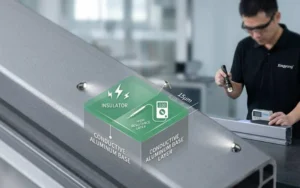
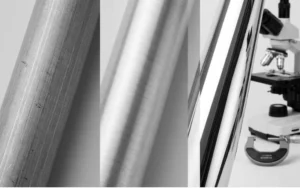
The finish advantage comes from the copper and iron limits. A clear anodize on 6063 reads bright and even; on 6061 the same process can turn out slightly grayer, and in dyed colors the shift is easier to see. For a single part nobody notices. For a retail program where sections from different production lots sit side by side on a shelf, it is the kind of difference that generates returns.
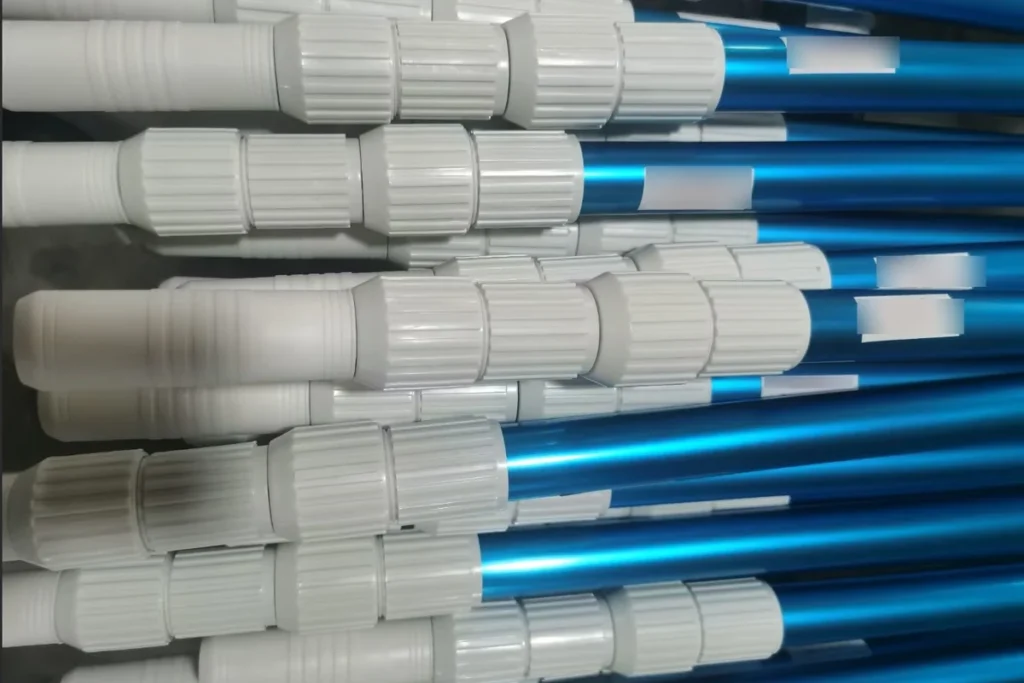
That is the case for 6063 in any custom-color program. A German pool-equipment distributor’s poles — custom blue, silver and gun-grey, all 6063-T5 — are the pattern: the value to the distributor is a color that matches from reorder to reorder, which starts with the alloy (German custom-color pool pole case study).
The failure boundary: do not specify 6061 for a thin-wall, color-matched anodized product unless the load case truly requires it, and if it does, approve color on production-lot samples rather than on a lab panel. For more on how the oxide layer forms, see what anodized aluminum is.
T5 vs T6: The Temper Question Hiding Inside the Alloy Question
Temper changes 6063’s yield strength by 50 % (140 to 210 MPa), so “6063” on a drawing without a temper is an incomplete specification — and 6063-T6 closes much of the gap to 6061-T6. Before you move a program to 6061, ask whether 6063-T6 already meets the load.
The letters describe the heat treatment. Per the Aluminum Extruders Council’s alloy and temper guide, T5 means cooled from the elevated extrusion temperature and then artificially aged; T6 means solution heat-treated and then artificially aged. For 6063, T5 is typically reached with the press-exit quench, which keeps it economical. T6 requires a faster, more controlled quench so more of the alloying elements stay in solution before aging.
6061 is almost always supplied as T6 for structural work, because its value is strength and T5 would give much of it away. You will also see 6061-T4 and 6061-O on drawings for parts that must be bent or formed first and heat-treated after.
Welding is where temper most often goes wrong. Arc welding reheats the metal beside the weld above its aging temperature, and that zone softens to a fraction of its T6 strength in both alloys. Fillers such as 4043 and 5356 are common for 6xxx welds, but no filler restores the base-metal temper — only a full re-heat-treatment after welding does.
The failure boundary: never place a weld at the highest-stress point of a T6 tube and design to T6 yield. Move the weld to a low-stress location, design to the welded-zone strength, or use a mechanical joint. Our aluminum welding guide for telescopic tools covers joint placement in more detail.
Choosing Between 6061 and 6063 by Application
Match the alloy to the way the part fails in service: flex and appearance point to 6063, yield, hardness and fastener loads point to 6061. The table below applies that rule to the programs we quote most often; treat it as a starting point for the drawing, not a substitute for a load check.
| Application | Typical choice | Deciding factor | Watch out |
|---|---|---|---|
| Pool, cleaning and dusting poles up to about 5 m | 6063-T5 | Stiffness set by OD; anodized finish sells | Lock zone denting on thin walls |
| Custom-color retail poles and tubes | 6063-T5 | Lot-to-lot color consistency | Approve color on production samples |
| Long-reach or tool-heavy poles near their load limit | 6063-T6 or 6061-T6 | Yield margin under levering loads | Check 6063-T6 before paying for 6061 |
| Machined fittings, threaded ends, brackets | 6061-T6 | Hardness holds threads and bearing faces | Different anodize tone from 6063 tube |
| Structural frames, posts, bollards | 6061-T6 | Design codes work from yield | Welds soften the heat-affected zone |
| Architectural trim, thin complex hollows | 6063-T5 | Extrudability and surface | Not for load-bearing members |
| Heat sinks and conductive profiles | 6063 | Higher thermal and electrical conductivity | Lower strength; keep mounting loads light |
Two patterns in that table are worth making explicit. First, most failures buyers blame on the alloy are geometry or temper problems, so the order of questions is: OD and wall, then temper, then alloy. Second, mixed-alloy assemblies are normal, but every visible part must be approved for color on the alloy it is actually made from.
For tube stock in either alloy, our 6061 aluminum tubing page lists the diameters, walls and finishes we extrude in 6061, and the 6063 aluminum tube page does the same for 6063. If your decision is between 6061 and a 7xxx alloy instead, that is a different trade-off, covered in 6061 vs 7075 for extrusion profiles.
How to Call Out 6061 or 6063 on an OEM Tube or Pole Specification
A drawing that says only “aluminum” or “6000 series” invites the cheapest interpretation; name the alloy, temper, governing standard and finish for every extruded and machined part. Quotes built on an incomplete alloy callout are not comparable, and the gap usually surfaces at the first production lot.
A specification that holds up in volume pins down six things for each part:
- Alloy and temper — for example 6063-T5 tube, 6061-T6 end fitting.
- Governing standard for minimum properties and tolerances, such as ASTM B221 for extruded tube.
- OD, wall and straightness per section, not only overall length.
- Finish — anodize class and color reference, or powder-coat system.
- Color approval rule — production-lot sample, and which parts must match.
- Test at approval — the load, drop or deflection check the part must pass.
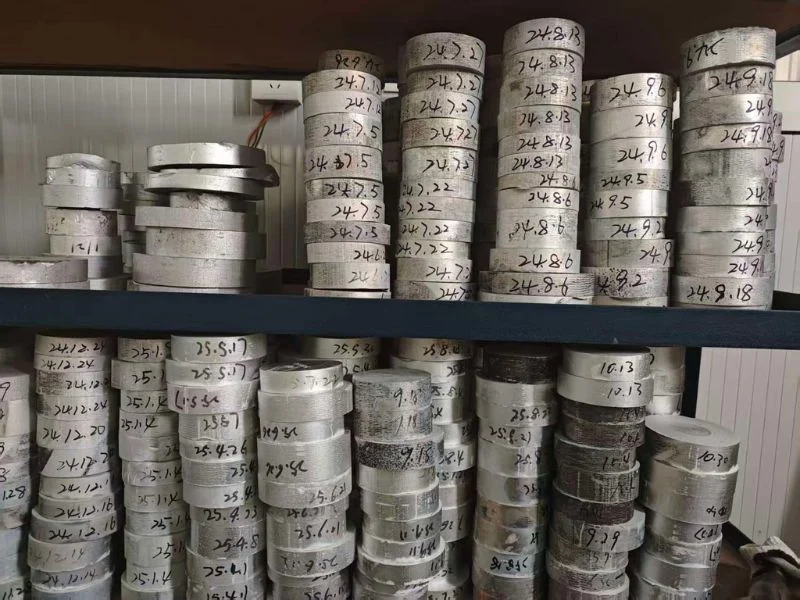
Xingyong extrudes both alloys on our own 2000-tonne press in Huai’an, anodizes in-house, and molds the plastic locks and end caps in our own injection shop, so tube, finish and assembly are held to one drawing by one supplier. We have been a direct manufacturer since 2010, not a trading company, with ISO 9001, IATF 16949 and amfori BSCI audits in place.
Send a drawing or a sample and we quote within 24 hours; samples ship in 25 to 35 days. If you are still deciding on the anodized finish itself, our anodizing and surface finishes page covers the options by alloy.
Frequently Asked Questions
Is 6061 stronger than 6063?
Yes. Typical yield strength is 270 MPa for 6061-T6, against 210 MPa for 6063-T6 and 140 MPa for 6063-T5. Stiffness is essentially the same, though, so 6061 resists permanent bending and denting better without flexing any less at the same tube size.
Is 6061 or 6063 easier to bend?
6063-T5 is easier. Its lower yield strength needs less bending force and springs back less, and it tolerates tighter radii before cracking. 6061-T6 bent cold on a tight radius is prone to cracking on the outside of the bend; parts that need forming are usually bent in 6061-T4 or O temper and heat-treated afterward.
Can 6061 be welded to 6063?
Yes. Both are 6xxx-series alloys and weld to each other with common fillers such as 4043 or 5356. In both, the heat-affected zone loses most of its T5 or T6 strength, so design the joint to the welded-zone strength or place the weld at a low-stress point.
Is 6063 cheaper than 6061?
Usually, yes, for extruded shapes. 6063 extrudes faster with less die wear, which lowers conversion cost. The difference tends to be smallest on simple heavy-wall tube and largest on thin or complex hollow profiles. Machined bar is a different market, where 6061 is the common stock alloy.
Can a telescopic pole mix 6061 and 6063 sections?
Yes, and some heavy-duty poles do, using 6061 where the load peaks. The practical risk is appearance: 6061 and 6063 sections anodized side by side can show a visible shade difference. Approve color on production-lot sections of both alloys, or keep all visible sections in one alloy.
Which alloy should a private-label pole or tube program specify?
Start from 6063-T5 unless a load check says otherwise. It covers stiffness through tube sizing, gives the most consistent anodized color across reorders, and keeps unit cost down. Move to 6063-T6 if yield margin is short, and to 6061-T6 only for parts that are threaded, clamped or loaded near their limit.
Does 6061 or 6063 resist corrosion better?
Both perform well outdoors, and 6063 has a slight edge because of its lower copper content. Once anodized or powder-coated, the finish dominates corrosion performance for either alloy, so specify the coating thickness and class rather than relying on the alloy choice alone.
Keep reading. These guides pick up where the 6061 vs 6063 comparison stops; start with the one that matches the decision in front of you.
- Best aluminum alloy for telescopic poles — how alloy, wall and lock interact once you are designing a specific multi-section pole.
- What 6063 aluminum is used for — commercial applications of the architectural alloy in more depth.
- Aluminum alloy grades explained — the full 1000–7000 series map if you are still choosing a family.
- 6061 vs 7075 — when a 7xxx alloy is worth its extrusion and finishing penalties.
If none of these fit, the fastest route is a drawing: one review of the load case, finish and volume usually settles the alloy question in a single quote.

 English
  Español
  Français
  Deutsch
  Português