
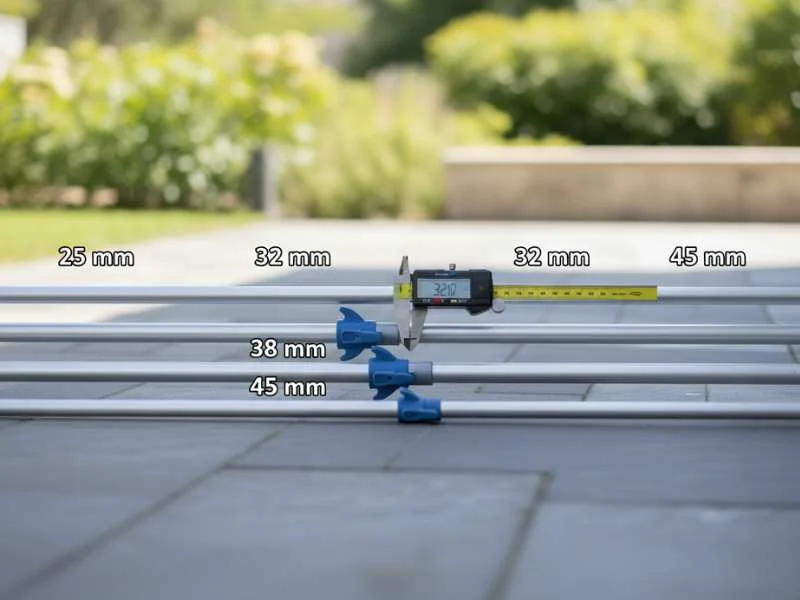
Most telescopic pole failures happen below 50% of their theoretical load capacity. The reason is simple—buyers calculate weight, but ignore leverage.
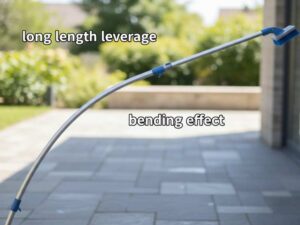
A small tool at the end of a long pole creates a large bending force. Over time, this leads to deformation, lock failure, and product returns. In OEM supply, these issues quickly turn into warranty claims and brand damage.
This guide explains how to calculate telescopic pole load capacity using real engineering logic, and how to specify a pole that performs reliably in bulk production.
Practical telescopic pole loads run 2–20 kg by class: 2–3 kg for dusting heads, 3–6 kg for wash brushes, 6–10 kg for rollers and rigs, 10–20 kg only on heavy-duty builds. Procurement teams can treat this article as technical background, then move into telescopic pole manufacturing for product fit and custom aluminum telescopic poles for factory capability; for an external cross-check, use Aluminum Association material resources.
What Is Telescopic Pole Load Capacity?
A telescopic pole typically supports 2–20 kg at the end, depending on diameter, wall thickness, length, and structure.
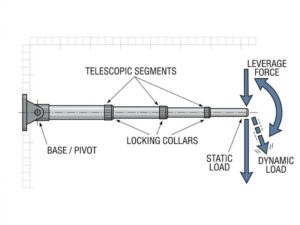
Load capacity includes:
- Static load: tool weight
- Dynamic load: motion and vibration
- Leverage load: force amplified by length
Key insight:
Load capacity is controlled by bending moment, not just weight.
How Much Weight Can a Telescopic Pole Hold? (Quick Reference)
Table: Telescopic Pole Weight Capacity (End Load, Safety Factor Included)
| Diameter | Wall Thickness | Length | Safe Load |
|---|---|---|---|
| 25 mm | 1.0 mm | 3 m | 2–3 kg |
| 32 mm | 1.2 mm | 6 m | 3–6 kg |
| 38 mm | 1.5 mm | 9 m | 6–10 kg |
| 45 mm | 2.0 mm | 12 m | 10–20 kg |
Notes:
- Based on 2× safety factor
- End-load condition (worst case)
- Actual performance depends on lock quality and overlap design
The Core Principle: Why Length Reduces Load Capacity
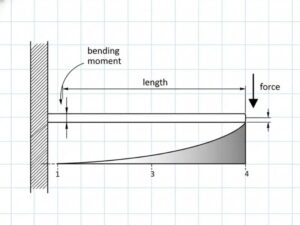
M = F × L
- M = bending moment
- F = load force
- L = distance from base
As length increases, stress increases directly. Deflection increases even faster.
Example:
- 3 m pole + 5 kg → stable
- 9 m pole + 5 kg → bending risk
Length is the primary driver of failure.
Reference: https://www.engineeringtoolbox.com/cantilever-beams-d_1848.html
Why Diameter Matters More Than Thickness (Critical Engineering Insight)
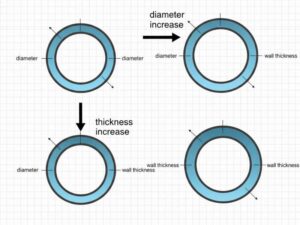
Bending stiffness is proportional to diameter⁴ (D⁴).
This means:
- Increasing diameter from 32 mm → 38 mm
→ large increase in stiffness - Increasing thickness from 1.2 mm → 1.5 mm
→ limited improvement
Practical rule:
- Increase diameter first
- Then adjust thickness
Most buyers over-spec thickness and under-spec diameter.
How to Calculate Telescopic Pole Load Capacity (Practical Example)
Scenario:
- Length: 6 m
- End load: 5 kg (~49 N)
Calculation:
- M = 49 × 6 = 294 Nm
Apply safety factor (×2–3):
- Required capacity: 600–900 Nm
Selection result:
- 32 mm pole → risk
- 38 mm pole → acceptable
This calculation prevents under-design in OEM projects.
Telescopic Pole Load Capacity vs Length
| Length | Relative Capacity |
|---|---|
| 3 m | 100% |
| 6 m | ~50% |
| 9 m | ~25% |
| 12 m | <20% |
Key takeaway:
Long poles require structural upgrades, not just longer tubes.
Real Failure Case: Why a 9m Pole Failed Under Light Load
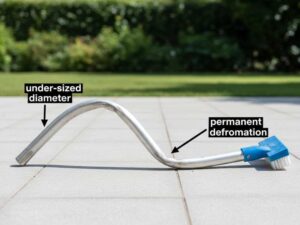
Scenario:
- 9 m pole
- 8 kg cleaning head
- 32 mm diameter, 1.2 mm wall
Failure:
- Progressive bending
- Lock slipping under angle
- Permanent deformation
Root cause:
- Diameter too small
- No safety factor
Correct solution:
- 38–45 mm diameter
- Thicker wall
- Flip-lock system
This is a typical failure pattern in under-specified bulk orders.
Common Failure Modes (And How to Prevent Them)
- Bending: increase diameter
- Buckling: increase thickness
- Lock failure: upgrade lock system
- Fatigue: ensure material consistency
Over 70% of failures come from incorrect specification.
Aluminum Telescopic Pole Load Capacity (Manufacturing Perspective)
Material consistency defines real-world performance.
Typical alloys:
At Xingyong:
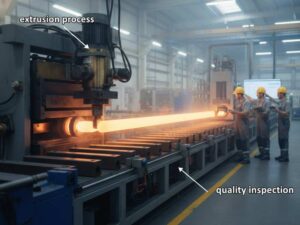
- 14 extrusion presses (350T–2000T)
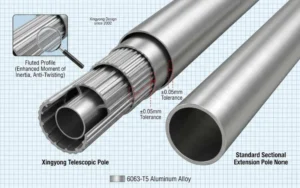
- Thickness tolerance ±0.05 mm
- Full inspection system (hardness, composition, thickness)
- ISO-certified production system
Why this matters:
- Stable thickness → stable load capacity
- Consistent batches → reduced failure rate
- Reliable extrusion → better structural strength
How to Choose the Right Load Capacity
Step 1: Define Load Scenario
- End load
- Dynamic vs static
Step 2: Define Length
- Longer poles require stronger structure
Step 3: Select Geometry
- Increase diameter first
- Then thickness
Step 4: Choose Lock Type
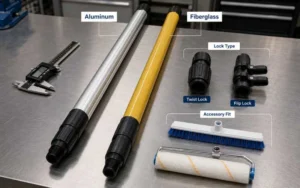
- Light: twist lock
- Medium: flip lock
- Heavy: pin lock
How to Avoid Costly Specification Mistakes in Bulk Orders
In OEM projects, small specification errors can lead to large losses.
Common risks:
- Undersized diameter
→ bending → product returns - Inconsistent wall thickness
→ unstable load performance across batches - Weak locking system
→ safety complaints - No safety factor
→ early failure in real use
Practical recommendation:
- Always calculate bending moment
- Specify tolerance requirements
- Request sample validation before mass production
Preventing one failed batch saves more than optimizing unit cost.
Aluminum vs Fiberglass vs Carbon Fiber
| Material | Strength | Weight | Cost | Use Case |
|---|---|---|---|---|
| Aluminum | Medium–High | Medium | $$ | OEM industrial |
| Fiberglass | Medium | Heavy | $ | Electrical |
| Carbon Fiber | High | Light | $$$ | High-end |
Aluminum remains the most scalable solution for industrial supply.
Common Buyer Mistakes
- Choosing based on length only
- Ignoring diameter impact
- Overestimating wall thickness
- Skipping safety factor
Most failures are preventable with proper specification.
FAQ
How much weight can a telescopic pole hold?
Typically 2–20 kg depending on structure and length.
Does diameter affect strength?
Yes. Diameter has a greater impact than thickness.
What safety factor should be used?
2× minimum, 3× for dynamic conditions.
Why do poles bend under light load?
Because leverage increases bending force over length.
How to improve load capacity?
Increase diameter, thickness, and reduce unsupported length.
Strength Comes from Engineering, Not Guesswork
A telescopic pole is a structural system, not just a tube.
Correct design reduces failure, improves durability, and protects your product line in large-scale supply.
The right specification is not heavier—it is engineered.

Get a Load Calculation Within 24 Hours
If you are sourcing telescopic poles for OEM or distribution, correct specification is critical before production.
Xingyong provides:
- Custom extrusion (6061 / 6063)
- Precision wall thickness control (±0.05 mm)
- Stable OEM production
- Flexible MOQ and lead time
Free support includes:
- Load capacity calculation
- Structural design optimization
- Sample validation before mass production
Send your required length and load scenario today.
We will provide a verified pole specification within 24 hours, helping you reduce failure risk before scaling production.
Related products: Explore related products and review matching solutions.
How to Test Telescopic Pole Load Capacity
A calculation is a screening tool; a controlled test confirms whether the complete pole is usable. Test the finished assembly—including locks, overlap, connector and attachment—at the maximum intended extension. Separate axial load from side load because a pole that carries weight vertically may still deflect excessively when used as a cantilever.
| Test | Setup | Record | Pass/fail basis |
|---|---|---|---|
| Static side-load test | Pole fixed at the normal hand or mounting point; load applied at tool center | Load, extension, deflection and residual bend | Project-specific deflection limit and no permanent deformation |
| Lock slip test | Apply representative axial and torsional load | Slip distance and release force | No unintended movement beyond the agreed tolerance |
| Cycle test | Extend, lock, load, release and retract repeatedly | Cycle count, wear and change in holding force | Meets the agreed service-life target |
| Abuse/impact check | Controlled drop or impact based on the use case | Dents, cracks, lock damage and function | Safe operation after the defined event |
Minimum data for a useful capacity claim
State the extended length, tube diameters and wall thicknesses, section overlap, alloy and temper, lock type, load direction, tool offset, allowable deflection and safety factor. Without these inputs, a single “maximum weight” number can be misleading. Capacity also declines as extension and horizontal offset increase.
Use the result with the extension-pole length guide and confirm the locking interface using our locking mechanism comparison.


 English
  Español
  Français
  Deutsch
  Português