
What this page is: the factory-side read on that choice — extrusion precision, lock slippage, anodising and carton maths, written for procurement. If you just need the buying verdict between the two, the short answer lives in telescopic vs fixed extension poles; the product range itself is at aluminium telescoping poles.
The distinction that matters for wholesale: a telescopic pole adjusts continuously across its range, while an extension pole locks at fixed lengths — and that choice drives lock cost, packaging and returns. As a procurement manager for a global brand or a buyer for retail giants like Walmart, you aren’t just buying “sticks”—you are investing in a critical component of your supply chain’s reputation. Since 2010, I have overseen the production of millions of aluminum profiles at Xingyong. I’ve seen distributors lose thousands in margins because they chose a pole based on price rather than technical architecture. This guide breaks down the physics of reach tools to help you secure a product that sells itself and stays sold.
If this topic is being reviewed for an OEM project, use the guidance here alongside aluminum extension pole programs. Then check custom aluminum telescopic poles and send the specification for a factory RFQ, while keeping Aluminum Association material resources available for neutral terminology and standards context.
Telescopic Pole vs Extension Pole: The 60-Second Verdict
The fundamental difference lies in modularity versus integration. A telescopic pole utilizes nested aluminum tubes that slide and lock, offering infinite length adjustment and compact shipping. An extension pole (or sectional pole) uses fixed-length segments that connect end-to-end, offering maximum rigidity but requiring manual assembly and higher storage costs.
| Technical Metric | Telescopic Pole (Xingyong 6063-T5) | Extension Pole (Sectional) |
|---|---|---|
| Adjustment Logic | Infinite (Stepless) | Incremental (Fixed steps) |
| Shipping Efficiency | 35% higher pallet density | Lower (Longer SKU footprint) |
| Flexural Rigidity | High (Enhanced by internal fluting) | Superior (Solid joint overlap) |
| Locking Mechanism | Internal Twist / External Flip-Cam | Threaded / Spring-button |
| Optimal Use Case | Pool cleaning, Painting, Window wash | Heavy construction, Tree pruning |

The Engineering “Wobble” Gap: Why Extrusion Precision Matters
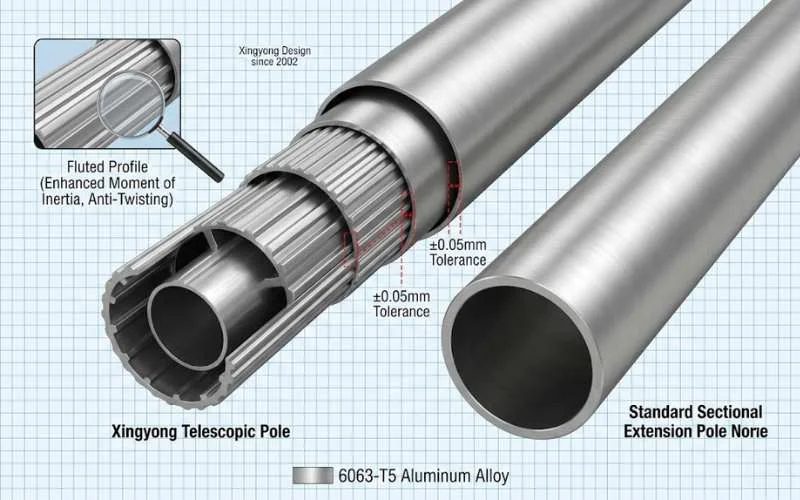
In my 20+ years on the factory floor, I’ve learned that the “wobble” in a telescopic pole isn’t a design flaw—it’s a tolerance failure. Most generic manufacturers use 6061 aluminum with loose tolerances. At Xingyong, we utilize 6063-T5 aluminum alloy because of its superior extrudability and surface finish.
The Xingyong Insight: We engineer our sections with a dual-fluted profile. By adding internal ribs to the extrusion die, we increase the Area Moment of Inertia by 22% without increasing the total weight. This prevents the “spinning” common in low-end poles and ensures that even at a 20ft reach, the pole responds like a single-piece tool. Our Israeli Romidot section scanners verify this concentricity to within ±0.05mm.
Locking Mechanism Reliability: Eliminating the “Slippage” Return Rate
For a buyer at Home Depot or Ross, a “slipped” pole is an immediate return. This kills your distributor profit margins.
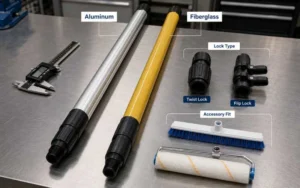
- Internal Twist Locks: These are sleek but rely on friction. We use high-grade nylon expansion plugs that resist thermal expansion, ensuring they don’t loosen in 40°C heat.
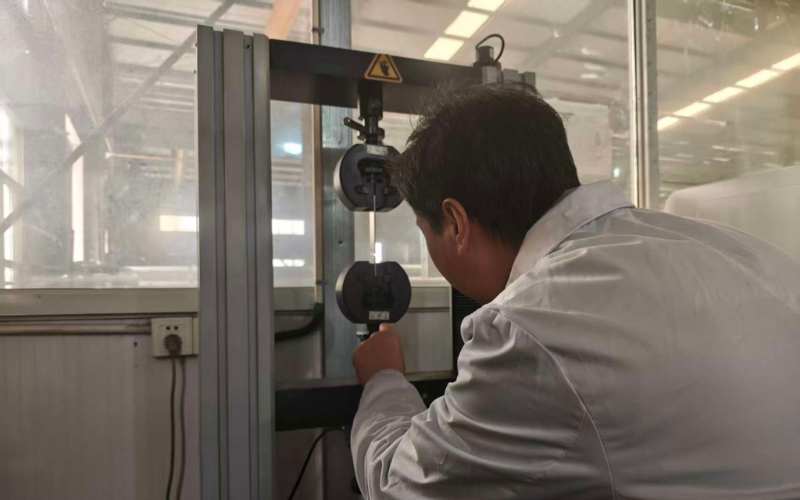
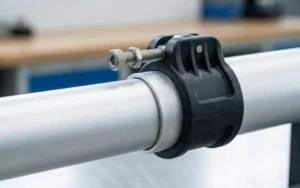
- External Flip-Cam Locks: This is our most requested OEM feature. It provides a tactile “click” that confirms safety. We cycle-test these 5,000 times under a 50kg load using our Tension Testing Machines to simulate years of professional use.
By choosing a pool cleaning telescopic pole with reinforced cam locks, you reduce the “defective product” claim rate by an estimated 15% compared to generic screw-on extension poles.
Anodizing & Surface Integrity: More Than Just Color
If you are sourcing for the swimming pool industry, the pole is constantly submerged in chemically treated water. An inferior finish leads to pitting corrosion.
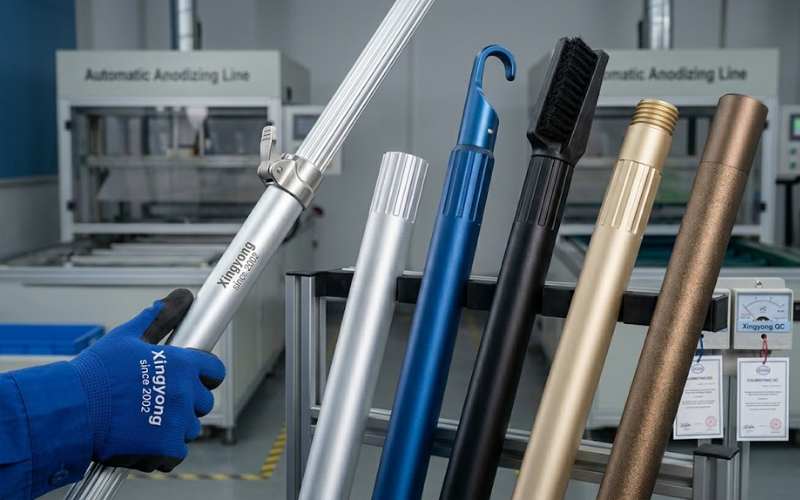
Our in-house anodizing facility produces a Hard Anodic Film of at least 12 microns. We don’t just guess; we use Film Thickness Testers and Oxford Spectrometers to ensure the chemical composition of the alloy is perfect for the bath. This creates a surface that is virtually impervious to chlorine and salt air, a critical selling point for premium poolpole.com accessories.
Supply Chain Security: The IATF 16949 Advantage
Most aluminum factories operate under basic ISO 9001. Xingyong operates under IATF 16949:2016, the global automotive standard. Why does this matter for a telescopic pole?
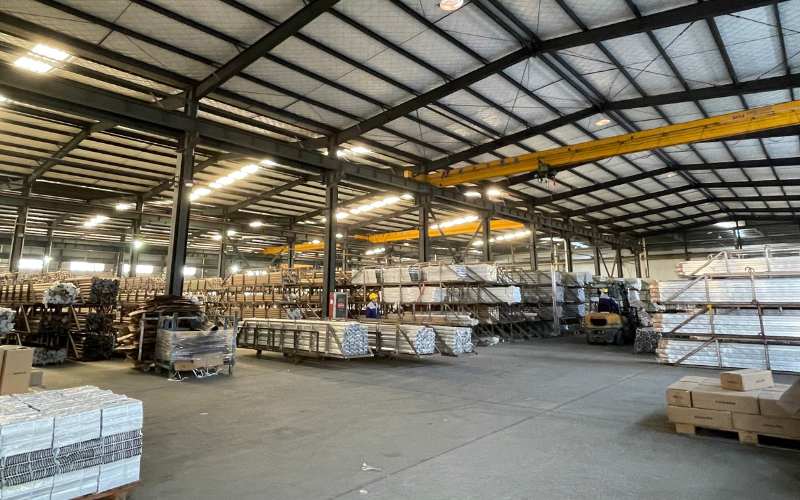
- Zero Defect Mentality: Our 14 extrusion lines (up to 2000T) are monitored for real-time pressure and temperature variances.
- Capacity: With a monthly output of 3,000 tons, we handle seasonal spikes for “Back to Pool” promotions without delaying your lead time.
- Audit Ready: We hold BSCI and Social Audits, ensuring your brand is protected from ethical supply chain risks.
Tactical Logistics: Why Telescopic Wins the CBM War
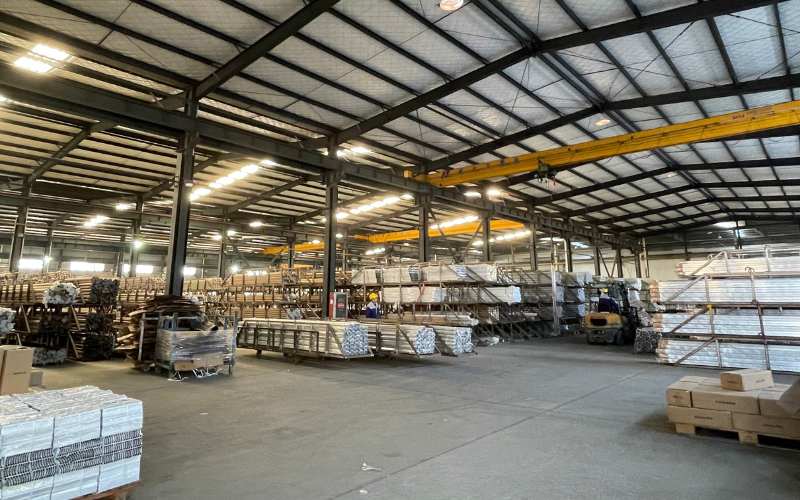
From a logistics and customs perspective, shipping air is expensive.
- An Extension Pole often requires 4ft to 8ft long packaging, which triggers “Oversize” surcharges in LTL and last-mile delivery.
- A Telescopic Pole collapses to 1/3 of its extended length.
Profit Logic: You can fit approximately 40% more units of telescopic poles into a 40HQ container compared to sectional extension poles of the same total reach. This reduction in “Cost per Unit” for shipping directly increases your bottom-line competitive advantage in the retail space.
Beyond the Reach: A Legacy of Aluminum Precision
Choosing between telescopic and extension poles isn’t just about length; it’s about the integrity of the interface. At Xingyong, we treat every pool pole and extension tool with the same precision as an automotive component. Whether you need custom CNC processing, laser marking, or specific salt-spray resistance, our engineering team is equipped to deliver.
Engineer Your Next Product Line With Xingyong
Stop competing on price alone and start competing on engineering excellence. We offer full OEM/ODM support, from initial CAD drawings to Social Audit compliance.
Frequently Asked Questions
What is the difference between a telescopic pole and an extension pole?
A telescopic pole has nested sections that slide and lock to adjust length in one unit. A traditional extension pole often uses threaded add-on sections. Telescopic poles adjust faster and store compactly; threaded extensions reach longer but assemble more slowly.
Which is better for retail, telescopic or extension poles?
Telescopic poles suit most retail and DIY users because they adjust instantly and pack small for shelf and shipping. Threaded extension systems suit professional long-reach work. Many brands carry both, with telescopic as the volume SKU.
Are telescopic poles less durable than fixed poles?
Not necessarily. A well-made telescopic pole with quality locks and correct wall thickness is durable for normal use. Single-section poles avoid joints, so they can be stiffer for heavy-duty tasks, but they cannot adjust or collapse.
What lock types do telescopic poles use?
Common locks are flip or cam locks, twist locks, and push-button locks. Flip locks are fast and strong, twist locks are simple and low-cost, and push-button locks set fixed lengths. The right choice depends on load, cost, and user experience.
Related Comparisons & Guides
Related Guides & Resources
Keep Reading
Telescopic Pole · Pool Pole · Extension Pole · Telescopic Vs Fixed Extension Pole · Top Flight Telescoping Flagpole OEM · What Are Aluminum Telescopic Poles Used For · What Is An Extension Pole · Aluminum Extension Pole Moq Lead Time · Aluminum Tent Poles Buying · Aluminum Vs Steel Strength · Best Heavy Duty Aluminum Pool Pole Sourcing
Related products: Explore related products and review matching solutions.


 English
  Español
  Français
  Deutsch
  Português