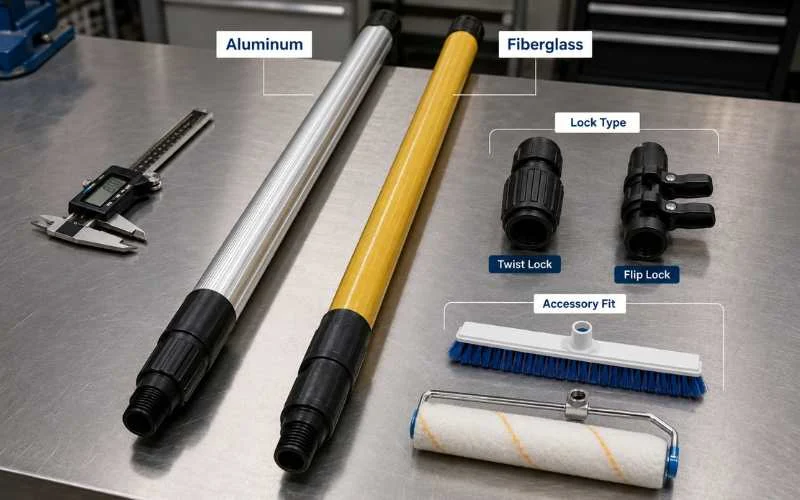
The rule is simple: choose aluminum for general cleaning, pool and painting programs; choose fiberglass only when electrical safety near live equipment is the main requirement. Choosing the wrong aluminum vs fiberglass extension pole can create more than a small product issue. A pole may feel too heavy, slip at full reach, dent during shipping, crack after impact, or create safety risk near electrical hazards. For B2B buyers, the material choice affects user comfort, return rate, landed cost, private-label design, and repeat order stability. This guide compares aluminum and fiberglass extension poles by application, safety, handling, durability, testing, OEM customization, and bulk purchasing risk.
Before sending this topic to a supplier, align the working specification with aluminum extension pole programs and confirm the manufacturing route through custom aluminum telescopic poles; Aluminum Association material resources can help when different teams use different material or safety terms.
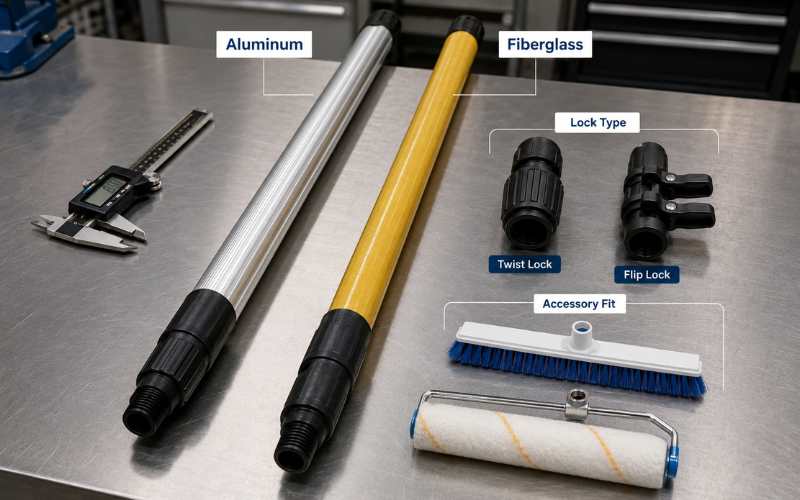
Aluminum vs Fiberglass Extension Pole: Quick Answer
For most commercial extension pole programs, an aluminum extension pole is the better default material. It is light, cost-efficient, easy to customize, clean in appearance, and suitable for pool cleaning, painting, window cleaning, solar panel cleaning, dusting, and retail OEM tool programs.
A fiberglass extension pole is the better choice when non-conductive material is required. This applies to utility tools, electrical-risk cleaning, and jobs where the pole may be used near exposed energized equipment.
The practical rule is simple:
Choose aluminum for general cleaning, pool, painting, and OEM retail programs. Choose fiberglass when electrical safety is the main buying requirement.
Aluminum vs Fiberglass Extension Pole Comparison Table
| Factor | Aluminum Extension Pole | Fiberglass Extension Pole | Better Choice |
|---|---|---|---|
| Weight | Light and easy to lift | Usually heavier at similar length | Aluminum |
| Daily handling | Easier for overhead work and repeated use | Can feel tiring at longer lengths | Aluminum |
| Electrical safety | Conductive, not for electrical-risk use | Non-conductive when clean, dry, and undamaged | Fiberglass |
| Corrosion resistance | Does not rust like steel; anodizing improves outdoor life | Strong moisture resistance | Tie |
| Surface finish | Anodizing, powder coating, polishing, color matching | Fewer finish options | Aluminum |
| OEM customization | Strong control over length, tube size, wall thickness, lock, logo, color, packaging | Possible, but less flexible | Aluminum |
| Cost control | Better for high-volume orders | Often higher unit and freight cost | Aluminum |
| Long reach stiffness | Strong when tube diameter, wall thickness, and overlap are correct | Strong in some designs, but heavier | Depends on design |
| Impact damage | May dent under heavy impact | May crack, chip, or expose fibers | Depends on use |
| Best applications | Pool poles, painting poles, cleaning poles, retail OEM programs | Electrical-risk poles, utility tools, safety products | Depends on risk |
The table shows why aluminum is common in high-volume extension pole programs. It gives buyers better control over weight, finish, cost, and repeat production. Fiberglass still has a clear role, but that role is more safety-specific.
Buyer Decision Table: Which Pole Material Fits Your Use Case?
| Buyer Situation | Recommended Material | Why It Fits |
|---|---|---|
| Pool cleaning pole program | Aluminum | Light, corrosion-resistant, easy to rinse, compatible with pool accessories |
| Painting tool brand | Aluminum | Better overhead control, good retail finish, easy private labeling |
| Window cleaning pole | Aluminum or fiberglass | Aluminum for general cleaning; fiberglass if electrical risk exists |
| Solar panel cleaning pole | Aluminum | Weight matters at long reach, especially with brush and water-fed heads |
| Electrical utility work | Fiberglass | Non-conductive material is the main requirement |
| Large retail private-label order | Aluminum | Better control over color, logo, lock, carton, and MOQ |
| Coastal outdoor cleaning pole | Aluminum or fiberglass | Depends on finish, salt exposure, and safety risk |
| Low-cost promotional pole | Aluminum | Easier to control price and appearance in volume |
| Safety-specific product line | Fiberglass | Better when the product must be non-metallic and non-conductive |
For OEM and distributor buyers, this table is more useful than a basic material chart. It connects the pole material to the real sales channel, user risk, and product return risk.
What Aluminum Extension Poles Do Well
An aluminum extension pole is a fixed, modular, or telescopic pole made from aluminum tube. It is widely used in pool cleaning, painting, window cleaning, solar panel cleaning, dusting, mop handles, brush handles, and outdoor maintenance tools.
Aluminum works well because it offers a strong balance of weight, strength, finish, cost, and customization. Most commercial users do not want the strongest material on paper. They want a pole that feels light, locks firmly, fits accessories, ships well, and looks clean on a retail shelf.
Common aluminum extension pole structures include:
- Telescopic aluminum extension pole for adjustable reach.
- Fixed aluminum pole for simple tool handles.
- Modular aluminum pole for threaded or snap-together systems.
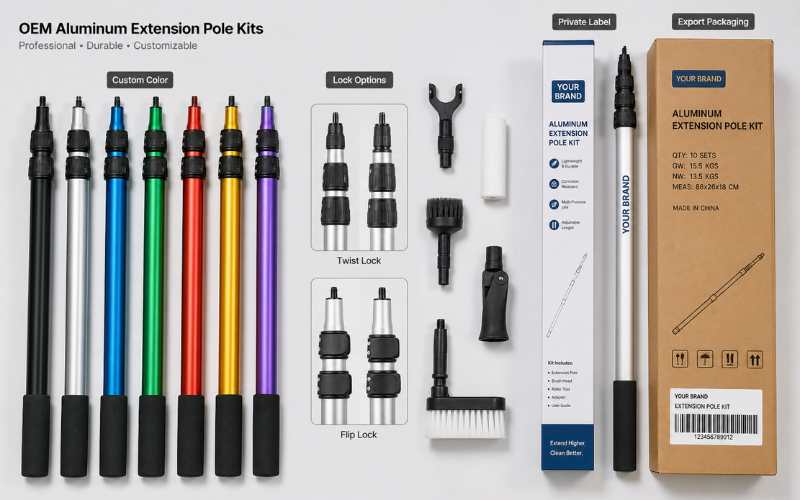
- Twist lock, flip lock, or button lock pole for different adjustment styles.
The telescopic pole locking mechanisms guide explains how twist locks, flip locks, and button locks affect real use.
Where Aluminum Extension Poles Are Not the Best Choice
Aluminum is not the right material for every extension pole. A strong article must say this clearly.
Aluminum has several limits:
- Aluminum conducts electricity, so it should not be used near exposed wires, power lines, or energized equipment.
- Thin-wall aluminum poles may dent if the supplier reduces wall thickness too much.
- Poor anodizing may stain, fade, or pit faster in saltwater or chemical environments.
- Long aluminum poles need correct section overlap and tube diameter to reduce wobble.
- A bad twist lock can slip, even if the aluminum tube itself is good.
This does not make aluminum weak. It means the pole must be engineered correctly. For most cleaning, pool, painting, and retail programs, aluminum remains the smarter default. But for electrical-risk work, fiberglass should come first.
What Fiberglass Extension Poles Do Well
A fiberglass extension pole is made from glass fiber reinforced resin. Its main advantage is simple: it can provide non-conductive performance when clean, dry, and undamaged.
Fiberglass performs well in these situations:
- Electrical-risk applications
- Utility tool programs
- Safety-focused cleaning tools
- Some rescue pole designs
- Moisture-heavy environments
- Certain long rigid pole structures
- Buyers who need a non-metallic pole
Fiberglass also resists moisture well. It does not rust. It can feel solid in hand. In the right application, it is not a compromise. It is the correct material.
The key is not to use fiberglass as a general “stronger” label. Use it when the job requires its real advantage.
Where Fiberglass Extension Poles Have Limits
Fiberglass is useful, but it has clear trade-offs.
A fiberglass extension pole can feel heavier than aluminum at similar length. That matters during overhead painting, pool cleaning, window cleaning, and solar panel cleaning. The longer the pole, the more users notice the weight.
Fiberglass can also crack, chip, splinter, or expose fibers after impact or surface wear. This may affect comfort, appearance, and product return rate. Surface finish options are usually less flexible than aluminum anodizing or powder coating.
For private-label retail programs, fiberglass may also limit fast SKU development. Buyers may find it harder to control color, machining details, logo position, and small design changes.
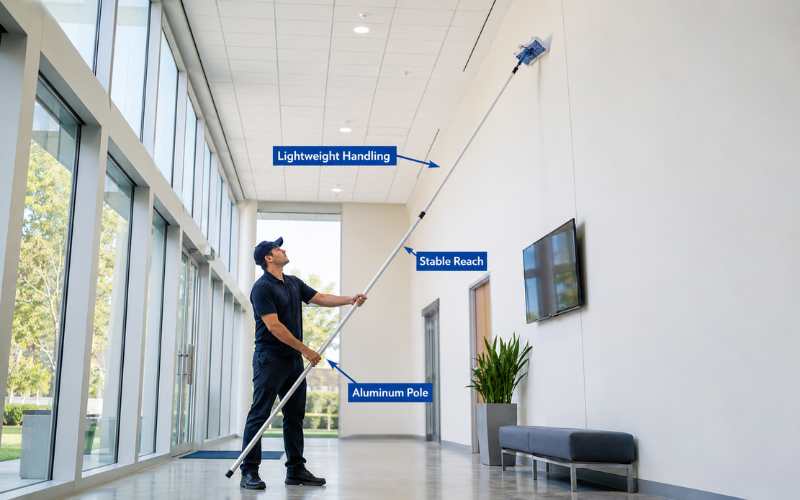
Weight and Handling: Why Aluminum Usually Feels Better
Weight affects every use of an extension pole. Users lift it, extend it, twist it, pull it back, rinse it, and store it. In many tasks, the pole stays above shoulder height.
An aluminum extension pole usually feels easier to control because it gives a strong strength-to-weight balance. This matters in pool cleaning, ceiling painting, window washing, solar panel brushing, and janitorial work.
Fiberglass can feel strong, but longer fiberglass poles often feel heavier. That extra weight may not look serious in a product sheet. In real use, it becomes obvious after repeated movement.
For distributors, lighter handling can reduce complaints. For OEM brands, it can improve repeat purchases. For retail buyers, it can help the product feel better during first use.
Strength, Flex, and Impact Damage
Many buyers ask whether fiberglass is stronger than aluminum. The honest answer is: it depends on design.
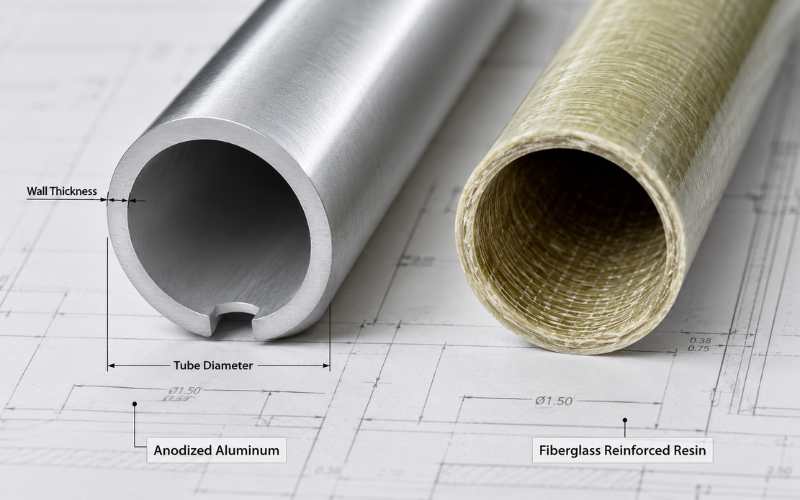
A pole’s strength depends on:
- Tube diameter
- Wall thickness
- Alloy or resin quality
- Section overlap
- Locking system
- Connector design
- Surface treatment
- Testing standard
- Packaging protection
A well-designed aluminum pole can outperform a weak fiberglass pole. A good fiberglass pole can outperform a thin, poorly locked aluminum pole. Material name alone does not decide quality.
For B2B buyers, repeatability matters more than one strong sample. A sample can look good. A container order must stay consistent across thousands of pieces.
Locking System Matters More Than Many Buyers Think
The locking system can ruin a good pole. A light aluminum tube with a weak lock will slip. A strong fiberglass tube with a poor connector will still disappoint users.
| Locking System | Best For | Main Advantage | Buyer Note |
|---|---|---|---|
| Twist lock | Pool poles, cleaning poles, simple retail poles | Clean appearance and lower cost | Tube fit and friction control must be stable |
| Flip lock | Painting, window cleaning, outdoor work | Fast adjustment and easy hand operation | Lock body strength affects service life |
| Button lock | Fixed-position poles, pool accessories, modular poles | Simple length positioning | Limited adjustment points |
| Threaded connector | Painting rollers, brush heads, custom tools | Good accessory compatibility | Thread standard must match target market |
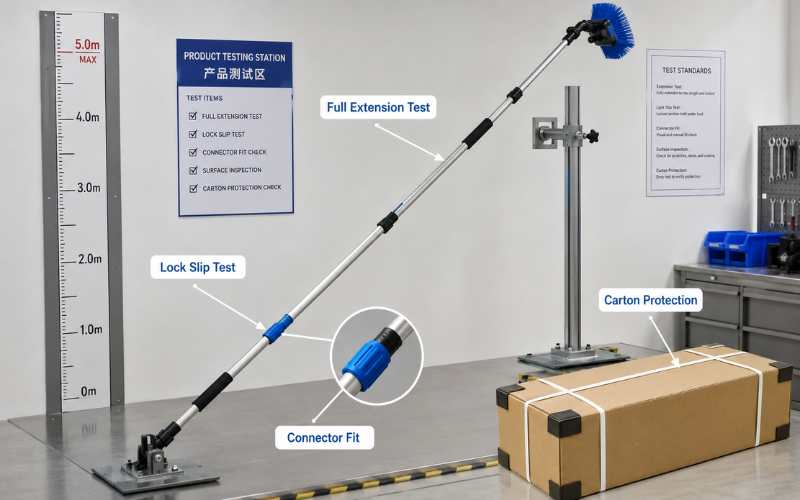
Do not approve a sample based only on material. Extend the pole fully. Add the tool head. Lock and unlock it many times. Check wobble, slipping, grip comfort, connector fit, and section movement.
If your pole line includes different lock styles, use dedicated product pages such as twist lock telescopic pole and flip lock telescopic pole to help buyers choose faster.
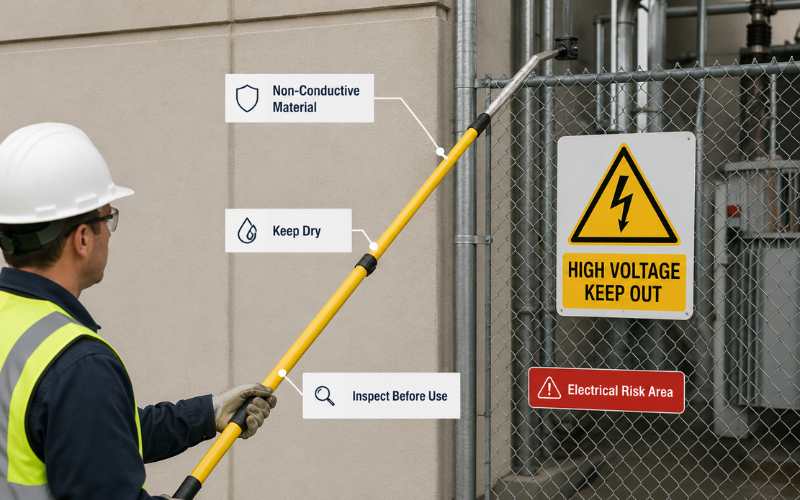
Electrical Safety: When Fiberglass Is the Better Choice
Fiberglass is the better material when an extension pole may be used near energized electrical equipment. Aluminum conducts electricity, so it should not be used around exposed wires, power lines, or electrical-risk work zones.
OSHA states that ladders must have nonconductive side rails when employees or ladders could contact exposed energized electrical equipment. This rule is written for ladders, but the safety logic also explains why buyers often choose fiberglass poles for electrical-risk applications. See OSHA’s rule on nonconductive side rails near energized electrical equipment.
But fiberglass should not be described as “100% safe around electricity.” It must stay clean, dry, and undamaged. Moisture, dirt, cracks, worn resin, or exposed fibers can reduce safety.
For B2B product labels, avoid risky claims:
- Do not write “electric-proof.”
- Do not write “safe for all electrical work.”
- Do not imply that the pole replaces electrical safety training.
- Do state that fiberglass is selected where non-conductive pole material is required.
This protects the user. It also protects your brand.
Corrosion and Outdoor Use
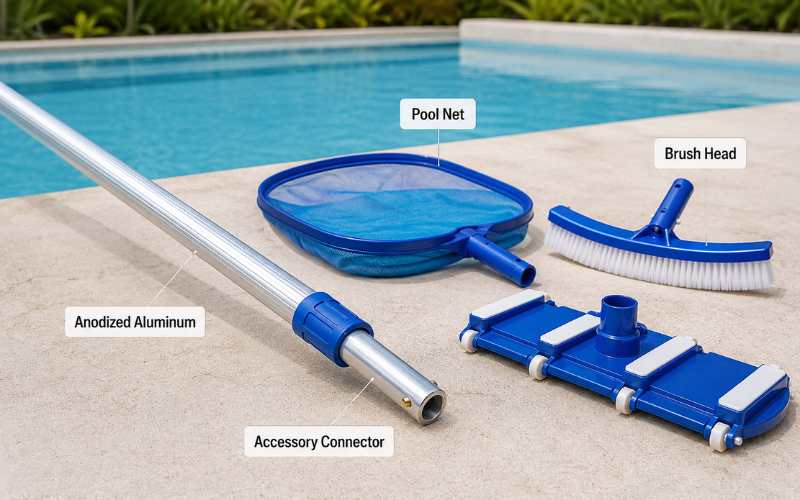
Aluminum does not rust like steel. This is one reason aluminum is widely used for pool poles, outdoor cleaning tools, marine accessories, and solar panel cleaning poles.
Aluminum can still oxidize, stain, or pit in harsh salt or chemical environments. That is why surface finish matters. Anodizing creates a harder oxide layer on aluminum and improves appearance and corrosion resistance. The Aluminum Anodizers Council explains more in its guide to specifying anodized aluminum.
Fiberglass also resists moisture well. It can work well in wet or coastal environments. But surface aging may appear after UV exposure, abrasion, or impact. Once fibers become exposed, the pole may feel rough and less attractive.
For pool cleaning, anodized aluminum is usually the stronger commercial choice. It looks clean, rinses easily, works with common pool accessories, and supports color and logo customization.
Application Specification Table
| Application | Common Length | Preferred Material | Recommended Lock | Buyer Note |
|---|---|---|---|---|
| Pool cleaning | 4–12 ft, 8–16 ft, 8–24 ft | Aluminum | Twist lock or button lock | Confirm pool net, brush, skimmer, and vacuum head fit |
| Painting | 2–4 ft, 4–8 ft, 6–12 ft | Aluminum | Flip lock or threaded connector | Check roller thread and grip comfort |
| Window cleaning | 8–24 ft | Aluminum or fiberglass | Flip lock | Use fiberglass if electrical risk exists |
| Solar panel cleaning | 12–30 ft | Aluminum | Flip lock or reinforced twist lock | Test flex at full reach with brush head |
| Dusting and janitorial tools | 3–10 ft, 6–12 ft | Aluminum | Twist lock or button lock | Weight matters for daily repeated use |
| Utility work | Custom | Fiberglass | Application-specific lock | Non-conductive requirement comes first |
| Retail private label | Depends on SKU range | Aluminum | Depends on product level | Check color, barcode, packaging, and carton strength |
| Marine and coastal cleaning | Depends on reach | Aluminum or fiberglass | Corrosion-resistant lock | Specify anodizing or suitable outdoor finish |
This table helps buyers avoid vague RFQs. Instead of asking for “a strong pole,” define the use case, length, lock, connector, finish, and packaging.
How Material Choice Affects Return Rate and Warranty Risk
Return rate often comes from small design failures, not from the material alone.
Common return causes include:
- Pole feels too heavy.
- Lock slips at full extension.
- Tube sections wobble.
- Connector does not fit the accessory.
- Surface scratches during shipping.
- Fiberglass surface splinters after impact.
- Thin aluminum tube dents in transit.
- Carton is too weak for long-length shipping.
Aluminum can reduce some return risks because it is easier to control in machining, surface finish, tube tolerance, and packaging design. Fiberglass can reduce safety-related risk when non-conductive material is required.
For B2B buyers, the best question is not “Which material is stronger?” The better question is:
Which material creates fewer complaints in this exact application?
Cost, MOQ, Shipping, and Landed Cost
For B2B buyers, unit price is only one part of cost. The real cost includes weight, carton size, loading quantity, damage rate, spare parts, inspection, freight, customs documents, and after-sales claims.
Aluminum often gives better cost control in large orders because it is easy to process in volume. Tubes can be cut, drilled, punched, anodized, marked, assembled, and packed with good consistency.
Fiberglass may cost more depending on resin system, wall design, production method, and surface treatment. It may also increase freight cost if the pole is heavier or needs larger carton protection.
Before choosing material, compare:
- Unit price
- Net weight
- Carton size
- Collapsed length
- MOQ
- Sample cost
- Tooling cost
- Surface finish cost
- Spare parts
- Loading quantity
- Shipping damage risk
- Lead time for repeat orders
A cheap sample can become expensive after shipping. A pole that feels strong in hand can still fail if the carton is too long, the lock slips, or the connector breaks in transit.
OEM Customization and Manufacturing Control
Aluminum is usually easier to customize for OEM extension pole programs. This is a major advantage for importers, retailers, and private-label brands.
With aluminum, buyers can specify:
- Tube diameter
- Wall thickness
- Alloy
- Number of sections
- Extended length
- Collapsed length
- Locking system
- Handle grip
- Thread or connector type
- Anodized color
- Logo marking
- Label and barcode
- Retail sleeve or color box
- Carton size and pallet plan
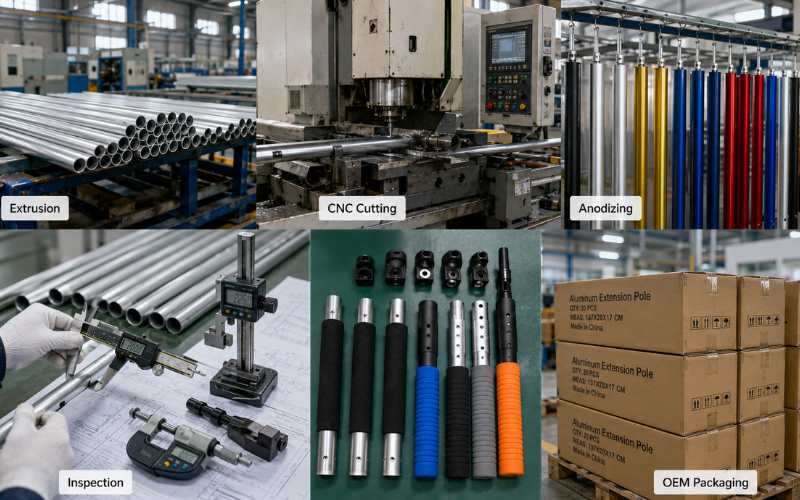
For aluminum extension poles, repeatability depends on extrusion control, anodizing consistency, machining accuracy, and inspection capacity. Xingyong supports this process with 14 aluminum extrusion presses from 350T to 2000T, anodizing lines, CNC finishing equipment, in-house testing instruments, and about 3,000 tons of monthly capacity. The factory was founded in 2010 and supports drawing-based, sample-based, and material-supplied processing for OEM buyers.
This type of production flow matters because extension pole quality depends on stable tube dimensions, smooth section fit, consistent finish, reliable lock assembly, and protective packaging.
Quality Control Points for Aluminum and Fiberglass Poles
A sample photo is not enough. Buyers should define clear quality checks before bulk production.
| Quality Check | Why It Matters |
|---|---|
| Tube diameter tolerance | Affects section fit and lock stability |
| Wall thickness | Affects strength, weight, and cost |
| Surface finish thickness | Affects corrosion resistance and appearance |
| Lock holding force | Prevents slipping during real use |
| Full-extension wobble | Affects user confidence |
| Connector fit | Prevents accessory complaints |
| Pull and twist testing | Checks working strength |
| Impact inspection | Helps find denting, cracking, or splintering risk |
| Carton drop test | Reduces shipping damage |
| Wet-use expectation | Important for pool, marine, and outdoor tools |
| Final inspection standard | Helps prevent mixed quality in bulk orders |
For aluminum poles, inspect anodizing quality, scratches, dents, tube fit, and lock force. For fiberglass poles, inspect cracks, surface fibers, resin consistency, and electrical-safety labeling.
Sample Testing Checklist Before Mass Production
Before approving a bulk order, test the sample like a real user.
| Test | How to Check | Pass Standard |
|---|---|---|
| Full extension wobble | Extend the pole fully and shake it with the target tool head | No obvious loose section |
| Lock slip test | Pull, twist, and press under working load | No sliding or sudden collapse |
| Connector fit | Attach the target brush, roller, pool net, or adapter | No loose thread or mismatch |
| Grip comfort | Hold and rotate the pole during repeated use | No sharp edge or uncomfortable seam |
| Surface finish | Check color, scratches, stains, and coating consistency | Stable color and clean appearance |
| Collapse and extend test | Open and close the pole many times | Smooth movement without jamming |
| Wet handling test | Rinse or wipe the pole if used for pool or cleaning | No serious slipping or finish problem |
| Impact check | Inspect after normal handling or carton movement | No serious dent, crack, or exposed fiber |
| Carton protection | Check both ends, locks, and accessories inside carton | No damage after transport simulation |
This checklist helps buyers catch problems before the first container ships. It also creates a clearer standard between buyer and supplier.
What Buyers Should Ask Suppliers Before Choosing Pole Material
A good supplier should answer more than “aluminum or fiberglass.”
Ask these questions before ordering:
- What tube diameter and wall thickness do you recommend for my length?
- Which lock type fits my application best?
- What is the expected full-extension wobble?
- Can the pole hold the target tool head without slipping?
- What surface finish do you recommend for pool or outdoor use?
- Can you match our brand color?
- Can you add laser marking, sticker, barcode, or custom packaging?
- What is the MOQ for each size?
- What is the lead time for samples and repeat orders?
- How do you inspect tube tolerance, lock force, and surface finish?
- How will the long cartons be protected during shipping?
- What spare parts are available for locks, tips, grips, or connectors?
For pool product buyers, accessory fit matters most. If you are building a full pool cleaning range, start with the pool pole structure, then match nets, brushes, vacuum heads, and packaging around the same aluminum tube platform. If your range includes pool cover systems, connect the pole program with pool cover reel components for a more complete aluminum product line.
Why Aluminum Works Better for High-Volume Retail Programs
Retail programs need more than a strong pole. They need a product that can be repeated, packed, shipped, scanned, displayed, and reordered.
Aluminum works well for high-volume programs because it supports:
- Stable tube dimensions
- Consistent anodized colors
- Clean retail appearance
- Standard accessory compatibility
- Logo and barcode placement
- Better carton planning
- Lower handling fatigue
- Faster SKU expansion
A buyer can build several SKUs from one aluminum tube platform. For example, the same pole family can include 4–8 ft, 6–12 ft, 8–16 ft, and 8–24 ft options. The finish, lock, grip, and packaging can stay consistent across the line.
This helps supermarkets, hardware chains, pool product distributors, cleaning tool brands, and private-label importers manage product families with less complexity.
Best Use Cases for Aluminum Extension Poles
An aluminum extension pole is usually the stronger commercial choice for general use.
Best-fit applications include:
- Pool cleaning poles for nets, brushes, skimmers, and vacuum heads.
- Painting extension poles for rollers, ceiling tools, and wall painting.
- Window cleaning poles for squeegees and washer heads.
- Solar panel cleaning poles for brush heads and water-fed systems.
- Dusting poles for home, hotel, and commercial cleaning.
- Mop and broom handles for janitorial supply programs.
- Retail OEM poles for distributors, supermarkets, and tool brands.
Aluminum wins in these categories because buyers need light handling, clean finish, accessory fit, and stable bulk cost.
Best Use Cases for Fiberglass Extension Poles
A fiberglass extension pole is usually the better choice when non-conductive material is the core requirement.
Best-fit applications include:
- Utility-related tools
- Electrical-risk cleaning
- Safety-focused maintenance tools
- Certain rescue poles
- Some antenna pole applications
- Some flagpole and outdoor pole designs
- Non-metallic pole programs
Fiberglass should not be selected only because it sounds stronger. It should be selected because the application needs its specific advantage.
That advantage is non-conductive performance.
Common Buying Mistakes
Many buyers make the wrong choice because they compare material names instead of finished products.
Avoid these mistakes:
- Choosing fiberglass only because it sounds stronger.
- Choosing aluminum only because it is cheaper.
- Ignoring wall thickness.
- Ignoring tube diameter.
- Ignoring lock design.
- Ignoring connector standard.
- Ignoring collapsed length.
- Ignoring carton size.
- Ignoring surface finish.
- Ignoring replacement parts.
- Ignoring full-extension testing.
- Ignoring after-sales return risk.
A better buying process compares the full pole system: material, structure, lock, finish, accessory fit, packaging, and inspection.
How to Specify an Aluminum Extension Pole for OEM Orders
Before asking for price, prepare a clear specification. This helps suppliers quote the same product and reduces sample mistakes.
| Specification Item | What to Confirm |
|---|---|
| Application | Pool cleaning, painting, solar cleaning, window cleaning, dusting, or custom tool use |
| Structure | Telescopic, fixed, or modular |
| Length | Collapsed length and extended length |
| Tube size | Outer diameter, inner diameter, and wall thickness |
| Material | 6061, 6063, or supplier-recommended alloy |
| Locking system | Twist lock, flip lock, button lock, or custom lock |
| Surface finish | Anodized, powder coated, polished, or custom color |
| Connector | ACME thread, pool clip, brush adapter, custom head, or threaded insert |
| Grip | Foam, rubber, plastic, or no grip |
| Logo | Laser marking, printing, sticker, or molded brand part |
| Packaging | Bulk carton, retail sleeve, color box, barcode, pallet plan |
| Testing | Pull test, lock test, surface check, dimension check, carton drop test |
| Trade details | MOQ, lead time, payment terms, shipping method, customs documents |
If your product requires extrusion-based customization, a dedicated aluminum extrusion manufacturer can help match tube profile, finish, machining, and packaging around your target market.
Aluminum vs Fiberglass Extension Pole: Final Material Choice
Choose aluminum extension poles when you need a lightweight, cost-controlled, good-looking, and easy-to-customize product. Aluminum is the better default choice for pool cleaning, painting, window cleaning, solar panel cleaning, dusting, brush handles, mop handles, and retail OEM programs.
Choose fiberglass extension poles when non-conductive material is required. Fiberglass is the better choice for electrical-risk applications, utility work, and safety-specific pole categories.
The strongest product line does not force one material into every use case. It uses aluminum for general commercial programs and fiberglass for safety-driven applications.
FAQs About Aluminum vs Fiberglass Extension Poles
Is aluminum or fiberglass better for an extension pole?
Aluminum is better for most general extension pole applications because it is lighter, easier to customize, easier to finish, and more cost-efficient in bulk orders. Fiberglass is better when the pole must be non-conductive for electrical-risk use.
Which extension pole material is lighter?
Aluminum is usually lighter than fiberglass at a similar length and structure. This makes aluminum easier to use for overhead painting, pool cleaning, window cleaning, and long-reach cleaning.
Is an aluminum extension pole safe near electricity?
No. Aluminum conducts electricity. Aluminum extension poles should not be used near exposed energized electrical equipment, power lines, or electrical-risk work zones.
Is fiberglass stronger than aluminum for extension poles?
Not always. Fiberglass can be strong, but strength depends on wall design, resin quality, fiber structure, lock design, and connector strength. A well-designed aluminum pole can outperform a poor fiberglass pole.
Which material is better for pool cleaning poles?
Aluminum is usually better for pool cleaning poles. It is light, easy to rinse, corrosion-resistant with the right finish, and compatible with common pool nets, brushes, skimmers, and vacuum heads.
Is fiberglass safer than aluminum near electricity?
Yes. Fiberglass is safer than aluminum near electrical-risk areas because it is non-conductive when clean, dry, and undamaged. But fiberglass still needs inspection because dirt, moisture, cracks, or exposed fibers can reduce safety.
Do fiberglass extension poles splinter?
Yes, fiberglass extension poles can splinter, crack, chip, or expose fibers if damaged by impact, wear, or aging. Buyers should check surface quality and provide proper user warnings.
Which extension pole is better for painting?
Aluminum is usually better for painting because it is lighter and easier to control. Fiberglass may be selected if the painting job involves electrical-risk areas.
Which extension pole material is better for private label?
Aluminum is usually better for private-label extension pole programs. It supports custom color, logo, length, lock type, tube size, grip, connector, packaging, and barcode control.
Which material is better for coastal use?
Both aluminum and fiberglass can work in coastal use. Aluminum should use a suitable surface finish, such as anodizing or powder coating. Fiberglass resists moisture well but should be checked for UV aging, abrasion, and surface wear.
Can aluminum extension poles be anodized?
Yes. Aluminum extension poles can be anodized in different colors. Anodizing improves surface hardness, appearance, and corrosion resistance.
Why do most pool poles use aluminum?
Most pool poles use aluminum because it is light, corrosion-resistant, easy to rinse, easy to extend, and compatible with standard pool cleaning accessories. It also gives distributors better control over color, length, packaging, and cost.
Which material is better for OEM extension pole manufacturing?
Aluminum is usually better for OEM extension pole manufacturing because extrusion, cutting, punching, anodizing, logo marking, lock assembly, and packaging can be controlled in a repeatable production flow.
Choose by Risk, Not by Material Name
The aluminum vs fiberglass extension pole decision should start with the job risk. If the pole may be used near electrical hazards, fiberglass should come first. If the pole is for pool cleaning, painting, window cleaning, solar panel cleaning, dusting, or retail OEM programs, aluminum is usually the smarter commercial choice.
A strong pole program is not built from material alone. It comes from the right tube size, wall thickness, lock system, surface finish, connector, packaging, and inspection standard.
Build Your OEM Pole Program With Xingyong
If you need OEM aluminum extension poles for pool cleaning, painting, cleaning tools, or retail programs, Xingyong can support custom tube size, wall thickness, surface finish, locking system, accessories, logo marking, packaging, and export production.
To get a practical quotation, send us:
- Target application
- Extended and collapsed length
- Tube diameter or sample photo
- Lock type
- Accessory head
- Surface color
- Packaging style
- Estimated order quantity
Xingyong can suggest a practical aluminum pole structure, finish, MOQ, lead time, and shipping plan for your market.
Extension Poles and Tent Poles Have Different Material Priorities
Searchers sometimes compare aluminum and fiberglass tent poles, but that decision should not be copied directly to an extension pole. Tent poles are designed to flex as part of a lightweight frame. Extension poles must control a tool at reach, resist torsion at the lock and maintain usable stiffness when sections are extended. The product geometry and failure mode are different even when the material names are the same.
| Decision factor | Tent pole | Extension pole |
|---|---|---|
| Primary load | Frame bending and wind-induced flex | Cantilever bending, tool weight and user torque |
| Desired behavior | Controlled flexibility and low packed weight | Stiffness, handling control and reliable locking |
| Critical interface | Ferrules, shock cord and hubs | Telescoping overlap, locks and tool connector |
| Electrical context | Usually not the main material driver | Can make fiberglass essential near live electrical hazards |
For cleaning, painting and pool-care products, compare materials using the actual extended length, attachment weight, electrical environment and cycle test. If the requirement is specifically for shelter frames, use a dedicated aluminum tent pole buying guide rather than treating tent-pole queries as interchangeable with extension-pole specifications.
Related Comparisons & Guides
- Aluminum vs steel strength guide
- Best aluminum alloy for telescopic poles
- Telescopic pole vs extension pole
Related products: Explore related products and review matching solutions.

 English
  Español
  Français
  Deutsch
  Português