
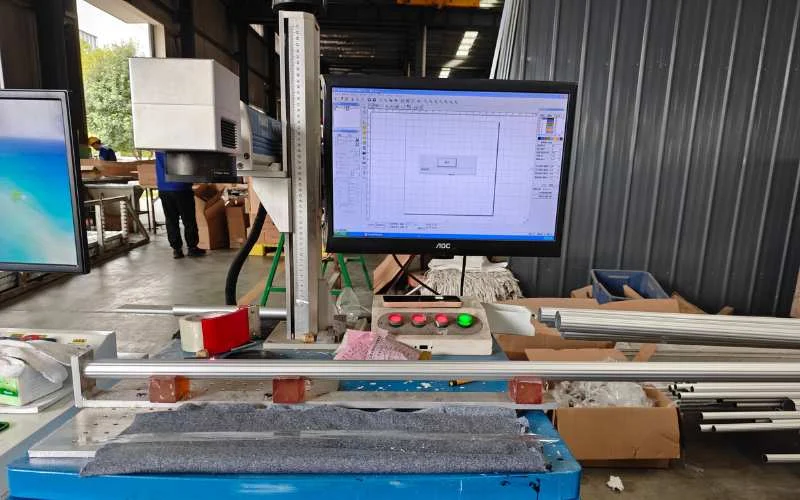
Buying telescopic poles in bulk isn’t just about length; it’s a high-stakes gamble on structural physics and shipping logistics. If you stock a 30ft pole with a standard residential wall thickness, your customers will face dangerous “whip” at full extension, and your return rate will skyrocket. At Xingyongwe’ve spent 16 years in the extrusion pits solving the “wet noodle” effect that plagues cheap imports. This guide deconstructs the profitability and engineering behind each length to ensure your next container load drives margin, not complaints.
When the discussion moves from research to sourcing, connect the points in this guide with telescopic pole manufacturing and custom aluminum telescopic poles. That makes the RFQ clearer, especially if the buyer also aligns terms with Aluminum Association material resources.
10ft vs 20ft vs 30ft Telescopic Pole: The Professional Verdict
The optimal choice depends on the Ratio of Leverage to Load. A 10ft pole is the high-velocity retail king, optimized for standard 40HQ container loading and DIY pool maintenance. The 20ft pole is the industry “sweet spot,” balancing a 6-meter reach with enough rigidity for professional scrubbing. The 30ft pole is a specialized high-reach tool that demands reinforced 6061-T6 aluminum and increased section diameters to mitigate the physics of deflection that can lead to catastrophic failure during commercial use.

Why “Cheap” Lengths Kill Your Margins: The Engineer’s Perspective
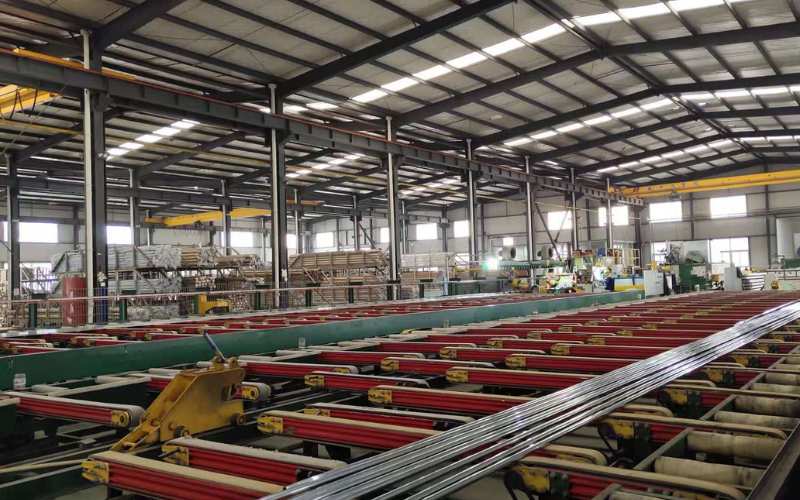
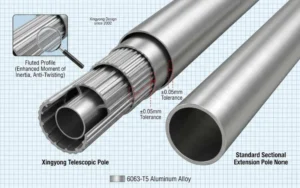
I’ve stood on our extrusion floor since 2010, and I’ve seen countless buyers make the same mistake: prioritizing price over Moment of Inertia. When a pole reaches 30 feet, the lateral force on the locking joints increases exponentially. If you are sourcing from a factory using 350T presses exclusively, they lack the pressure to create the dense, thick-walled profiles required for stability.
At Xingyong, we utilize our 2000T heavy-duty extrusion press for our long-reach series. This allows us to push high-tempered 6063-T5 aluminum through precision dies, ensuring that even at 30 feet, the “droop” is kept within a 2% tolerance.
B2B Sourcing Matrix: Logistics & Performance
| Feature | 10ft (Retail Grade) | 20ft (Pro Grade) | 30ft (Industrial Grade) |
|---|---|---|---|
| Container Yield (40HQ) | ~4,500 – 5,000 pcs | ~2,200 – 2,800 pcs | ~800 – 1,200 pcs |
| Material Yield Strength | Standard ASTM B221 | High-Temp T5/T6 | Reinforced Ribbed Profiles |
| Primary Failure Point | Plastic End Caps | Internal Cam Slippage | Section Buckling |
| Shipping Classification | Parcel / Standard | LTL / Oversized | Freight / OOG |
| Typical B2B Margin | 15% – 25% | 30% – 45% | 50%+ (Specialized) |
10ft Poles: The High-Volume “Cash Cow”
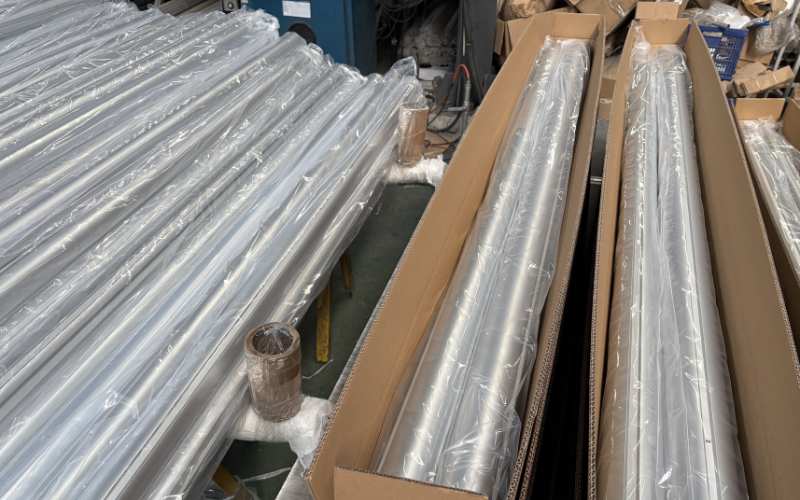
For suppliers to Walmart or Home Depot10ft poles are about volume and velocity. These poles are essentially “shipping air” if not packed correctly.
- Logistics Win: We design our 10ft poles to collapse under 1.5 meters, avoiding the “oversized” surcharges from carriers like UPS or FedEx.
- Production Speed: With 14 extrusion lines, we can pump out 3,000 tons monthly, ensuring your seasonal “spring cleaning” stock never runs dry.
- Consumer Safety: Shorter lengths minimize the risk of electrocution via overhead lines—a critical liability for big-box retailers.
20ft Poles: The Professional Service Standard
In my experience, the 20ft (6-meter) pole is the most profitable SKU for pool service distributors. It allows a technician to clean a standard pool without walking around the entire perimeter.
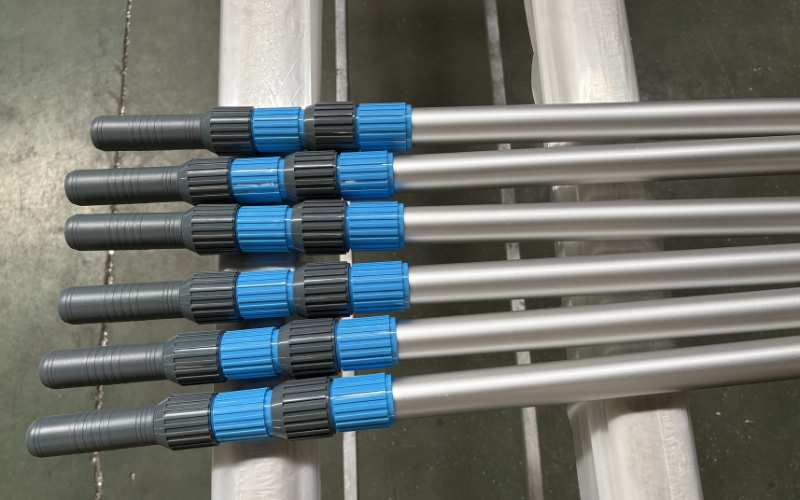
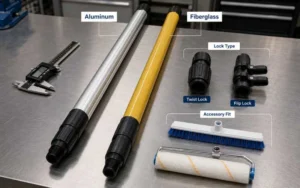
- The Locking Problem: Most 20ft poles fail because the lock can’t handle the torque. We use CNC-machined aluminum locks rather than cheap plastic friction rings.
- Surface Integrity: Our two automatic anodizing lines apply a 15-micron coating. This isn’t just for looks; it prevents the “black residue” that rubs off on a pro’s hands after a day of use.
30ft Poles: High-Reach Engineering or Liability?
Selling 30ft poles is not for the faint of heart. Without proper tensile strength testing, a 30ft pole becomes a liability the moment it’s extended.
- Structural Ribbing: At Xingyong, we don’t just use thicker aluminum for 30ft poles; we use internally ribbed profiles. This increases rigidity by 30% without adding excessive weight.
- The Straightness Test: We use Israel Romidot section scanners to verify the concentricity of every tube. If the tube isn’t perfectly round, the sections will jam. In 20+ years, I’ve learned that a jammed 30ft pole is an automatic refund.
Distributor Profitability: The Inventory Split
I always tell our partners at Ross and other major buying groups: don’t overstock the extremes. A healthy B2B inventory follows a 60/30/10 logic:
- 60% (10ft): High turnover, low margin, feeds the DIY market.
- 30% (20ft): Moderate turnover, high margin, feeds the pro contractor.
- 10% (30ft): Low turnover, extreme margin, feeds the specialized industrial sector.
Beyond the Aluminum: Why Xingyong?
We aren’t just an extrusion plant; we are a fully integrated manufacturing ecosystem. From our own sewage treatment plant (ensuring zero-stop production under environmental audits) to our ISO 9001 certificationswe mitigate your supply chain risk. Whether you need standard pool poles or custom OEM telescopic solutions, we provide the Oxford Spectrometer data to prove your metal is pure.
Build a Resilient Supply Chain
Stop competing on price alone and start competing on structural reliability. If your current supplier can’t explain the Young’s Modulus of their 30ft pole, you’re buying a liability. Let’s discuss your container requirements and custom branding needs today.
[Request a Technical Breakdown and Bulk Pricing from Xingyong Engineers]
Frequently Asked Questions
What length telescopic pole do I need?
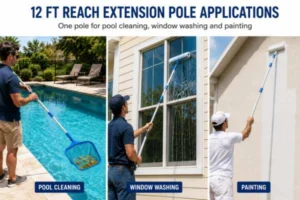
Match collapsed and extended length to the task: about 10 ft suits most pool and window cleaning, 20 ft reaches two-story windows, and 30 ft handles gutters and high-reach jobs. Longer poles trade rigidity and control for reach.
Are longer telescopic poles less stable?
Yes. As extended length grows, deflection and flex increase, so longer poles need larger diameters and thicker walls to stay rigid. A 30 ft pole needs more sections and stronger tube than a 10 ft pole to remain usable.
How many sections does a long telescopic pole have?
More length usually means more sections. A 10 ft pole may use two to three sections, while 20 to 30 ft poles often use four to five. Each added section adds reach but also more joints to lock and align.
Which length is best for pool cleaning?
Most pool cleaning uses poles in the 8 to 16 ft range, which reaches across typical residential pools while staying light and controllable. Commercial pools may need longer reach with heavier-duty tube.
Related Comparisons & Guides
Related products: Explore related products and review matching solutions.

 English
  Español
  Français
  Deutsch
  Português