

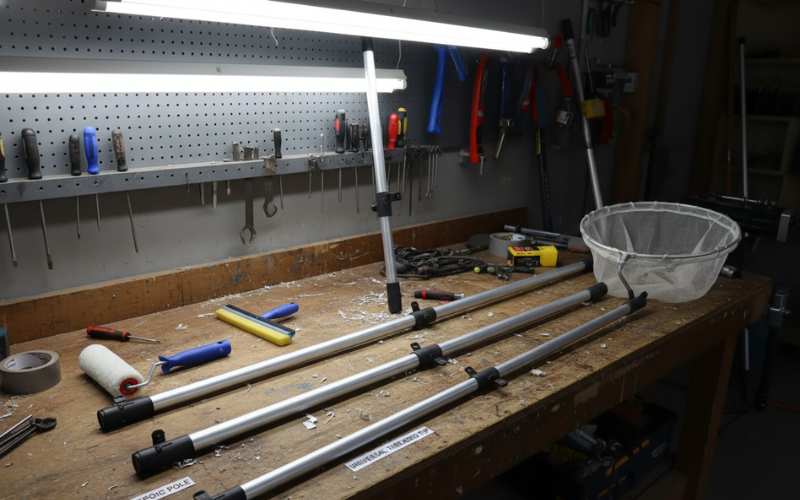
An extension pole is a long handle that lets a tool reach beyond normal arm’s reach. A telescopic pole is an adjustable extension pole made of nested tube sections that slide to change the working length and lock in place. Fixed-length and modular poles provide other reach options. For dimensions, locks and product configurations, see our telescopic pole product range.
What Is a Telescopic Pole?
Extension pole describes the function: carrying a tool beyond normal arm’s reach. Telescopic describes the structure: nested tube sections slide to adjust working length and lock in place. A telescopic pole is one common extension-pole design; fixed-length and modular poles are alternatives.
How a Telescopic Extension Pole Works
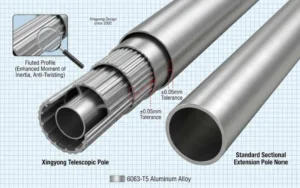
A telescopic pole uses nested tube sections. The user extends the sections to the working length, then engages a lock to keep them from sliding during use. When the task is finished, the sections retract for storage or transport. Tube fit, section overlap and the attached tool’s load affect how stable the extended pole feels.
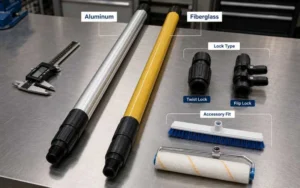
Lock designs vary by pole. The telescoping pole locking mechanism guide explains twist, flip and button locks in detail.
Common Extension Pole Structures
Telescopic poles adjust across a range of lengths and retract to a shorter storage size. Fixed-length poles hold one working length, while modular poles add or remove separate sections. The practical trade-offs in reach, rigidity and storage are covered in our telescopic vs. fixed extension pole comparison.
Key Extension Pole Terms
- Extended length: the pole’s working length when sections are deployed.
- Collapsed length: the pole’s storage or transport length when sections are retracted.
- Section overlap: the length by which nested tubes remain engaged when extended.
- Tool interface: the threaded, button or other connection between the pole and its attachment.
These terms describe a pole’s construction and dimensions. They do not specify a safe working load by themselves; load depends on the complete pole, extension and tool setup.
Where Extension Poles Are Used
Extension poles connect to tools for pool care, window washing, painting, dusting, solar panel cleaning and other reach tasks. See the dedicated telescopic extension pole applications guide for use-specific examples and selection considerations.
Frequently Asked Questions
Is an extension pole the same as a telescopic pole?
No. Extension pole describes a handle used to extend tool reach; telescopic describes an adjustable nested-tube structure. A telescopic pole is one common type of extension pole.
What is the difference between telescopic and fixed-length poles?
A telescopic pole adjusts and retracts, while a fixed-length pole stays at a set length. See the full comparison for the trade-offs.
What should I check before choosing a pole?
Start with the required working reach, collapsed storage length and tool connection. For OEM product options, review the telescopic pole product range; manufacturers and factory capabilities are described on the aluminum telescopic pole manufacturer page.
Related Guides
Applications · Telescopic vs. fixed comparison · Locking mechanisms · Telescopic pole products


 English
 Español
 Français
 Deutsch
 Português