

Compare telescopic and fixed extension poles by adjustment, working rigidity, collapsed length, shipping footprint and cost. This guide supports the choice between the two pole structures for a product or sourcing program.
For industry use cases, see the telescopic extension pole applications guide. For product configurations, see the telescopic pole range.
The Telescopic Side: What You Are Buying
A telescopic extension pole is a multi-section pole that can extend and retract to different lengths using a locking mechanism. Each tube slides inside another, allowing users to adjust the working height while keeping the pole compact during storage and transportation.
This design is widely used in tools that require flexible reach, especially when users need to work at different heights.

Typical characteristics of telescopic poles include:
- Adjustable length, allowing users to reach different working heights
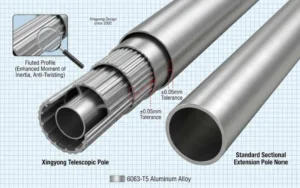
- Nested aluminum tubes that slide smoothly during extension
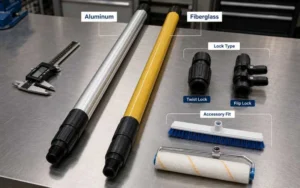
- Locking systems such as twist locks or flip locks
- Compact transport size, reducing shipping and storage space
Because of these advantages, telescopic poles are commonly used in many industries.
Common applications include:
- window cleaning pole systems used by professional cleaners
- solar panel cleaning pole tools for rooftop maintenance
- telescopic washing pole systems used with water-fed brushes
- fruit picking extension pole tools in orchards
- spray can extension pole tools for industrial maintenance
- light bulb extension pole tools used in facility management
For distributors and OEM brands, telescopic poles are attractive because they provide multiple working lengths in a single product, which improves versatility for end users.
The Fixed Side: What You Are Buying
A fixed extension pole is a single-length pole made from one solid tube or a permanently joined structure. Unlike telescopic poles, it does not extend or retract. The length remains constant during use.
Because of its simple structure, a fixed pole provides higher rigidity and torque transmission, which makes it suitable for tools that require strong pushing or pulling force.

Typical structural characteristics include:
- Single tube construction without moving parts
- Higher structural strength compared with telescopic poles
- Lower manufacturing cost
- Minimal maintenance because there are no locking systems
Fixed poles are commonly used in tools where durability and stability are more important than adjustable length.
Common applications include:
- broom handle used in commercial cleaning
- Aluminum Mop handles for janitorial work
- brush extension pole for scrubbing walls or decks
- squeegee extension pole for glass cleaning
- pool pole used with vacuum heads and brushes
- swimming pool net pole for removing leaves and debris
- power washer extension pole for surface cleaning
For large retailers and distributors, fixed poles are often preferred because they are more cost-efficient and structurally stronger, especially for heavy-duty cleaning tools.
Telescopic vs Fixed Extension Pole: Key Differences

The main difference between telescopic poles and fixed poles is adjustability versus structural rigidity. Each design has advantages depending on the application.
| Feature | Telescopic Extension Pole | Fixed Extension Pole |
|---|---|---|
| Length | Adjustable | Fixed |
| Structure | Multi-section sliding tubes | Single tube |
| Storage Size | Compact | Full length |
| Strength | Moderate | Higher rigidity |
| Cost | Higher manufacturing cost | Lower cost |
| Maintenance | Lock mechanism may require care | Almost maintenance-free |
| Shipping | Easier to pack and ship | Larger packaging size |
For example, a telescopic window cleaning pole can extend to reach a second or third floor but retract for easy transport. In contrast, a fixed broom handle provides stronger push force when sweeping large areas.
The Right Pole Depends on the Job
Choose a telescopic pole when one product must cover varying reach and pack into a shorter space. Choose a fixed pole when the working length is known and rigidity or simple construction is the priority. Confirm the tool load and working conditions before finalizing either design.
Frequently Asked Questions
Which is easier to store, telescopic or fixed?
A telescopic pole retracts to a shorter storage length. A fixed pole keeps its full working length.
Which pole is more rigid?
A fixed pole usually has fewer joints and is generally more rigid at the same length. Telescopic performance depends on section overlap, tube dimensions and lock design.
When should I choose a telescopic extension pole?
Choose telescopic when working height changes, compact storage matters or one product must serve multiple reach needs.
When is a fixed extension pole a better fit?
Choose fixed when the required length is consistent and the task benefits from a simple, rigid tube structure.
What should OEM buyers check before choosing?
Compare working reach, collapsed length, tool attachment, load, operating frequency, shipping dimensions and target cost. Use the load capacity guide to review structural requirements.
Related Guides
Continue by Topic
Telescopic pole product range · Applications by industry · Extension pole definition · Locking mechanisms


 English
 Español
 Français
 Deutsch
 Português