
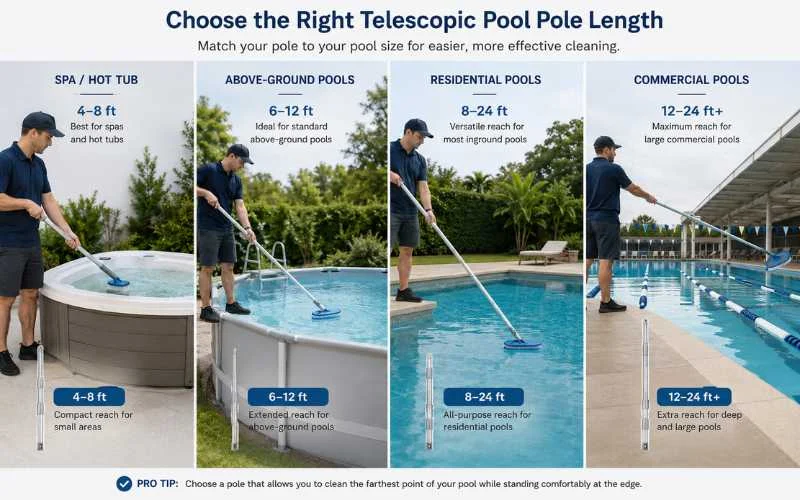
The best pool pole length depends on pool size, cleaning task, tool load, collapsed length, carton size and target sales channel. For most residential pool cleaning, 8–16 ft is the safest main length. For small pools and spas, 4–8 ft or 6–12 ft is usually enough. For large inground pools, deep ends and commercial cleaning, 12–24 ft may be required.
This page focuses only on pool pole length selection. It compares 4–8 ft, 6–12 ft, 8–16 ft and 12–24 ft pool pole options from the perspective of cleaning reach, handling stability, carton size, shipping cost and OEM SKU planning.
After choosing the right length range, buyers can compare aluminum pool pole options such as tube structure, finish, lock style, packaging and OEM customization.
Best Pool Pole Length: Quick Comparison
A pool pole should not simply be as long as possible. It should reach the working area while staying stable, easy to handle and practical to ship.
| Pool Pole Length | Best For | Main Cleaning Use | B2B SKU Position |
|---|---|---|---|
| 4–8 ft pool pole | Spas, hot tubs, fountains and very small pools | Light skimming, small brush work and compact cleaning kits | Entry-level SKU with compact carton and lower freight pressure |
| 6–12 ft pool pole | Above ground pools and small residential pools | Skimming, light brushing and shallow vacuuming | Good online retail SKU with controlled carton size |
| 8–16 ft pool pole | Most residential inground pools | Skimming, brushing, leaf removal and vacuuming | Mainstream retail and wholesale SKU |
| 12–24 ft pool pole | Large inground pools, deep ends and commercial cleaning | Long-reach brushing, vacuuming and professional cleaning | Higher-value SKU with higher shipping and stability requirements |
For most OEM and wholesale buyers, 8–16 ft should be the core product length. 6–12 ft can support compact pool kits and above ground pool channels, while 12–24 ft should be reserved for large-pool or professional cleaning applications.
A Simple Rule for Choosing Pool Pole Length
The practical rule is:
Pool pole working length = farthest cleaning reach + 2–3 ft control margin
This does not mean every buyer should choose the longest pole. It means the pole should work comfortably without staying at maximum extension all the time.
A pool pole that is always used at full extension may feel less stable, especially when paired with a brush, leaf rake or vacuum head. A better length plan chooses the shortest pole that can reach the required cleaning area while keeping enough handling margin.
| Farthest Cleaning Reach | Practical Pool Pole Choice | Why It Works |
|---|---|---|
| 5–6 ft | 4–8 ft pool pole | Enough reach for spas, small pools and compact cleaning kits. |
| 8–9 ft | 6–12 ft pool pole | Good balance for above ground pools and light daily cleaning. |
| 12–13 ft | 8–16 ft pool pole | Best general-purpose range for most residential pool cleaning. |
| 18–20 ft | 12–24 ft pool pole | Better for large inground pools, deep ends and commercial cleaning. |
Pool Pole Length by Pool Type
Pool size is the first decision point, but it should not be the only one. Cleaning access, pool shape, user position and tool load also affect the final pool pole length.
| Pool Type | Typical Use Situation | Recommended Pool Pole Length | OEM SKU Note |
|---|---|---|---|
| Spa or hot tub | Short reach, compact space and light tools | 4–8 ft | Best for compact retail kits and low freight cost. |
| Small above ground pool | Basic surface cleaning and side-wall brushing | 4–8 ft or 6–12 ft | Choose 6–12 ft if the kit includes a brush or small vacuum head. |
| Medium above ground pool | Daily skimming, light brushing and shallow vacuuming | 6–12 ft | Strong entry-level SKU for online and seasonal retail channels. |
| Standard residential inground pool | Skimming, brushing, vacuuming and leaf removal | 8–16 ft | Best main SKU for most residential pool cleaning programs. |
| Large inground pool | Longer reach, deeper areas and heavier cleaning tools | 12–24 ft | Needs better stiffness and more careful carton planning. |
| Commercial pool | Frequent cleaning, wider working range and repeated use | 12–24 ft or custom | Position as a professional SKU, not as a general entry-level item. |
Pool size, deck access and cleaning position can vary by pool design. For residential inground pool projects, buyers can also reference broader residential inground pool standards when evaluating how pool dimensions and use conditions may affect cleaning reach.
4–8 ft Pool Pole: Best for Small Pools, Spas and Fountains
A 4–8 ft pool pole is best for compact cleaning tasks where control matters more than long reach. It is suitable for spas, hot tubs, fountains, small above ground pools and compact pool cleaning kits.
This length is easy to store, easy to handle and easier to ship than longer poles. It also supports smaller cartons, which can reduce shipping pressure for online sellers and seasonal retailers.
However, a 4–8 ft pool pole should not be positioned as a universal pool cleaning pole. It may force users to walk around larger pools more often, and it may not provide enough reach for vacuuming or deeper areas.
| Best Use | Advantages | Limitations | B2B Positioning |
|---|---|---|---|
| Spas, hot tubs, fountains and small pools | Compact, lightweight, easy to pack and easy to control | Limited reach for larger pools or deep cleaning tasks | Entry SKU, compact kit SKU or low-freight online SKU |
6–12 ft Pool Pole: Best for Above Ground Pools
A 6–12 ft pool pole is a practical choice for many above ground pools and smaller residential pools. It gives more reach than a 4–8 ft pole while keeping the product easier to handle and ship than a 16 ft or 24 ft pole.
This length works well for skimming, light brushing and shallow vacuuming. For retailers, 6–12 ft can be a strong price-sensitive SKU because it looks more useful than a short spa pole while still keeping carton size under better control.
The main risk is underbuilding the structure. A 6–12 ft pole may look acceptable with a skimmer net but feel weak when used with a brush or vacuum head.
| Best Use | Recommended Channel | Tool Load | SKU Warning |
|---|---|---|---|
| Above ground pools and small home pools | Online retail, seasonal pool kits and entry-level wholesale programs | Light to medium | Do not pair thin structures with heavier tools without testing. |
8–16 ft Pool Pole: Best Main Length for Most Residential Pools
An 8–16 ft pool pole is the best all-around length for most residential pool cleaning. It can support skimming, brushing, leaf removal and vacuuming while still remaining easier to handle than a 12–24 ft pole.
For distributors and OEM buyers, 8–16 ft often works as the main retail SKU because customers understand it quickly. It gives enough perceived value, covers common pool sizes and fits many pool cleaning kits.
The important point is stability at working length. A 16 ft pole should not only extend; it should still feel controlled when locked and used with a pool brush or vacuum head.
| Why 8–16 ft Often Wins | B2B Benefit |
|---|---|
| Covers most residential pool cleaning tasks | Reduces the need for too many length SKUs. |
| Works with skimmer nets, brushes, leaf rakes and vacuum heads | Suitable for complete pool cleaning kits. |
| Offers better perceived value than short poles | Supports stronger retail presentation. |
| More manageable than 12–24 ft for general users | Reduces handling complaints from mainstream buyers. |
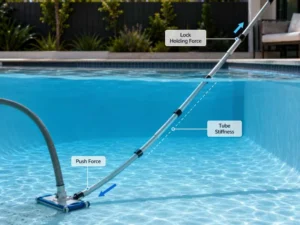
If the main cleaning task is vacuuming, buyers should test how the pole performs when they use the pole with a vacuum head, because vacuum drag increases lock and connector load.
For longer pool pole lengths, buyers should not evaluate length alone. Tube diameter, wall thickness, section overlap and aluminum profile consistency also affect working stability. ASTM B221 is a useful reference for buyers who want to understand specifications related to aluminum extruded tubes.
12–24 ft Pool Pole: Best for Large Inground and Commercial Pools
A 12–24 ft pool pole is best for large inground pools, deeper pool areas and commercial cleaning. It provides longer reach, but it also creates more bending force, more wrist load and more pressure on the lock and connector.
This length should not be treated as a simple upgrade from 8–16 ft. It needs stronger structural planning and more careful packaging evaluation. For B2B buyers, the 12–24 ft SKU can increase order value, but it can also increase freight cost, carton damage risk and after-sales complaints if it is not positioned correctly.
| 12–24 ft Planning Factor | Why It Matters | Buyer Decision |
|---|---|---|
| Longer working reach | Supports large pools and commercial cleaning tasks. | Use only when the market needs long reach. |
| Higher bending force | Long poles feel weaker if the structure is too light. | Confirm stiffness at working length. |
| Heavier tool load | Brushes, leaf rakes and vacuum heads increase end load. | Test with the actual pool tool. |
| Longer collapsed size | Affects carton length, storage and shipping cost. | Check carton limit before approving the SKU. |
| Higher return risk | Weak long poles are more likely to receive user complaints. | Position as large-pool or professional-use SKU. |
Collapsed Length and Carton Size Matter for B2B Buyers
For retail and wholesale buyers, extended length is only half of the decision. Collapsed length affects carton size, freight cost, warehouse storage, shelf display and damage risk.
A pool pole that looks attractive because of longer reach may become less profitable if the collapsed size creates oversized cartons or higher damage rates. This is especially important for online sellers, seasonal retailers and importers shipping mixed pool accessories.
| Length Range | Collapsed Size Impact | Carton / Shipping Note | Best SKU Use |
|---|---|---|---|
| 4–8 ft | Lowest collapsed length pressure | Easier carton design and lower shipping risk | Compact kits and entry-level retail |
| 6–12 ft | Moderate collapsed length pressure | Good balance between reach and carton control | Above ground pool kits and online retail |
| 8–16 ft | Higher carton planning requirement | Mainstream length but needs careful packaging design | Primary residential pool cleaning SKU |
| 12–24 ft | Highest collapsed length and damage risk | Requires stronger carton and clearer sales positioning | Large-pool and commercial-use SKU |
If carton length is a major constraint, compare 2-section and 3-section designs carefully. A 3-section pole may reduce collapsed size, but it can also require more attention to overlap, sliding feel and working stability.
When collapsed length increases carton size, packaging risk should be checked before bulk shipment. Buyers can reference ISTA package testing procedures when evaluating carton strength, vibration risk and shipping damage control.
Pool Pole Length by Tool Load
Different pool tools create different loads. A pole that feels acceptable with a skimmer net may feel unstable with a brush or vacuum head.
Length decisions should therefore consider the actual attachment, not only the pool size.
| Pool Tool | Typical Load | Recommended Length Range | Length Planning Note |
|---|---|---|---|
| Skimmer net | Light | 4–8 ft, 6–12 ft or 8–16 ft | Do not overbuild entry-level kits if the main task is light skimming. |
| Pool brush | Medium to high | 8–16 ft or 12–24 ft | Brushing creates side pressure, so full-extension stability matters. |
| Leaf rake | Medium | 6–12 ft, 8–16 ft or 12–24 ft | Wet leaves add load, especially at longer reach. |
| Vacuum head | High | 8–16 ft or 12–24 ft | Vacuum drag makes lock holding and connector stability more important. |
| Commercial brush or vacuum tool | High | 12–24 ft or custom | Should be treated as a professional-use SKU. |
Best Pool Pole Length for OEM SKU Planning
A good OEM pool pole program usually does not rely on one length for every market. Different sales channels need different reach, price points, carton sizes and return-risk control.
For many distributors, a balanced SKU plan may include:
- 4–8 ft for spa, small pool and compact kits
- 6–12 ft for above ground pool kits
- 8–16 ft as the main residential pool cleaning SKU
- 12–24 ft for large pool or professional cleaning channels
| SKU Role | Suggested Length | Target Buyer | Why This SKU Exists |
|---|---|---|---|
| Compact SKU | 4–8 ft | Spa, small pool and online bundle buyers | Controls carton size and entry-level pricing. |
| Entry retail SKU | 6–12 ft | Above ground pool buyers and seasonal retailers | Balances reach, price and shipping cost. |
| Mainstream SKU | 8–16 ft | Residential pool owners, distributors and pool cleaning kit brands | Covers the broadest pool cleaning demand. |
| Professional SKU | 12–24 ft | Large pool, deep pool and commercial cleaning buyers | Provides long reach for heavier or more demanding tasks. |
For OEM projects with carton limits or special reach requirements, buyers may need to adjust the collapsed and extended length instead of using a standard 4–8 ft, 6–12 ft, 8–16 ft or 12–24 ft model.
Why the Longest Pool Pole Is Not Always the Best Choice
The longest pool pole is not always the best pool pole. Longer reach can improve coverage, but it can also make the pole heavier, harder to control and more difficult to ship.
For B2B buyers, the wrong long-length SKU can create several problems:
- Higher carton cost
- More warehouse space
- Greater shipping damage risk
- More user complaints about bending or wobble
- Slower sell-through if the market mainly needs shorter poles
- Higher after-sales cost when the structure does not match tool load
A better strategy is to choose length by use case. Use 8–16 ft as the main residential SKU, add 6–12 ft for above ground pool kits, and reserve 12–24 ft for large-pool or professional channels.
Common Mistakes When Choosing Pool Pole Length
| Mistake | Why It Causes Problems | Better Decision |
|---|---|---|
| Choosing the longest length for every market | Increases cost, carton size and handling difficulty. | Match each length to a specific pool type and sales channel. |
| Ignoring collapsed length | Creates unexpected shipping and storage pressure. | Check carton size before approving the final length. |
| Using one SKU for all pool tools | Skimmer nets, brushes and vacuum heads create different loads. | Plan length together with tool load. |
| Selling 12–24 ft as a general home-use pole | May be too long, heavy or expensive for small pools. | Position 12–24 ft for large pools or professional use. |
| Approving length without full-extension testing | The pole may look fine when closed but feel unstable in use. | Test at working length with the actual attachment. |
| Ignoring SKU hierarchy | Too many similar SKUs can confuse buyers and slow inventory. | Build a clear 4–8, 6–12, 8–16 and 12–24 ft length ladder. |
Recommended Pool Pole Length Ladder for Wholesale Programs
For wholesale buyers, the most practical length plan is not one single product. It is a clear length ladder.
| Length Ladder | Role in Product Line | Keep or Optional? |
|---|---|---|
| 4–8 ft | Small pool, spa and compact kit SKU | Optional, useful for entry-level or compact packaging programs |
| 6–12 ft | Above ground pool and seasonal retail SKU | Recommended if targeting price-sensitive retail channels |
| 8–16 ft | Main residential pool cleaning SKU | Highly recommended as the core SKU |
| 12–24 ft | Large-pool and commercial cleaning SKU | Recommended only when the market clearly needs long reach |
This structure helps buyers avoid two common problems: carrying only short poles that cannot cover enough use cases, or carrying too many long poles that increase shipping cost and slow inventory turnover.
FAQ About Pool Pole Length
What is the best pool pole length for most pools?
The best pool pole length for most residential pools is 8–16 ft. It provides enough reach for skimming, brushing, leaf removal and vacuuming while staying manageable for daily use.
Is a 4–8 ft pool pole too short?
A 4–8 ft pool pole is too short for many standard residential pools, but it is suitable for spas, hot tubs, fountains, small pools and compact pool cleaning kits.
Is a 6–12 ft pool pole enough for above ground pools?
Yes, a 6–12 ft pool pole is usually enough for many above ground pools. It offers better reach than 4–8 ft while keeping the product easier to handle and ship than longer poles.
Is a 16 ft pool pole enough for pool cleaning?
A 16 ft pool pole is enough for most residential pool cleaning. It is especially suitable when the user can clean from more than one side of the pool.
When should buyers choose a 12–24 ft pool pole?
Buyers should choose a 12–24 ft pool pole for large inground pools, deep ends, wide pool areas and commercial cleaning tasks. It should not be used as the default SKU for every residential pool.
Does collapsed length affect pool pole cost?
Yes. Collapsed length affects carton size, shipping cost, warehouse space, retail display and damage risk. For B2B buyers, collapsed length can affect real profit as much as extended length.
Should wholesale buyers carry more than one pool pole length?
Yes. Many wholesale buyers use 8–16 ft as the main SKU, 6–12 ft for above ground pool kits, 4–8 ft for compact products and 12–24 ft for large-pool or professional channels.
Does tool load change the best pool pole length?
Yes. Skimmer nets need less stiffness, while brushes, leaf rakes and vacuum heads create more load. Longer pool poles should be checked with the actual tool before final approval.
Send Your Target Pool Pole Length Plan
The right pool pole length should match the pool type, cleaning task, tool load, collapsed length, carton size and sales channel. For most wholesale programs, 8–16 ft should be the main residential SKU, while 6–12 ft and 12–24 ft can support more specific channels.
Send Xingyong your target pool type, required length range, collapsed length limit, tool application, expected order quantity and packaging requirement. Our team can help you evaluate whether 4–8 ft, 6–12 ft, 8–16 ft, 12–24 ft or a custom telescopic length is more suitable for your OEM pool pole program.
Discuss an OEM Best Pool Pole Length Guide Project
For an OEM project based on Best Pool Pole Length Guide, send the target length, tube diameter, wall thickness, section count, lock or connector, working load and annual quantity. Xingyong can review the structure and prepare an OEM quotation based on the intended tool and market.
Related products: Explore related products and review matching solutions.
Pool Pole Diameter, Length and Tool Load: Choose Them Together
The correct pool pole length cannot be selected from pool dimensions alone. Diameter, section overlap and the attached tool determine how controllable the pole feels at full reach. A light skimmer net can use a smaller, lighter tube system; a vacuum head or heavily loaded brush usually needs more diameter, overlap or wall thickness to control deflection.
| Cleaning situation | Practical length range | Tool-load consideration | Specification priority |
|---|---|---|---|
| Spa or small above-ground pool | 4–8 ft or 6–12 ft | Light net, brush or small vacuum head | Low weight and compact storage |
| Typical residential pool | 8–16 ft | Mixed skimming, brushing and vacuuming | Balanced diameter, stiffness and reach |
| Large inground pool or deep end | 12–24 ft | Higher bending moment at full extension | Section overlap and deflection control |
| Commercial cleaning program | Multiple sizes | Frequent cycles and varied attachments | Durability, replaceable locks and SKU coverage |
A quick sizing method
Measure the farthest horizontal reach from the operator’s safe standing position, then add only the reach needed to keep the tool at an effective working angle. Do not automatically buy the longest option: extra sections add weight, flex and shipping length. For an OEM program, validate the proposed tube diameter with the heaviest attachment at maximum extension and define an acceptable deflection limit on the sample.
See the broader extension-pole length selection method or compare complete pool pole configurations.

 English
  Español
  Français
  Deutsch
  Português