
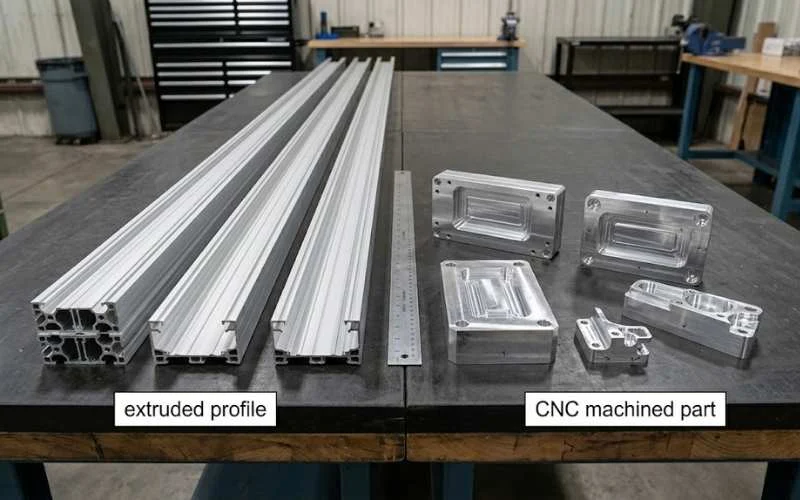
This article settles the cost question — extrusion vs CNC machining at volume. For the hands-on machining process itself, see how to CNC machine aluminum extrusions.
Manufacturers often face a difficult decision when producing aluminum parts: extrusion or CNC machining. The wrong choice can raise unit cost, increase material waste, and slow down production timelines.
If this topic is being reviewed for an OEM project, use the guidance here alongside CNC machining for aluminum pole components. Then check precision aluminum tube manufacturing and send the specification for a factory RFQ, while keeping Aluminum Association material resources available for neutral terminology and standards context.
Many buyers focus only on piece price. But tooling, volume, lead time, and material utilization all influence the real cost. For bulk orders, the difference between extrusion and machining can reach 30–70% in total manufacturing cost.
This guide explains how both processes work, compares their cost structures, and shows when each method makes financial sense for large-volume production.
What Is Aluminum Extrusion
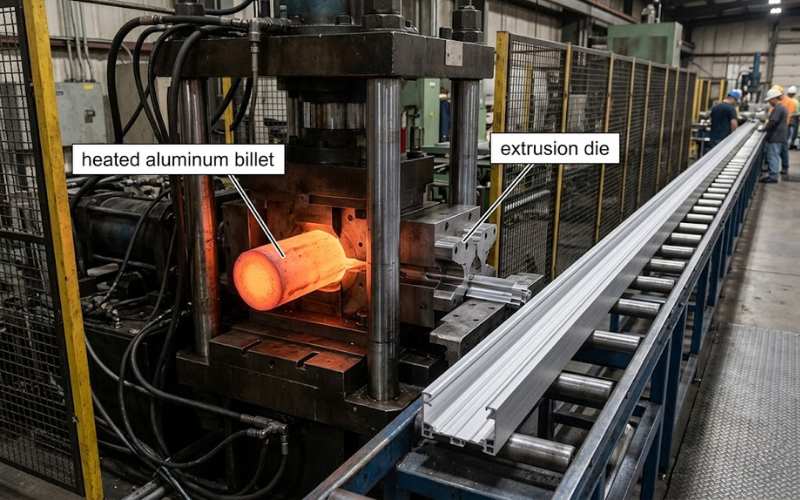
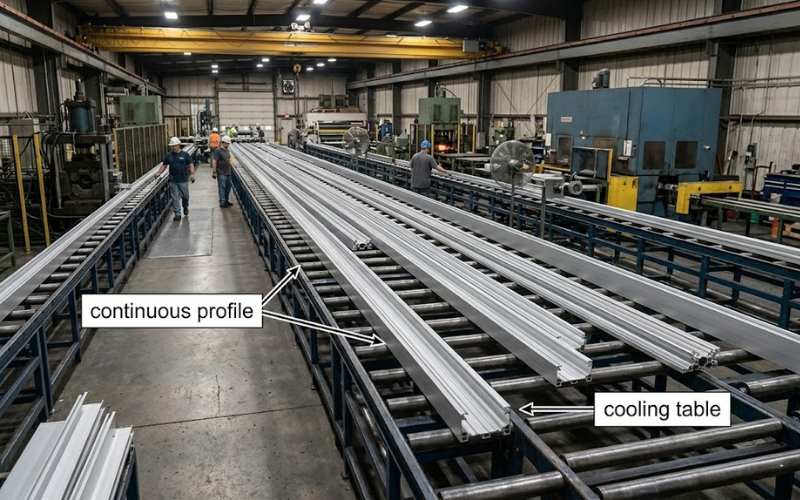
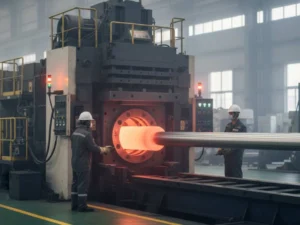
Aluminum extrusion is a manufacturing process where heated aluminum billet is pushed through a shaped die to create a continuous profile with a fixed cross-section.
This process produces long aluminum profiles that can later be cut, drilled, or machined into finished parts.
Key characteristics:
- Aluminum billet is heated and pressed through a steel extrusion die
- The resulting profile maintains the same cross-section along its length
- Parts are usually cut from the continuous extrusion
Common extruded products include:
- telescopic poles
- window and door frames
- aluminum rails and tracks
- structural framing systems
Because extrusion forms the material instead of removing it, material waste remains very low compared with subtractive manufacturing methods.
What Is CNC Machining for Aluminum Parts
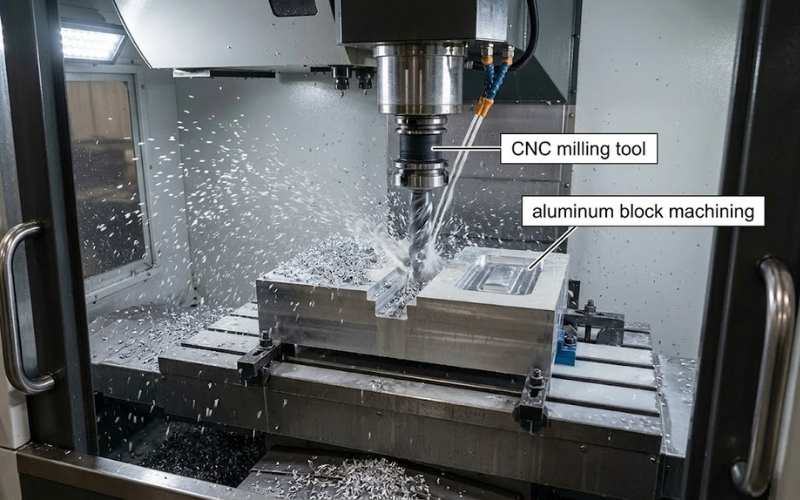
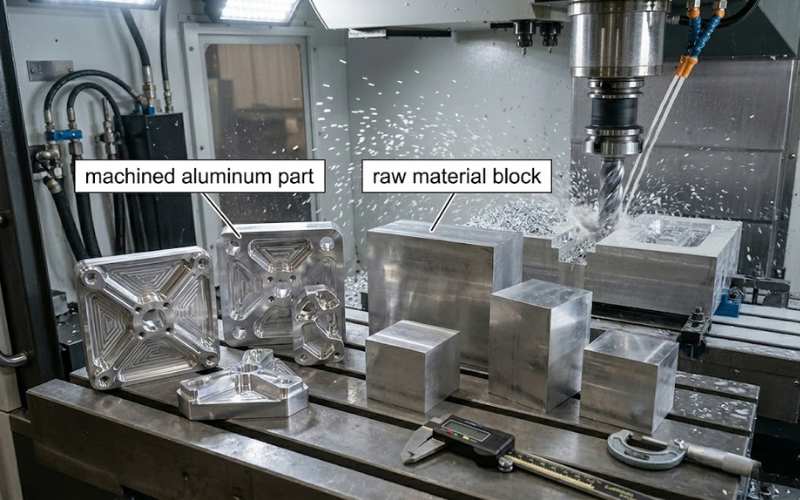
CNC machining is a subtractive manufacturing process that removes material from a solid aluminum block using computer-controlled cutting tools.
Machines such as CNC mills, lathes, and routers shape the part by gradually cutting away excess material.
Key characteristics:
- Computer controlled precision cutting
- Suitable for complex 3D geometries
- No dedicated forming tooling required
- Flexible for low or medium production volumes
Typical CNC-machined aluminum parts include:
- mechanical brackets
- electronic housings
- aerospace components
- precision fixtures
Because machining removes material, scrap rates can reach 30–70% depending on the part design.
Aluminum Extrusion vs CNC Machining: Key Manufacturing Differences

| Feature | Aluminum Extrusion | CNC Machining |
|---|---|---|
| Manufacturing type | Forming process | Subtractive process |
| Tooling requirement | Custom extrusion die | Standard cutting tools |
| Ideal part geometry | Constant cross-section | Complex 3D geometry |
| Material waste | Low | Higher |
| Best production volume | High volume | Low to medium volume |
| Setup cost | Higher initial tooling | Lower initial cost |
In simple terms:
- Extrusion favors high volume production
- Machining favors flexibility and complexity
Understanding this difference is essential for cost planning.
Cost Structure of Aluminum Extrusion
The cost of aluminum extrusion includes three main components.
Extrusion Die Cost
Extrusion requires a custom steel die to shape the aluminum profile.
Typical cost range:
| Profile Complexity | Die Cost |
|---|---|
| Simple shapes | $500 – $1,000 |
| Medium complexity | $1,000 – $2,000 |
| Complex hollow profiles | $2,000 – $3,500 |
Once produced, the die can be reused thousands of times.
According to the Aluminum Extruders Council
https://aec.org/
extrusion dies allow extremely efficient production once tooling is amortized.
Unit Cost in High-Volume Production
After the die is paid for, extrusion becomes highly economical.
Advantages include:
- continuous production of long profiles
- fast cycle times
- minimal machining requirements
Large orders distribute the tooling cost across many parts, lowering the final unit price.
Material Efficiency
Extrusion typically uses 85–95% of the aluminum billet, producing minimal scrap.
This high utilization helps reduce raw material cost.
Cost Structure of CNC Machining
CNC machining cost depends mainly on machine time and material usage.
Machine Time Cost
Industrial CNC machining rates typically range from:
| Machine Type | Hourly Rate |
|---|---|
| Standard 3-axis CNC mill | $50 – $80 / hour |
| 5-axis CNC machining center | $80 – $150 / hour |
These rates vary by region and machine capability.
Programming and Setup
Before machining begins, engineers must:
- program tool paths
- configure fixtures
- set cutting parameters
Programming cost can range from $100–$500 per part design.
Material Waste
Because machining removes material, waste can be significant.
For complex parts:
- raw block weight may be 2–3× the finished part weight
This increases material cost and recycling effort.
The manufacturing resource MIT Machine Shop Guide notes that subtractive processes inherently produce more scrap than forming processes.
https://web.mit.edu/machineshop
Bulk Order Cost Comparison
The real cost difference becomes clear when comparing production volumes.
| Order Quantity | Extrusion Cost Trend | CNC Machining Cost Trend |
|---|---|---|
| 100 pcs | High due to tooling | Lower |
| 1,000 pcs | Competitive | Higher |
| 10,000 pcs | Much lower | Significantly higher |
For example:
- Extruded aluminum pole sections may cost $2–$4 per piece in high volume
- CNC machining the same geometry from solid stock could cost $10–$20 per piece
The break-even point usually appears between 500 and 1,500 units, depending on part complexity.
When Aluminum Extrusion Is More Cost-Effective
Extrusion is usually the better choice when production volume increases.
Situations where extrusion excels:
- Long uniform parts
- High-volume production runs
- Simple or constant cross-section shapes
- Applications requiring lightweight aluminum structures
Typical industries include:
- construction systems
- solar mounting structures
- marine hardware
- pool equipment and telescopic poles
For example, aluminum telescopic poles used in pool cleaning or window washing are commonly produced by extrusion before secondary machining.
When CNC Machining Is the Better Option
CNC machining is preferable when design complexity outweighs volume.
Machining works best for:
- prototype development
- complex 3D shapes
- tight tolerance mechanical components
- small production batches
Industries relying heavily on CNC machining include:
- aerospace manufacturing
- robotics
- medical devices
- precision electronics
Because CNC machines can switch programs quickly, they offer strong flexibility for custom parts.
Design Limitations of Extrusion vs Machining
Extrusion has certain geometric limitations.
Extrusion constraints:
- profile must maintain a consistent cross-section
- extremely thick walls may be difficult
- internal cavities require complex dies
Machining limitations:
- higher material waste
- longer machining times
- increased cost for large parts
According to the Aluminum Association
https://www.aluminum.org
extrusion works best for shapes that remain constant along their length.
Combining Extrusion and CNC Machining
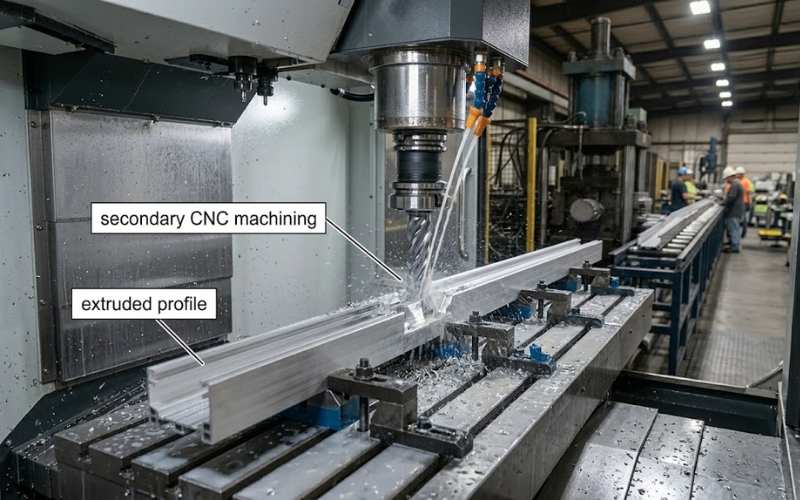
Many manufacturers combine both processes.
Typical workflow:
- Extrude aluminum profile
- Cut profile to length
- CNC machine holes or slots
- Apply surface finishing
This hybrid approach offers several advantages:
- low material waste
- lower machining time
- improved design flexibility
It is widely used for:
- telescopic aluminum poles
- industrial aluminum rails
- equipment frames
!extruded aluminum profile cnc machining drilling operation
Tips for Buyers Sourcing Aluminum Parts from China
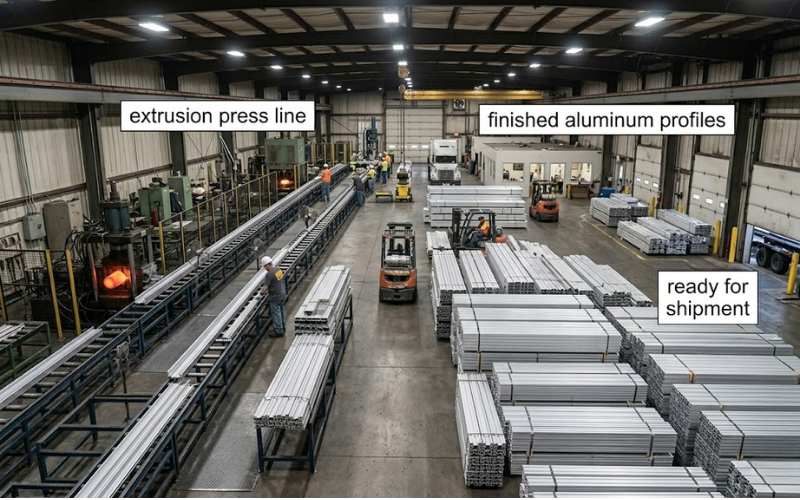
When ordering aluminum parts from overseas suppliers, buyers should verify several factors.
Important checkpoints:
- extrusion press capacity
- die development experience
- CNC secondary machining capability
- anodizing or finishing services
Factories with integrated capabilities can handle both extrusion and machining in a single production flow.
For example, some manufacturers operate multiple extrusion presses and full CNC workshops, enabling them to supply both raw profiles and finished components.
:contentReference[oaicite:0]{index=0}
Integrated production helps reduce logistics cost and lead time for bulk orders.
Making the Right Manufacturing Choice
Choosing between extrusion and CNC machining ultimately depends on three variables:
- production volume
- part geometry
- acceptable tooling investment
Extrusion dominates high-volume production because tooling cost spreads across thousands of units.
CNC machining dominates low-volume manufacturing because it avoids upfront tooling investment.
Understanding this balance allows engineers and procurement teams to choose the most economical manufacturing method.
Discuss Your Aluminum Part Design
If you are planning a bulk aluminum part order, the best approach is often a design review before manufacturing begins.
Engineers can evaluate:
- whether extrusion or machining is more economical
- the expected break-even production volume
- possible design adjustments to reduce cost
Manufacturers with both extrusion and CNC capabilities can help optimize the design for large-scale production.
Contact a qualified aluminum supplier to review your drawings, estimate tooling requirements, and provide a cost comparison for your specific application.
FAQ
Is aluminum extrusion cheaper than CNC machining?
Yes for large production volumes. Once the extrusion die cost is distributed across thousands of units, the per-piece price becomes much lower than CNC machining.
What is the minimum order quantity for aluminum extrusion?
Many suppliers recommend 500–1,000 pieces to justify the extrusion die cost.
Can extruded parts be CNC machined later?
Yes. Many aluminum parts are extruded first and then CNC machined to add holes, slots, or precision features.
Which industries use aluminum extrusion most?
Common industries include construction, renewable energy, transportation, marine equipment, and consumer products.
Related Comparisons & Guides
- Square vs round tubing
- T-slot vs V-slot extrusion
- Custom OEM telescopic poles
Related Guides & Resources
Keep Reading
Anodizing Surface Finishes · CNC Machining · Aluminum Extrusion Profiles · Anodized Aluminum Pool Poles Corrosion Resistance · Anodizing Aluminum Telescopic Poles · Custom Aluminum Extrusion · How To Choose Aluminum Extrusion Manufacturer · How To CNC Machine Aluminum Extrusions · How To Make An Aluminum PCB Enclosure · How To Polish Aluminum · Industrial Aluminum Welding Guide High Strength Telescopic T
Related products: Explore related products and review matching solutions.

 English
  Español
  Français
  Deutsch
  Português