
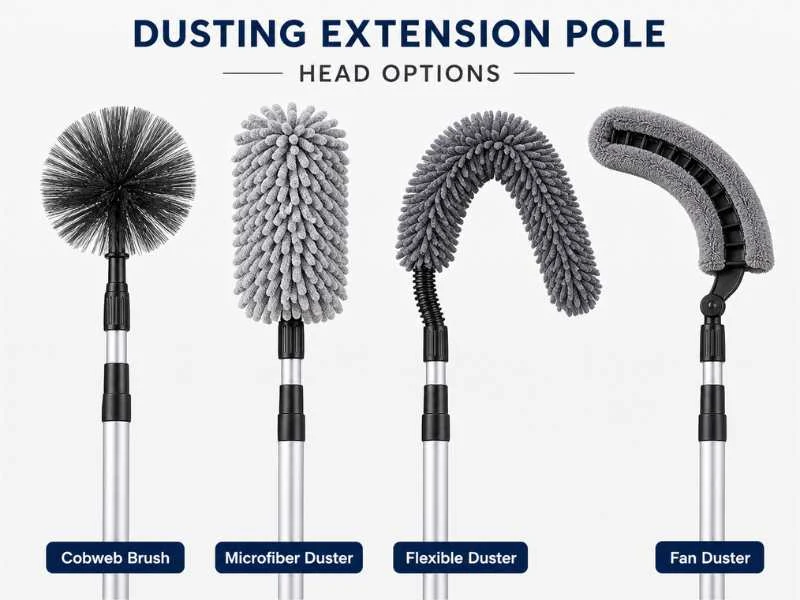
An extension pole for dusting solves this problem by giving users safer reach and better control. For B2B buyers, the pole is not just an aluminum tube. It is a complete system: tube + lock + connector + grip + duster head + finish + packaging. If one part fails, users feel it immediately: the pole slips, the head wobbles, the grip twists, or the package arrives damaged.
What Is an Extension Pole for Dusting?
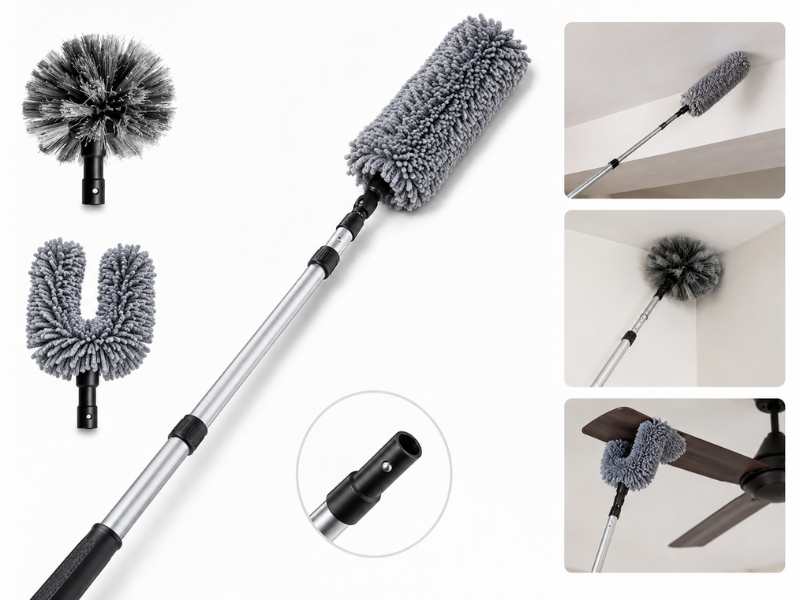
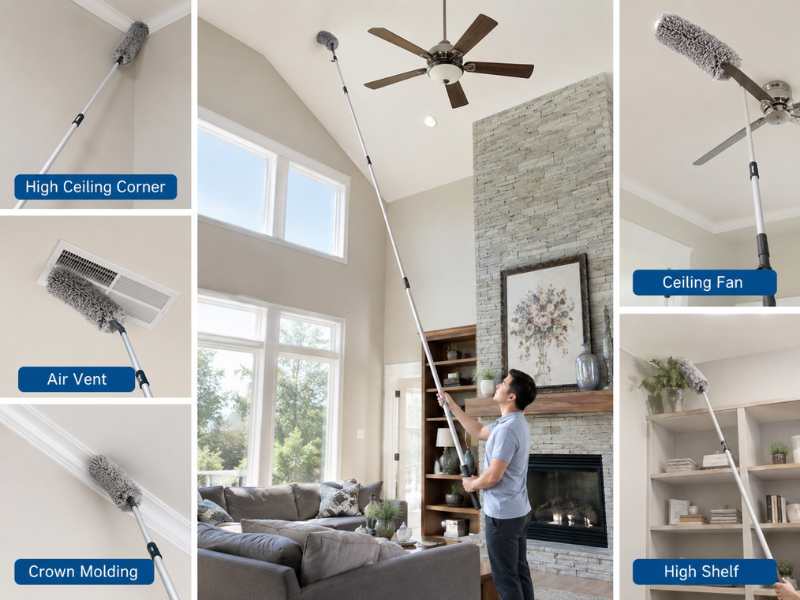
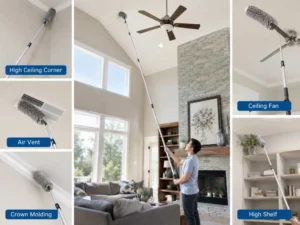
An extension pole for dusting is a telescopic pole that connects to microfiber, cobweb, ceiling fan, or vent duster heads. It helps users clean high ceilings, corners, fans, vents, shelves, and outdoor eaves without frequent ladder use. For OEM buyers, aluminum poles with stable locks and tight connectors offer the best balance of reach, weight, and durability.
A dusting pole is commonly used with:
- Cobweb brush heads
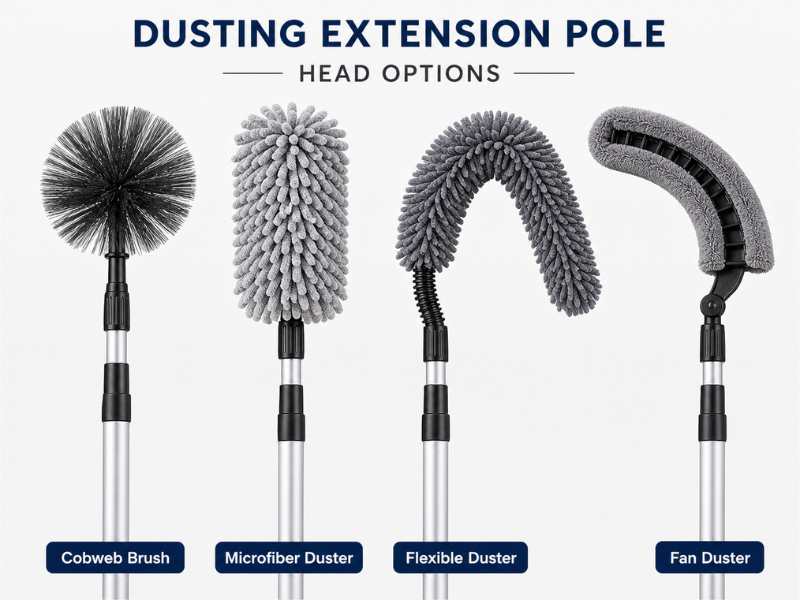
- Microfiber duster heads
- Ceiling fan duster heads
- Flexible bendable dusters
- Vent cleaning brushes
- Window frame cleaning heads
- Multi-purpose cleaning attachments
A dusting pole usually fails as a system, not as one single part. The aluminum tube may be strong, but a loose connector can still ruin the product. The lock may look good, but poor tube tolerance can make it slip. This is why OEM buyers should review the complete kit before sampling.
Where a Dusting Extension Pole Is Used
A good dusting extension pole must match real cleaning zones. Dust and cobwebs collect in high, narrow, and awkward areas where normal hand tools do not work well.
Indoor High Dust Areas
Indoor dust often builds up above eye level. Users may not notice it until light hits the surface or dust falls during cleaning.
Common indoor uses include:
- Ceiling corners
- Ceiling fans
- Crown molding
- Curtain rods
- Air vents
- Return grilles
- Light fixtures
- High shelves
- Cabinet tops
- Bookcases
- Stairwell corners
- Tall interior windows
For indoor cleaning, the duster head should be soft enough for painted walls, fan blades, shelves, and fixtures. Microfiber and soft-bristle cobweb heads work well because they pick up dust without scratching most surfaces.
Outdoor Cobweb and Dust Areas
Outdoor dusting needs more strength. The pole may touch rough walls, porch beams, soffits, exterior window frames, and garage corners.
Common outdoor uses include:
- Eaves
- Soffit edges
- Porches
- Patios
- Exterior window frames
- Garage corners
- Shed corners
- Gutter edges
- Outdoor furniture
- Entryway ceilings
A flat microfiber head may not remove thick outdoor cobwebs well. A round cobweb brush with soft-to-medium bristles gives better contact with corners and uneven surfaces.
Commercial and Facility Cleaning
Commercial users need speed, reach, and repeated-use durability. A cleaner may extend, lock, unlock, and collapse the pole many times in one day.
Typical commercial applications include:
- Hotels
- Schools
- Retail stores
- Offices
- Warehouses
- Gyms
- Clinics
- Property maintenance
- Cleaning service companies
For these users, lock holding force, tube stiffness, connector strength, and replacement head compatibility matter more than a low first price.
Because many users buy a high-reach dusting pole to reduce ladder use, product copy should avoid unsafe claims and stay aligned with general ladder safety principles from OSHA ladder safety resources.
How an Extendable Cobweb Duster Differs From a Basic Dusting Pole
An extendable cobweb duster is made for webs, ceiling corners, eaves, garage edges, and high outdoor dust. It is not the same as a flat microfiber duster.
A cobweb duster usually has:
- A round or dome-shaped brush head
- Fluffy soft bristles or medium-stiff bristles
- A wide contact area for corners
- A threaded or snap-fit connector
- A lightweight telescopic pole
- A non-slip grip for overhead control
A microfiber dusting pole works better on shelves, blinds, vents, and furniture tops. A cobweb brush works better in corners, porches, garages, and exterior eaves.
| Comparison Point | Cobweb Duster With Extension Pole | Microfiber Duster Extension Pole |
|---|---|---|
| Best For | Cobwebs, corners, eaves, garages | Fine dust, shelves, vents, blinds |
| Head Shape | Round, dome, or fluffy brush | Flat, flexible, or sleeve-style head |
| Surface Contact | Good for uneven corners | Good for smooth surfaces |
| Indoor Use | Ceiling corners and high edges | Furniture tops, vents, shelves |
| Outdoor Use | Porches, eaves, garage corners | Light exterior dust only |
| Pole Stress | Higher drag on rough areas | Lower drag on smooth surfaces |
| OEM Notes | Needs strong connector and stable lock | Needs washable microfiber and good head fit |
For retail kits, many brands combine both heads in one package. A microfiber head covers indoor fine dust, while a cobweb brush covers corners and outdoor eaves. This increases product value, but it also requires stronger packaging and clearer instructions.
A large fluffy brush creates more drag when it touches a rough corner. If the pole is too thin, the head shakes. If the connector is loose, the brush twists during cleaning. For OEM products, the head and pole must be designed together.
Why Aluminum Works Well for a Telescopic Duster Pole
Aluminum is often the best material for a telescopic duster pole because it gives users reach without too much weight.
Plastic can work for short, low-price dusters. But once the pole extends beyond 8–10 ft, many plastic designs lose control and bend more easily.
Steel may look stronger in a spec sheet, but users feel the weight during overhead work. A heavy pole makes ceiling dusting tiring, especially with a brush head attached.
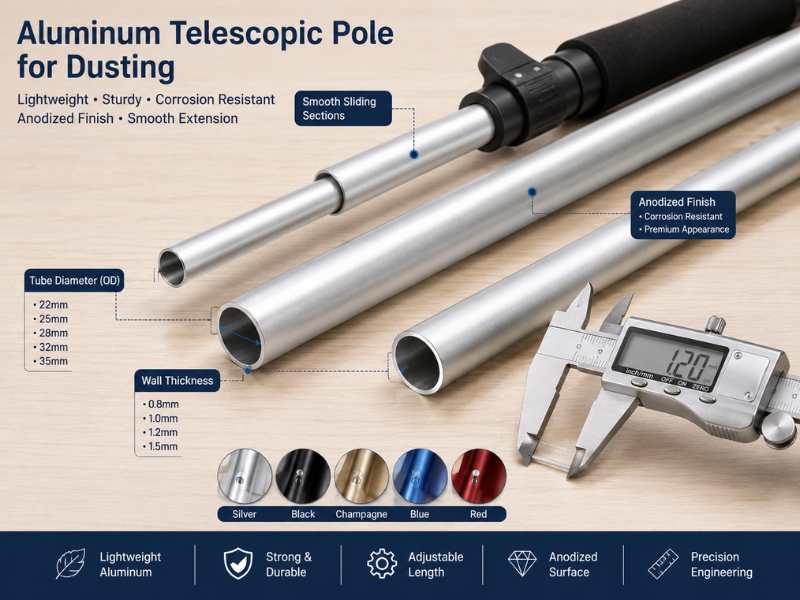
Aluminum gives a better balance:
- Light enough for overhead use
- Stiff enough for longer reach
- Suitable for telescopic tube structures
- Good appearance after anodizing
- Better corrosion resistance than raw steel
- Custom color options
- Compatible with plastic locks, connectors, and grips
- Practical for retail and OEM production
Aluminum is not automatically better. It still needs the right tube diameter, wall thickness, tube overlap, and lock fit. A poorly designed aluminum pole can still bend, wobble, or slip.
For dusting poles, buyers usually care less about alloy names and more about finished performance. Still, common aluminum alloy options such as 6061, 6063, or similar extrusion-grade alloys can be selected based on stiffness, surface finish, cost, and forming needs. Xingyong commonly works with aluminum alloy grades such as 6061, 6005, 6063, 7075, and 6003 for custom aluminum pole projects.
How Long Should a High-Reach Dusting Pole Be?
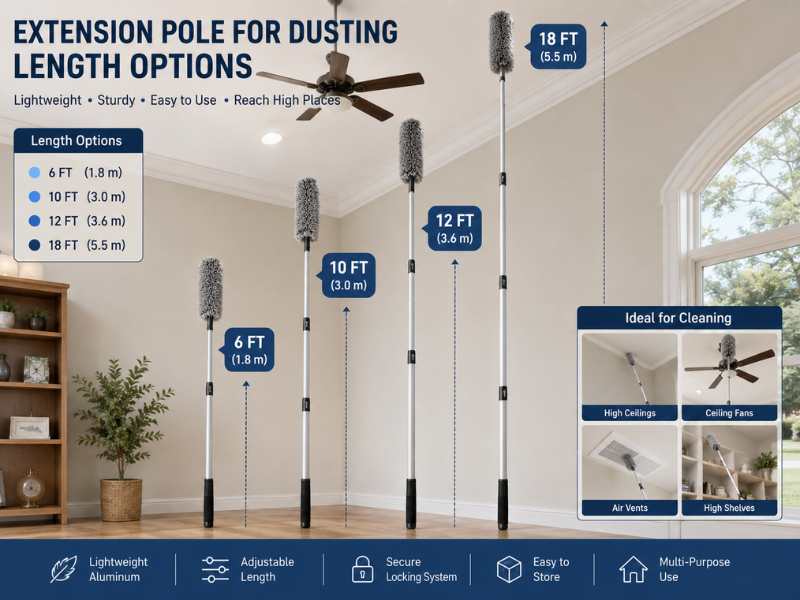
The right length depends on ceiling height, cleaning area, user height, head weight, and storage needs. Longer reach sounds better, but it can create control problems if the pole is not designed well.
When a pole extends farther, the tip moves more. A small amount of looseness near the lock or connector becomes much larger at the head. This is why a 20 ft pole needs better tube stiffness than a 6 ft pole.
| Pole Length | Typical Use | Best Application | Design Requirement |
|---|---|---|---|
| 3–6 ft | Low to medium reach | Shelves, vents, furniture tops | Light tube, simple lock, compact packaging |
| 6–10 ft | Standard home reach | Ceiling corners, fans, tall cabinets | Good choice for general retail kits |
| 8–12 ft | Higher home reach | Stairwells, high ceilings, curtain rods | Better lock fit and tube overlap needed |
| 12–18 ft | High reach cleaning | Large rooms, exterior frames, facility cleaning | Stronger tube and lock design required |
| 18–30 ft | Extra high reach | Outdoor eaves, warehouses, tall halls | Light cobweb contact only; test full-extension stability |
For normal home products, 6–12 ft often works well. For outdoor cobweb removal or commercial cleaning, 12–18 ft may be more useful.
For 18–30 ft products, buyers should define whether the tool is for light cobweb contact only. Heavy brushing, wet cleaning, or fan pressure at this length can make the pole hard to control.
Collapsed length also matters. It affects:
- Retail shelf size
- E-commerce shipping cost
- User storage
- Carton length
- Container loading
- Packaging strength
For example, a 12 ft pole with 3 sections may pack shorter than a 2-section pole. That helps shipping and storage. But the extra section can increase cost and reduce stiffness if tube overlap is not controlled.
Recommended Dusting Extension Pole Specs by Application
| Application | Suggested Length | Head Type | Lock Type | Tube Requirement | Buyer Notes |
|---|---|---|---|---|---|
| Home ceiling dusting | 6–10 ft | Microfiber or cobweb head | Twist lock or flip lock | Light aluminum tube with smooth sliding | Good for retail starter kits |
| Ceiling fan cleaning | 6–12 ft | Curved fan duster | Flip lock or twist lock | Increased tube overlap for side pressure | Head weight must stay low |
| Outdoor cobweb removal | 8–18 ft | Round cobweb brush | Flip lock or clamp lock | Larger OD or thicker wall for outdoor drag | Connector must resist twisting |
| Stairwell cleaning | 8–12 ft | Flexible microfiber duster | Twist lock or flip lock | Smooth movement with stable lock fit | Short collapsed length helps storage |
| Commercial cleaning | 12–18 ft | Replaceable heads | Clamp lock or strong flip lock | Thicker wall and stable tube overlap | Test repeated extension cycles |
| E-commerce kit | 6–12 ft | Multi-head kit | Twist lock or flip lock | Compact collapsed length with enough overlap | Strong mailer packaging needed |
| Supermarket retail kit | 6–10 ft | Cobweb or microfiber head | Simple visible lock | Consistent surface finish | Clear packaging and barcode placement |
This table prevents a common mistake: choosing one pole design for every cleaning task. A ceiling fan duster, outdoor cobweb brush, and flexible gap duster do not create the same load on the pole.
Choose the Right Duster Head
A dusting pole depends on the head. The head decides what the tool can clean, how much pressure the user applies, and how much wobble the pole must handle.
Head weight affects pole control more than many buyers expect. A heavy brush head may feel fine on a short pole, but it can make a 12–18 ft pole shake or feel top-heavy. During sampling, always test the pole with the final duster head, not a lighter substitute.
Cobweb Brush Head
A cobweb brush head is designed for corners, eaves, garages, sheds, porches, and outdoor webs.
Good cobweb brush heads often use:
- Round brush shape
- Fluffy soft bristles
- Medium-stiff bristles for outdoor use
- Large contact surface
- Rinse-clean design
- Threaded connector
Soft bristles reduce scratch risk indoors. Medium-stiff bristles remove heavier webs better outdoors.
Microfiber Duster Head
A microfiber duster head is better for fine dust. It works well on smoother surfaces and indoor areas.
Common uses include:
- Shelves
- Vents
- Blinds
- Light fixtures
- Cabinet tops
- Furniture tops
- Interior window frames
Microfiber traps dust better than many feather dusters. A washable microfiber head also improves repeat use and lowers replacement cost.
For indoor dust-sensitive spaces, cleaning tools can work together with air control. The EPA guide to air cleaners in the home explains how air cleaners can help reduce airborne particles, but surface dust still needs direct removal.
Ceiling Fan Duster Head
A ceiling fan duster should clean broad flat blades without forcing users onto ladders.
Common fan duster designs include:
- Curved microfiber head
- Split head that wraps around blades
- Wide flat pad
- Flexible bendable head
Ceiling fan cleaning creates side pressure. This makes pole stiffness important. If the pole is too thin, the user feels shaking at full extension.
Flexible Bendable Duster Head
A flexible duster head works for cabinet gaps, tall shelves, narrow spaces, and irregular surfaces.
OEM buyers should check:
- Bendable wire strength
- Shape retention
- Microfiber sleeve quality
- Sleeve removal method
- Connector fit
- Replacement head plan
A bendable head can improve product value, but only if the connector stays tight after repeated bending and twisting.
Locking System Options for Dusting Extension Poles
The lock controls user confidence. If the pole slips during overhead cleaning, the product feels unsafe.
A lock does not work alone. It depends on tube OD, tube roundness, wall thickness, surface finish, and section overlap. If the aluminum tube tolerance is unstable, even a good lock design may slip or feel rough.
| Lock Type | How It Works | Strength | Best Use | OEM Notes |
|---|---|---|---|---|
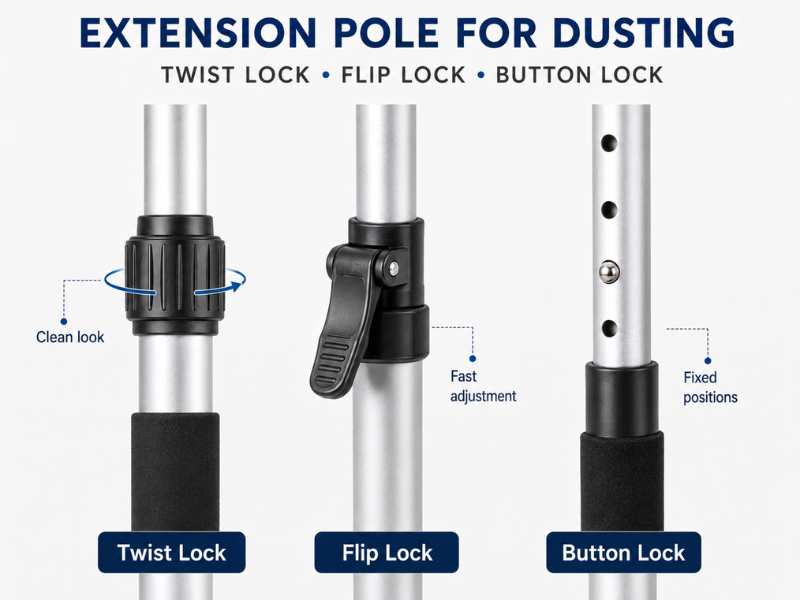
| Twist Lock | Inner and outer sections tighten by twisting | Clean look and simple structure | Home dusters and compact designs | Needs precise tube fit |
| Flip Lock | External lever clamps the tube | Fast and easy adjustment | Retail dusting kits | Plastic quality and clamp force matter |
| Button Lock | Spring button fixes set positions | Clear position control | Short to medium poles | Less flexible length adjustment |
| Clamp Lock | Strong external clamping force | High holding power | Longer and professional poles | Adds bulk but improves grip |
| Friction Lock | Holds by tube friction | Low cost | Short low-price poles | Not ideal for long reach |
A twist lock can look clean and simple. A flip lock is easier for many retail users because they can see whether it is locked. A button lock gives fixed length positions but less flexible adjustment.
For OEM projects, the lock should be developed together with the aluminum tube, not selected after the tube is finished. Tube tolerance, lock material, and section overlap must work as one system.
For sample testing, buyers can lock and unlock each section 50–100 times, then test whether the pole still holds under light side pressure.
Connector Design Matters More Than Buyers Think
The connector is small, but it controls the duster head. A loose connector makes the head wobble. At full extension, even a little wobble feels much worse.
A strong aluminum telescopic cleaning pole needs a connector that matches the head, thread, and expected cleaning pressure.
Common connector options include:
- Universal threaded tip
- Custom plastic connector
- Snap-on connector
- Angle-adjustable connector
- Multi-head adapter
- Fixed molded connector
- Removable accessory adapter
Buyers should confirm:
- Thread size
- Thread depth
- Plastic material
- Insert length
- Torque resistance
- Head replacement design
- Fit with standard cleaning heads
- Fit with private-label accessories
- Assembly strength between plastic and aluminum
Angle-adjustable connectors add function, but they also add a failure point. If the joint is weak, the head may fold or rotate when cleaning fan blades or outdoor corners.
This is where many low-cost poles lose user trust. The tube may look acceptable, but the head shakes, loosens, or rotates during use.
For brands that sell replacement heads, connector compatibility is also a sales opportunity. A reliable thread system can support microfiber heads, cobweb brushes, fan dusters, and future accessory kits.
Xingyong’s advantage is that it can support both aluminum telescopic tube production and matching plastic connection parts. This helps control fit between the tube, lock, connector, and final cleaning tool assembly.
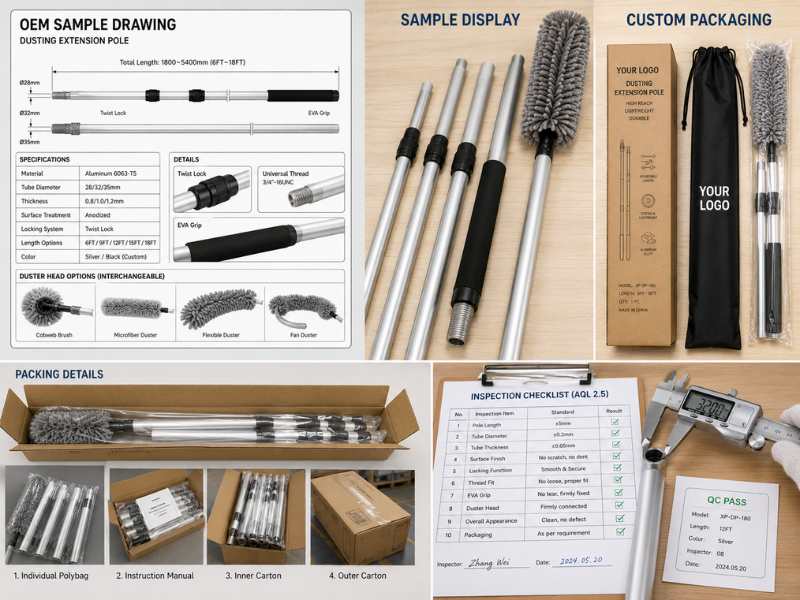
OEM Specification Checklist for an Extension Pole for Dusting
Before requesting a quote, prepare a clear specification sheet. This reduces sample changes and avoids hidden cost issues.
| Specification Item | What to Confirm |
|---|---|
| Product Type | Cobweb duster, microfiber duster, fan duster, or full kit |
| Extended Length | Total usable pole length |
| Collapsed Length | Storage, packaging, and shelf display size |
| Pole Sections | 2-section, 3-section, 4-section, or custom |
| Tube Diameter | OD and matching inner tube design |
| Wall Thickness | Strength, weight, and cost balance |
| Aluminum Grade | Based on strength, cost, and finish requirement |
| Lock Type | Twist lock, flip lock, button lock, or clamp lock |
| Duster Head | Bristle, microfiber, flexible, fan, or mixed heads |
| Connector | Thread size, plastic material, and replacement design |
| Grip | Foam, rubber, TPR, plastic, or custom handle |
| Surface Finish | Anodized, sandblasted, brushed, printed, or custom |
| Color | Silver, black, blue, red, champagne, or brand color |
| Logo | Laser marking, printing, label, or packaging logo |
| Packaging | Hang tag, color box, mailer box, display box, bulk carton |
| Testing | Lock force, tube fit, surface check, assembled product test |
| MOQ | Based on finish, custom parts, packaging, and assembly |
| Lead Time | Sampling, tooling, pilot run, and mass production |
| Target Market | Retail, e-commerce, supermarket, cleaning service, or distributor |
A clear sheet helps the buyer compare quotations fairly. One supplier may quote only the pole. Another may include the head, connector, grip, logo, retail packaging, and final assembly.
Common Mistakes When Buying Dusting Extension Poles
Many problems start with a quote that looks too good. A low unit price may hide weak locks, thin tubes, loose connectors, or poor packaging.
Avoid these mistakes:
- Choosing the longest pole without checking stiffness
- Using a heavy head on a thin pole
- Ignoring tube wall thickness
- Ignoring lock holding force
- Choosing weak plastic connectors
- Not checking thread compatibility
- Approving samples without full-extension testing
- Testing the pole without the final duster head
- Ignoring collapsed length and carton size
- Choosing packaging that cannot protect the pole
- Not confirming replacement head fit
A longer pole is not better if the head feels uncontrolled. The connector is where many low-cost dusting poles lose user trust. Sampling should test the final kit, not only the aluminum tube.
FAQ
What is an extension pole for dusting used for?
An extension pole for dusting is used to clean high ceilings, ceiling fans, air vents, shelves, crown molding, stairwell corners, garage edges, outdoor eaves, and cobweb areas. It connects to different duster heads so users can reach high areas without frequent ladder use.
What is the best material for a dusting extension pole?
Aluminum is usually the best material for a dusting extension pole because it keeps the pole light enough for overhead work while giving better stiffness than plastic at longer lengths. For OEM buyers, aluminum also supports anodized colors, custom tube diameters, wall thickness control, and stable matching with plastic locks and duster head connectors.
How long should a telescopic duster pole be?
For normal home use, a 6–12 ft telescopic duster pole works for many ceiling corners, fans, vents, shelves, and cabinet tops. For high ceilings, stairwells, outdoor eaves, garages, or commercial spaces, 12–18 ft or longer may be needed. The longer the pole, the more important tube stiffness and lock strength become.
What makes a dusting pole feel stable at full extension?
Full-extension stability depends on tube diameter, wall thickness, tube overlap, tube roundness, lock holding force, connector fit, and duster head weight. A pole can use aluminum and still feel unstable if the tube is too thin or the connector is loose.
Is a twist lock or flip lock better for a dusting pole?
A twist lock gives a clean appearance and works well for simple home dusters. A flip lock is faster to adjust and easier for many retail users to understand. For long dusting poles, the lock name matters less than the actual holding force, tube fit, and repeated-use stability.
Can one telescopic pole fit different duster heads?
Yes. One telescopic pole can fit different duster heads if the connector and thread standard match the accessory system. OEM buyers should confirm thread size, plastic material, insert depth, torque strength, and replacement head compatibility before production.
Build Your Custom Dusting Extension Pole With Xingyong
If you are developing a cobweb duster, microfiber duster, ceiling fan cleaner, high-reach cleaning kit, or private-label dusting tool, Xingyong can help turn your idea into a manufacturable OEM product.
To start a custom dusting extension pole project, send Xingyong your target length, collapsed size, tube diameter, wall thickness, lock type, head connector, duster head sample, color, logo method, packaging style, target market, MOQ plan, and expected lead time.
We can help check whether your target length, lock structure, duster head, and packaging plan are practical before opening tooling or placing mass orders.
Related Guides & Resources
Related products: Explore related products and review matching solutions.



 English
  Español
  Français
  Deutsch
  Português