A sourcing manager approves an aluminum extension pole for solar panel cleaning because the sample looks straight, bright, and affordable. Then the first container reaches the distributor. Installers report three problems: the pole bends when the water-fed brush is attached, the twist lock slips with wet hands, and the threaded tip does not match the existing brush adapter.
To make the article actionable, convert the key takeaway into an RFQ line item, compare it against aluminum extension pole programs, and use custom aluminum telescopic poles for the production route. For external technical context, use Aluminum Association material resources.
The supplier blames the brush. The distributor blames the pole. The buyer pays for replacement parts.
This guide helps OEM buyers prevent that problem before mass production. You will learn how to specify aluminum tube structure, lock design, connector fit, surface finish, water-fed options, sample testing, packaging, MOQ, quotation details, and supplier capability.
What Is an Aluminum Extension Pole for Solar Panel Cleaning?
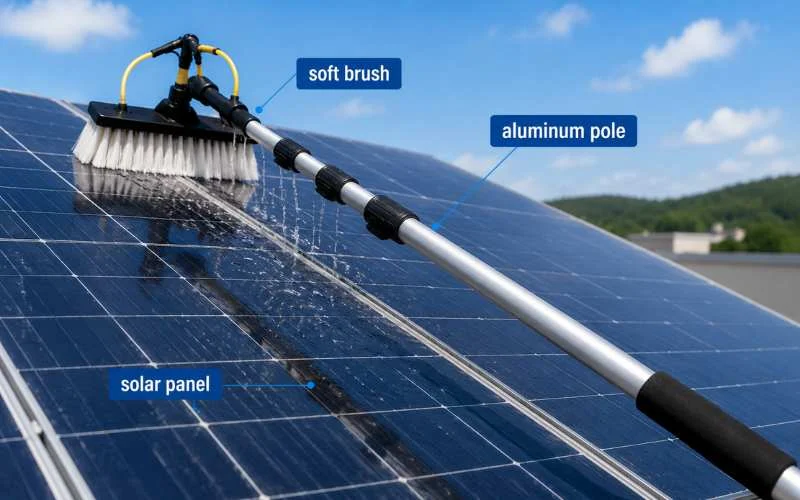
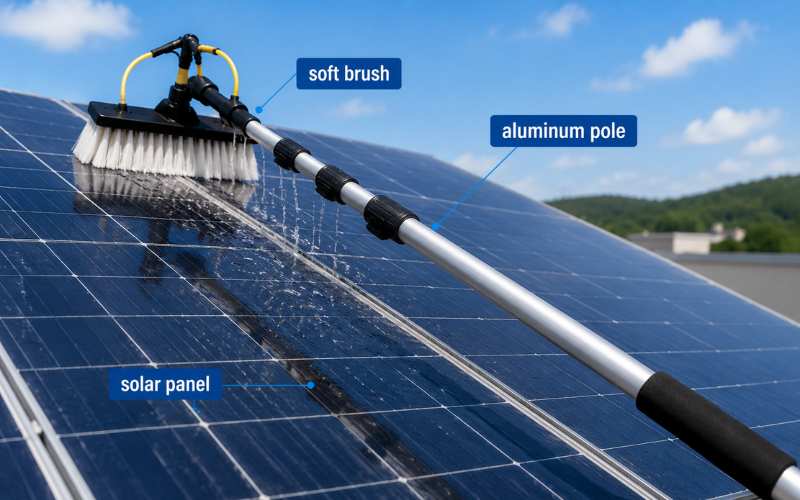
An aluminum solar panel cleaning pole is a telescopic aluminum handle that connects to soft brushes, squeegees, angle adapters, or water-fed brush heads. It lets users clean solar panels from a safer working distance while OEM buyers control length, alloy, lock type, connector, finish, and packaging.
The pole can be used for rooftop panels, solar carports, ground-mounted solar arrays, and low-rise commercial PV systems. It may work as a dry brush pole, a flow-through brush pole, or a water-fed aluminum extension pole.
Solar photovoltaic panels convert sunlight into electricity. Dirt, pollen, bird droppings, and other deposits can reduce light reaching the panel surface. The U.S. Department of Energy explains how photovoltaic technology converts sunlight into electricity, while NREL research discusses how PV module soiling can reduce energy output by lowering light transmission. solar photovoltaic technology basics PV module soiling and energy loss
For OEM sourcing, the pole is only one part of the SKU. A complete solar panel cleaning pole kit may include:
- Aluminum telescopic pole
- Soft bristle brush
- Angle adapter
- Threaded tip or snap connector
- External or internal hose
- Water connector
- Grip sleeve
- Logo and label
- Retail carton or export carton
- Instruction sheet
- Spare lock parts
If one part fails, the full kit fails.
Why OEM Buyers Still Choose Aluminum Instead of Carbon Fiber
For OEM buyers, material choice is not a lab contest. It is a channel decision. A carbon fiber pole may win in weight and stiffness, but a retail buyer also needs to control price band, carton size, replacement parts, color consistency, and repeat order cost. In that situation, aluminum often becomes the more practical commercial material.
Aluminum works especially well for mid-reach, retail, distributor, and private-label solar panel cleaning pole programs. It offers stable production cost, clean surface finish, strong branding options, and easier tube customization.
| Material | Best Use Case | Main Strength | Main Limitation | OEM Buying Decision |
|---|---|---|---|---|
| Aluminum | Retail kits, distributor SKUs, mid-reach solar panel cleaning | Cost control, anodized finish, tube customization | Heavier than carbon fiber at long reach | Strong fit for private-label volume orders |
| Carbon fiber | Long high-reach professional cleaning | Light weight and high stiffness | Higher cost | Better for premium contractor systems |
| Fiberglass | Certain electrical safety-sensitive tools | Non-conductive material properties | Can feel heavy or less premium | Needs careful stiffness and wear checks |
Aluminum gives OEM buyers practical production advantages:
- Stable extrusion cost for volume orders
- Easy anodizing in private-label colors
- Clean appearance for retail tools
- Easy cutting, drilling, punching, swaging, and laser marking
- Better replacement part standardization
- Strong fit for mass-market solar cleaning kits
- Easier control over tube diameter, wall thickness, and section design
For a 12 ft, 18 ft, or 24 ft solar panel cleaning pole sold through distributors or retail channels, aluminum can deliver a better business result than a premium material that pushes the SKU above the target price.
Xingyong has produced aluminum products since 2010. Its factory supports OEM aluminum extension pole programs with 14 aluminum extrusion presses, automatic anodizing lines, CNC and finishing equipment, inspection instruments, and 3,000 tons of monthly production capacity.
That matters because buyers can control the pole from aluminum tube design to finished carton, instead of managing several disconnected subcontractors.
OEM Specification Table for Solar Panel Cleaning Poles
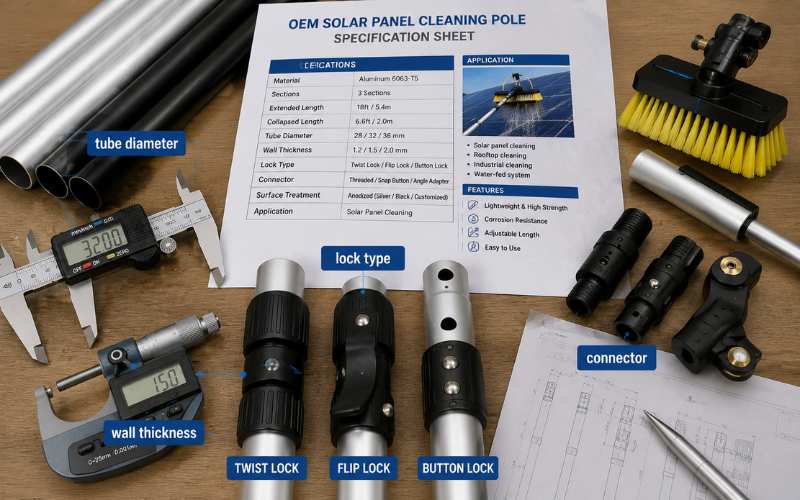
A good OEM solar panel cleaning pole should be specified by structure, not only by length. Buyers should confirm the extended length, collapsed length, tube diameter, wall thickness, alloy, section count, lock type, connector, grip, surface finish, brush load, and packaging.
| Specification | OEM Decision | Risk If Ignored | QC Method |
|---|---|---|---|
| Extended length | 8 ft, 12 ft, 18 ft, 24 ft, 30 ft + | Pole may be too short or too weak when extended | Full extension test with brush attached |
| Collapsed length | Match carton and storage needs | Carton becomes too long or shipping cost rises | Measure sample and carton size |
| Tube diameter | Match stiffness and user grip | Pole feels weak or too bulky | Caliper check and bending test |
| Wall thickness | Match length and brush load | Tube bends under wet brush pressure | Wall thickness measurement |
| Alloy | 6063, 6061, or custom aluminum grade | Wrong balance of strength, finish, and cost | Alloy verification |
| Section count | 2, 3, 4, or 5 sections | Too many locks or poor compact size | Assembly and cycle test |
| Lock type | Twist, flip, or button lock | Lock slipping and high return rate | Wet-hand pull test |
| Connector | Threaded tip, snap button, angle adapter, water-fed connector | Brush wobble or poor accessory fit | Test with actual brush and adapter |
| Surface finish | Clear anodized, color anodized, brushed, powder coated | Scratches, color mismatch, corrosion complaints | Coating thickness and color check |
| Grip | EVA, PVC, rubber, or textured aluminum | Poor wet-hand control | Grip adhesion and comfort test |
| Packaging | Retail box, mail-order carton, master carton | Shipping damage and retailer rejection | Carton drop and end-impact check |
Do not approve an aluminum extension pole sample only by appearance. A bright anodized surface does not prove the pole can handle a wet brush, repeated locking, outdoor use, or long-distance shipping.
For many OEM programs:
- 6–8 ft works for compact home kits and ground-mounted solar panels.
- 10–12 ft works for basic residential kits.
- 15–18 ft works for mid-range retail SKUs.
- 20–24 ft works for distributors and light commercial cleaning.
- 30 ft+ needs careful testing because aluminum weight and bending become more serious.
Best Aluminum Alloy and Tube Design
The right aluminum alloy depends on pole length, brush load, surface finish, and target price. Most OEM buyers compare 6063, 6061, and 6005 aluminum.
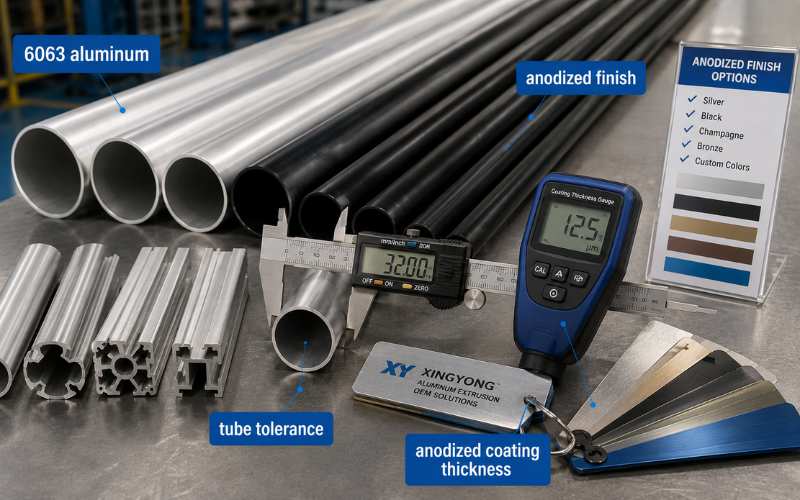
6063 aluminum is common for extruded aluminum tubes. It gives a clean surface and works well with anodizing. It suits many retail and distributor aluminum telescopic pole programs where appearance, cost control, and corrosion resistance matter.
6061 aluminum offers stronger mechanical performance in many applications. It may suit heavier-duty poles, thicker tube walls, or longer cleaning tools. Procurement teams should confirm finish quality, cost, and tolerance before choosing it for a private-label cleaning pole.
6005 aluminum can fit certain structural tube designs. It may work when the pole needs a stronger section profile, but the final choice should be based on testing, not only alloy name.
| Alloy | Buying Reason | Best Fit | Watch Point |
|---|---|---|---|
| 6063 | Good surface finish and anodizing quality | Retail aluminum solar cleaning poles | Confirm wall thickness for longer poles |
| 6061 | Higher strength potential | Heavy-duty or longer OEM pole programs | Check cost and finish consistency |
| 6005 | Structural profile use | Custom tube sections | Confirm extrusion and lock fit |
Tube design also affects stiffness. A larger tube diameter can improve stability, but it increases weight and carton size. A thicker wall can reduce bending, but it raises material cost. Oval, ribbed, or fluted tubes may improve grip or anti-rotation performance, but they need correct lock design.
Buyers developing a broader aluminum telescopic pole platform can standardize tube sections across solar cleaning, pool cleaning, window cleaning, and general outdoor cleaning tools.
Xingyong’s 14 extrusion presses range from 350T to 2000T. This helps buyers develop different tube diameters, wall thicknesses, and custom sections for multi-SKU cleaning pole lines.
Xingyong Recommended OEM Configurations
The right configuration depends on market level, brush type, and target price. The table below gives practical starting points for OEM buyers. Final specs should still be tested with the buyer’s actual brush and packaging plan.
| Buyer Goal | Suggested Pole Setup | Why It Works |
|---|---|---|
| Entry retail kit | 8–12 ft aluminum pole, twist lock, threaded tip, clear anodized finish | Controls cost and keeps assembly simple |
| Mid-range distributor kit | 12–18 ft pole, stronger wall, angle adapter, soft grip | Improves reach and user control |
| Water-fed solar cleaning kit | 18–24 ft pole, external hose clips, flow-through brush connector | Easier repair and field use |
| Private-label premium kit | Color anodized tube, custom grip, logo marking, retail carton | Improves shelf identity and repeat orders |
| Contractor supply kit | 20–24 ft pole, flip lock, reinforced connector, spare lock parts | Supports frequent adjustment and replacement needs |
These configurations help buyers avoid overbuilding the wrong product. A low-cost retail kit does not need every premium feature. A contractor kit should not use the weakest lock only to save a few cents. A private-label program must protect color, logo, packaging, and repeat order consistency.
Xingyong’s extrusion, anodizing, machining, laser marking, and inspection setup allows buyers to tune each configuration by length, wall thickness, lock system, finish, and carton plan.
Locking Systems: Twist Lock, Flip Lock, and Button Lock
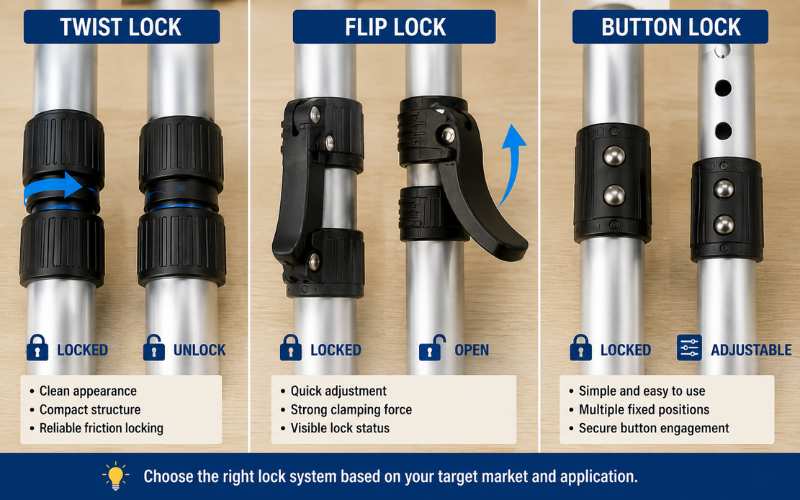
The lock decides whether the aluminum extension pole for solar panel cleaning feels safe, stable, and easy to adjust. Solar cleaning adds extra stress because users often work with water, dust, wet hands, angled brushes, and extended pole sections.
A twist lock uses internal friction. It gives a clean outer appearance and compact structure. It is common for retail cleaning poles, but it must be tested for slip after repeated extension and water exposure.
A flip lock uses an external lever clamp. Users can see whether the lock is open or closed. It adjusts quickly and suits frequent use. The buyer should test lever strength, clamp force, and replacement part availability.
A button lock uses spring buttons and fixed holes. It is simple and easy to understand. It works well for fixed-position poles, but it gives less adjustment freedom.
| Lock Type | Best For | Wet-Hand Use | Replacement Part Complexity | Return Risk | QC Test |
|---|---|---|---|---|---|
| Twist lock | Retail solar cleaning kits | Medium | Medium | Slipping if tolerance is poor | Pull test, torque test, cycle test |
| Flip lock | Professional or distributor poles | Good | Higher | Lever damage if over-tightened | Clamp force and lever fatigue test |
| Button lock | Simple fixed-length poles | Good | Low | Hole misalignment or spring failure | Button cycle and alignment test |
For OEM buyers, lock choice should match the buyer channel. A low-cost retail pole may need simple operation. A distributor pole may need spare locks. A professional cleaning pole may need faster adjustment and stronger visible clamping.
Connector and Brush Compatibility
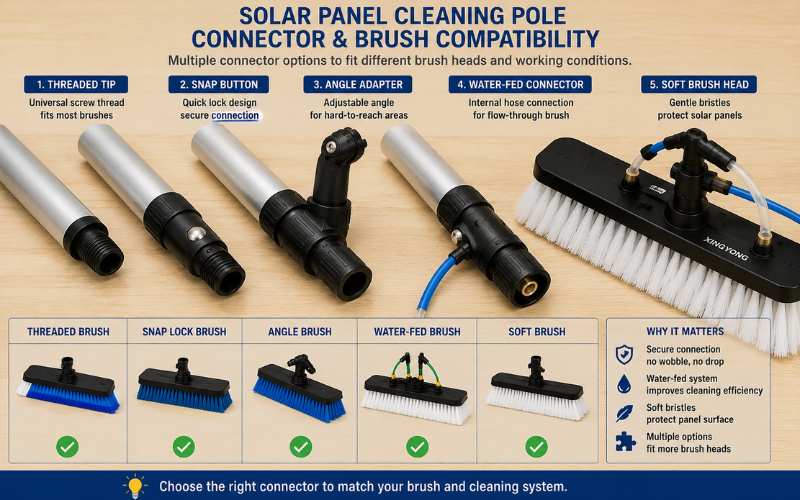
A solar panel cleaning brush pole must fit the cleaning head correctly. This is one of the most common OEM failure points.
The pole may look correct, but the brush may wobble, thread poorly, sit at the wrong angle, leak water, or detach during use. One wrong connector can create returns across the full SKU.
Common connector options include:
- Threaded connector
- Snap button connector
- Tapered adapter
- Universal tool tip
- Angle adapter
- Water-fed connector
- Flow-through brush connection
| Connector Type | Best Use | OEM Buying Risk | Approval Test |
|---|---|---|---|
| Threaded tip | Brushes, squeegees, angle adapters | Wrong thread size | Test with real brush |
| Snap button connector | Fast accessory change | Button position mismatch | Assembly and pull test |
| Tapered adapter | Universal cleaning tools | May loosen under side pressure | Side-load test |
| Angle adapter | Tilted solar panels | Joint may slip | Brush angle holding test |
| Water-fed connector | Flow-through brush heads | Leakage or hose mismatch | Water pressure and seal test |
If your product line includes a water-fed extension pole, test the hose route, connector seal, and brush weight before confirming the tube wall.
Buyers should send the brush, adapter, thread standard, and hose connection to the pole manufacturer during sample development. Do not approve the pole and brush separately. Test the full assembly.
Water-Fed Design: Internal Hose or External Hose?
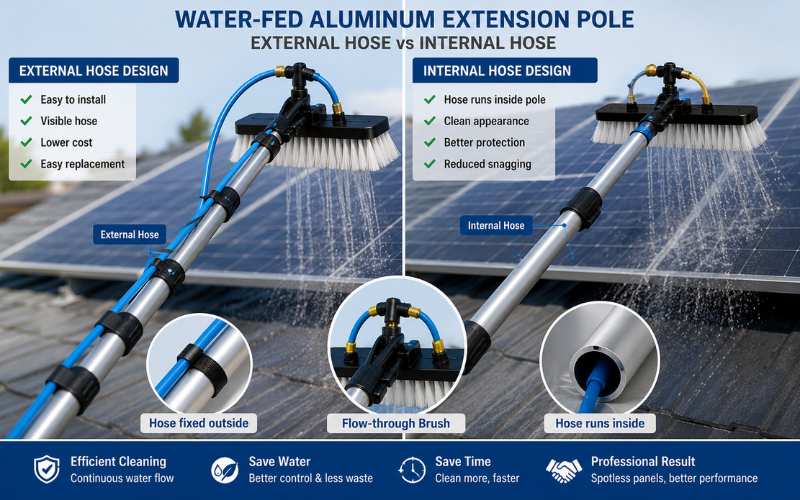
A water-fed aluminum extension pole sends water to the brush head while the user cleans. This can improve cleaning speed and reduce separate rinsing work. It is useful for solar cleaning kits designed for contractors, distributors, and higher-value retail channels.
There are two common designs: external hose and internal hose.
| Water-Fed Design | Best For | Advantage | Limitation |
|---|---|---|---|
| External hose | Entry and mid-range kits | Easy assembly, easy repair | Hose may catch during use |
| Internal hose | Cleaner professional design | Neater appearance | More complex assembly |
| Dry brush pole | Basic kits | Lower cost | Requires separate rinsing |
| Flow-through brush kit | Complete solar cleaning bundle | Better cleaning workflow | Needs full system matching |
Internal hose systems look cleaner, but they need tighter assembly control. External hose systems are easier to repair and suit markets where distributors want simple spare parts.
For OEM buyers, the decision should be based on target user:
- Home-use kits may only need a dry brush or external hose.
- Distributor kits often benefit from external hose repairability.
- Professional kits may prefer internal hose and better water connectors.
- Retail kits need clear instructions and simple part layout.
OEM Sample Approval Checklist Before Mass Production
Sample approval should test the product as users will use it. Do not only check surface finish and carton artwork.
Use this checklist before mass production:
| Sample Check | How To Test | Why It Matters |
|---|---|---|
| Full extension stiffness | Extend pole fully and attach real brush | Half-extension tests hide bending problems |
| Wet-hand lock holding | Lock and pull sections with wet hands | Solar cleaning often uses water |
| Brush load test | Attach brush and hose, then push against panel angle | Confirms real working stability |
| Connector fit | Test thread, adapter, angle joint, and water connector | Prevents wobble and mismatch |
| Extension cycle | Extend and retract repeatedly | Finds lock wear and sliding issues |
| Dust exposure | Add light dust before lock test | Simulates outdoor use |
| Surface check | Inspect anodizing under natural light and light box | Controls color and scratch risk |
| Logo check | Confirm position, size, and durability | Prevents private-label complaints |
| Carton end-impact test | Drop-test carton ends and corners | Long cartons often fail at ends |
| Instruction review | Check warnings and assembly steps | Reduces user error and returns |
Xingyong’s inspection center includes Oxford spectrometer equipment, section imaging equipment, microscopes, section scanners, color comparison light boxes, tensile testing equipment, hardness testers, depth gauges, and coating thickness meters. These tools help control alloy, tube tolerance, finish quality, and assembled pole consistency.
Common OEM Failure Cases and How To Avoid Them
Case 1: The Pole Looks Good but Bends With a Wet Brush
This often happens when buyers choose length first and wall thickness second. A dry pole may feel fine in the hand. Once a wet brush and hose are attached, the pole deflects too much.
Avoid this by testing the pole fully extended with the real brush, hose, and angle adapter.
Case 2: The Lock Slips During Outdoor Use
Some locks hold well in a clean office but slip with wet hands, dust, or repeated use. Solar cleaning creates side force, not only straight pulling force.
Avoid this by testing lock force after wet operation and extension cycles.
Case 3: The Brush Connector Does Not Match the Buyer’s Accessory System
A thread may look similar but still fail in production. Small connector differences can cause wobble, leakage, or poor angle control.
Avoid this by sending actual brush samples, drawings, photos, or thread standards before sample production.
Case 4: The Anodized Color Changes Between Batches
Private-label buyers often want the pole, brush, grip, and carton to match. If anodizing control is weak, repeat orders may look different.
Avoid this by approving color range, checking samples under a light box, and keeping production records.
What To Send Your OEM Supplier for a Faster Quote
A clear RFQ saves time. It also reduces wrong samples.
Send your supplier:
- Target extended length
- Target collapsed length
- Number of sections
- Current sample or tube diameter
- Wall thickness requirement if known
- Brush width and brush weight
- Connector photo, drawing, or thread size
- Angle adapter requirement
- Dry brush or water-fed design
- Internal hose or external hose preference
- Lock type preference
- Surface finish and color
- Logo method
- Grip style
- Packaging style
- Barcode and carton mark requirements
- Destination market
- Annual forecast or first order quantity
- Required audits, certificates, or retailer documents
Xingyong supports supplied drawings, supplied samples, and material processing for OEM buyers. Its production setup covers aluminum extrusion, anodizing, CNC processing, cutting, punching, polishing, laser marking, inspection, and carton packing.
FAQ
What length aluminum extension pole is best for solar panel cleaning?
A 12–24 ft aluminum extension pole is suitable for many residential and light commercial solar panel cleaning kits. An 8–12 ft pole works for compact home kits and ground-mounted panels. A 24 ft+ pole should be tested carefully for stiffness, lock strength, brush control, and user fatigue.
Can an aluminum solar panel cleaning pole be water-fed?
Yes. An aluminum solar panel cleaning pole can use an external hose, internal hose, water connector, and flow-through brush head. External hose designs are easier to repair, while internal hose designs look cleaner.
Should OEM buyers choose an internal or external water-fed hose?
External hose designs are better for simple assembly and field repair. Internal hose designs are better for a cleaner appearance but need tighter assembly control and better testing.
How do I know if a solar panel cleaning pole sample is strong enough?
Test it fully extended with the real brush, hose, and connector attached. A sample that feels strong without accessories may still bend during real cleaning.
Should OEM buyers use the same connector across different pole lengths?
Yes, if the connector can handle the brush load across all lengths. Standardizing connectors reduces accessory confusion, spare part cost, and packaging complexity.
What information should I send to an OEM pole manufacturer?
Send the target length, collapsed size, section count, brush type, connector drawing, lock preference, finish color, logo method, packaging style, destination market, and estimated order quantity.
Can one aluminum pole design support different brush kits?
Yes. One aluminum pole platform can support different brush kits if the connector, tube strength, lock system, and packaging are planned from the start. This helps buyers build entry-level, mid-range, and premium SKUs with fewer tooling changes.
Send Your Pole Specs, We’ll Check the OEM Risk
Send Xingyong your target length, collapsed size, brush type, connector drawing, lock preference, finish color, logo method, packaging style, destination market, and annual forecast.
Our team can review tube structure, lock fit, connector compatibility, finish process, sample testing method, and export packing before sample production. For OEM buyers, distributors, retail sourcing teams, and private-label cleaning tool brands, this creates a cleaner path from product idea to repeat bulk order.
Related products: Explore related products and review matching solutions.

 English
  Español
  Français
  Deutsch
  Português