
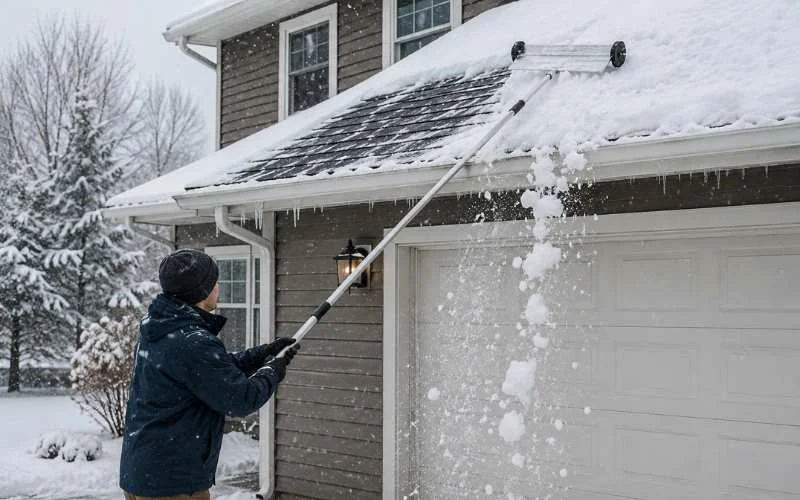
Snow on a roof rarely becomes a problem all at once. It builds slowly. A sunny afternoon softens the upper layer. A cold night freezes the roof edge again. Water creeps beneath shingles near the gutter line. The snow near the eaves turns darker, denser, and heavier than the soft layer above it.
If you are shortlisting suppliers after reading this, start with aluminum extension pole programs and use custom aluminum telescopic poles to translate the topic into tube size, wall thickness, finish and packaging notes; OSHA winter weather safety guidance is a helpful reference point.
That is when small winter problems begin.
A roof snow rake helps you remove dangerous snow buildup before it turns into ice dams, gutter damage, water leaks, or structural stress. But the tool only works well when you use it correctly. Pull too hard, scrape too low, or use a weak telescopic pole, and the job becomes slower, riskier, and harder on the roof.
This guide explains when to rake snow off your roof, how to do it safely from the ground, how different roof types respond, and why telescopic pole quality matters more than most homeowners expect.
What Is a Roof Snow Rake?
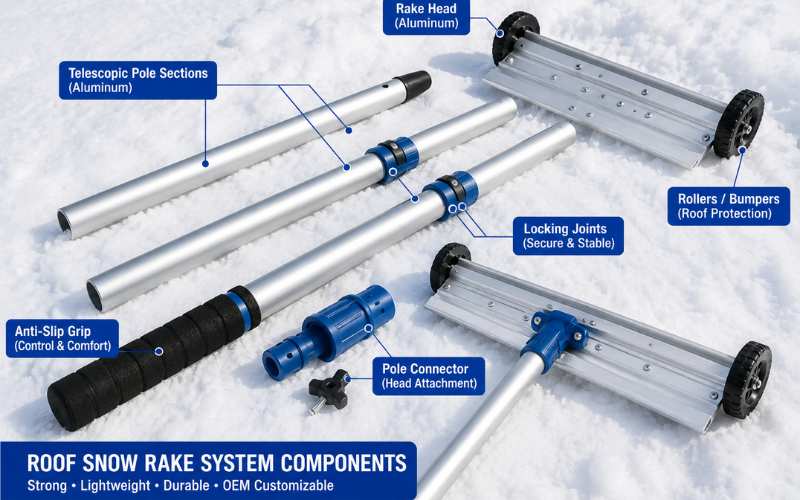
A roof snow rake is a long-reach snow removal tool designed to pull snow off a roof while the user stays on the ground. Most roof snow rakes include a telescopic extension pole, a rake head or snow slide, locking joints, and rollers or bumpers that help protect the roof surface.
Homeowners use roof snow rakes to:
- Reduce roof snow load
- Prevent ice dams
- Lower water leak risk
- Protect gutters
- Avoid climbing onto icy roofs
- Keep snow from compacting into heavy ice layers
Unlike a shovel, a snow rake works from the roof edge downward. It removes snow in controlled strips instead of forcing someone to walk across a slippery roof.
How a Roof Snow Rake Works
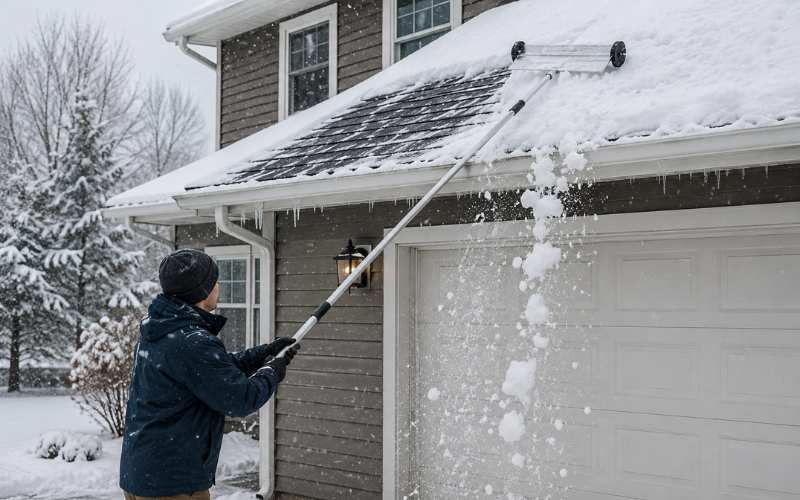
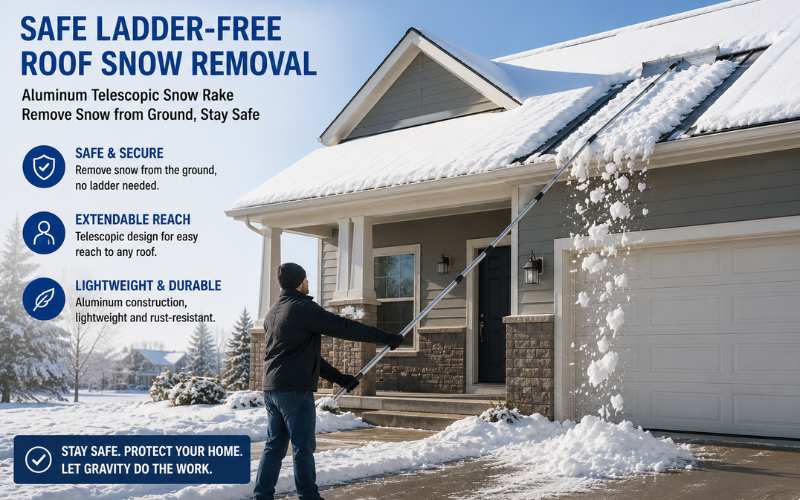
A roof snow rake pulls loose snow toward the ground in small sections. You extend the pole, place the rake head into the snow several feet above the roof edge, and pull downward with steady pressure.
Fresh powder usually slides easily.
Wet snow feels different. It drags against the rake head almost like slush concrete. Sometimes the rake moves smoothly for a few feet, then suddenly catches on a dense frozen layer near the eaves. That sudden resistance is where weak poles twist, cheap locks slip, and users start forcing the tool sideways.
A good roof snow rake should feel controlled, not shaky.
Main Parts of a Roof Snow Rake
| Component | Function | Why It Matters |
|---|---|---|
| Telescopic pole | Extends reach from ground level | Controls stability and user fatigue |
| Rake head | Pulls snow downward | Determines snow removal speed |
| Rollers or bumpers | Keep the head above the roof surface | Help prevent shingle damage |
| Locking joints | Hold pole sections in place | Reduce collapse and wobble risk |
| Grip handle | Improves control | Helps during repeated pulling |
The rake head removes snow. The pole controls the experience.
That difference matters most on tall roofs, wet snow, and long removal sessions.
When Should You Rake Snow Off Your Roof?
The best time to rake snow off your roof is usually within 12 to 24 hours after a major snowfall, before melting and refreezing turn soft snow into dense-packed layers.
Fresh snow is easier to move. Packed snow creates more drag. Ice is worse.
Once the roof snow starts freezing near the eaves, every pull becomes heavier and less predictable.
How Much Roof Snow Is Too Much?
There is no single safe snow depth for every roof because snow weight changes with moisture content.
| Snow Type | Approximate Weight |
|---|---|
| Dry powder snow | 3–5 lbs per cubic foot |
| Packed snow | 10–15 lbs per cubic foot |
| Wet snow | 20+ lbs per cubic foot |
| Ice | Around 57 lbs per cubic foot |
Wet snow can place several tons of extra load across a large roof area. The National Weather Service notes that wet snow is much heavier than dry snow, which is why storm timing and temperature matter.
Many homeowners begin roof snow removal when they see:
- 6–8 inches of wet snow
- 12+ inches of packed snow
- Large icicles near gutters
- Heavy snow overhanging the roof edge
- Repeated thaw-freeze cycles
- Early ice dam formation
Older roofs, low-slope roofs, and poorly ventilated attics need closer attention.
Warning Signs Your Roof Needs Snow Removal
Watch for:
- Sagging gutters
- Ceiling stains
- Creaking sounds
- Cracked drywall
- Doors suddenly sticking
- Thick ice along the gutter line
- Snow near the eaves turning darker and denser
These signs often appear before serious damage becomes visible indoors.
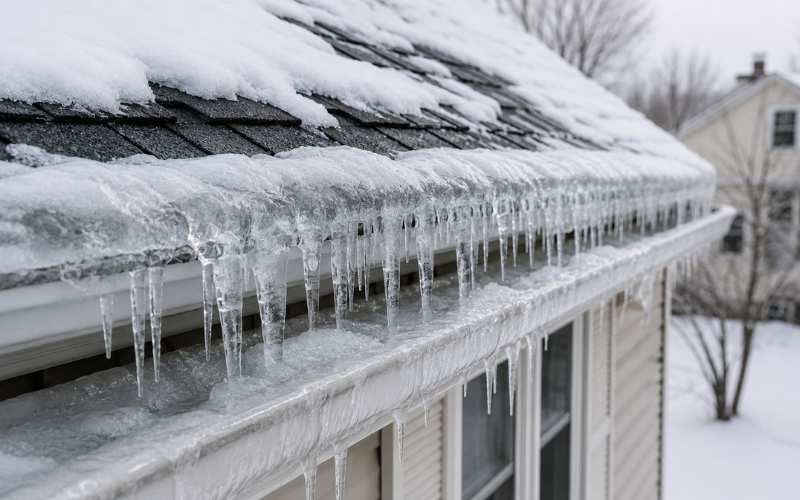
Why Ice Dams Form
Ice dams form when warm attic air melts snow on the upper roof. Meltwater runs downward until it reaches the colder roof edge. Then it freezes again.
That frozen ridge traps more water behind it.
Over time, trapped water can:
- Seep beneath shingles
- Soak insulation
- Stain ceilings
- Damage roof decking
- Bend gutters
The FEMA guidance on snow load risk highlights the danger of prolonged snow accumulation, especially for flat roofs, older structures, and buildings exposed to repeated winter storms.
How to Use a Snow Rake on Your Roof Safely
Use a roof snow rake from the ground. Work slowly. Pull snow downward in small sections. Do not scrape the roof surface bare.
Step 1 — Check the Area First
Before extending the snow rake:
- Look for overhead power lines
- Check for icy walking surfaces
- Move vehicles away from falling snow zones
- Keep children and pets away
- Plan where the snow will fall
- Avoid high winds and freezing rain
Never stand directly beneath heavy snow overhangs.
Metal roofs are especially unpredictable because snow may release in large sheets.
The OSHA winter weather safety guidance recommends maintaining stable footing and avoiding slippery surfaces during winter maintenance work.
Step 2 — Extend the Telescopic Pole Gradually
Open the pole one section at a time.
Lock each section fully before extending the next one.
A stable roof snow rake pole should:
- Extend smoothly
- Stay aligned
- Resist twisting
- Hold its lock under load
- Feel rigid when fully extended
Cheap poles often become unstable beyond 18–20 feet. The problem becomes obvious when wet snow drags against the rake head and the user has to pull repeatedly from below.
Step 3 — Start Near the Roof Edge
Do not start high on the roof.
Place the rake head several feet above the eaves and pull downward gently. Clear the lower roof edge first, then work gradually upward if needed.
This helps:
- Reduce ice dam risk
- Control falling snow
- Prevent sudden large slides
- Lower pole stress
Step 4 — Pull Downward, Not Sideways
Snow should move toward you in a straight downward path.
Side pulling creates a twisting force through the telescopic sections. That force increases lock wear, tube wobble, and connector stress.
If you cannot comfortably reach an area, adjust your body position. Do not force the pole sideways.
Step 5 — Work in Small Sections
Do not try to remove a huge slab of snow in one pull.
Instead:
- Clear a narrow strip
- Move sideways
- Repeat the motion
- Gradually move higher up the roof
Small sections reduce sudden snow collapse and make the tool easier to control.
Step 6 — Leave 1–2 Inches of Snow Behind
Do not scrape directly against shingles, metal panels, or roof membranes.
Leave a thin snow layer to protect:
- Asphalt shingle granules
- Painted metal roofing
- Waterproof membranes
- Roof coatings
The goal is to reduce dangerous load, not expose bare roofing material.
Common Mistakes That Damage Roofs
Most snow rake damage comes from force, angle, or poor tool control.
Scraping Shingles Too Aggressively
Asphalt shingles rely on mineral granules for weather protection.
Repeated scraping along the same lower roof edge can slowly remove those granules over several winters. The roof may not fail immediately, but that area ages faster.
Avoid:
- Metal edges touching shingles
- Chopping motions
- Hard downward pressure
- Trying to remove every trace of snow
Trying to Break Ice With a Snow Rake
A roof snow rake is made for snow, not thick ice.
Trying to break ice can damage:
- Shingles
- Gutters
- Rake heads
- Pole locks
- Roof coatings
Once thick ice forms, the job becomes much riskier. Early snow removal is easier and safer.
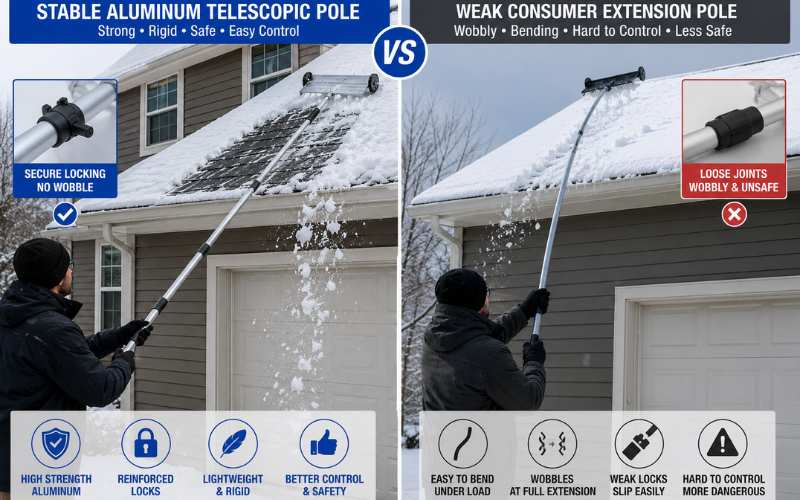
Using a Weak Consumer Extension Pole
Many inexpensive roof snow rakes use extension poles adapted from dusting tools or light cleaning poles. Those poles may work for powder snow, but wet snow exposes their limits quickly.
| Failure | Root Cause | Common User Complaint |
|---|---|---|
| Pole wobble | Loose tube fit | “Hard to control when fully extended” |
| Lock cracking | Brittle plastic | “Pole collapsed during use” |
| Tube bending | Thin wall tubing | “Too flexible for wet snow” |
| Rough extension | Poor tube alignment | “Sections stick in cold weather” |
| Connector loosening | Poor fit accuracy | “Head feels unstable” |
Longer poles amplify small dimensional gaps. A tiny looseness between sections may become obvious wobble at full extension.
How to Use a Snow Rake on Different Roof Types
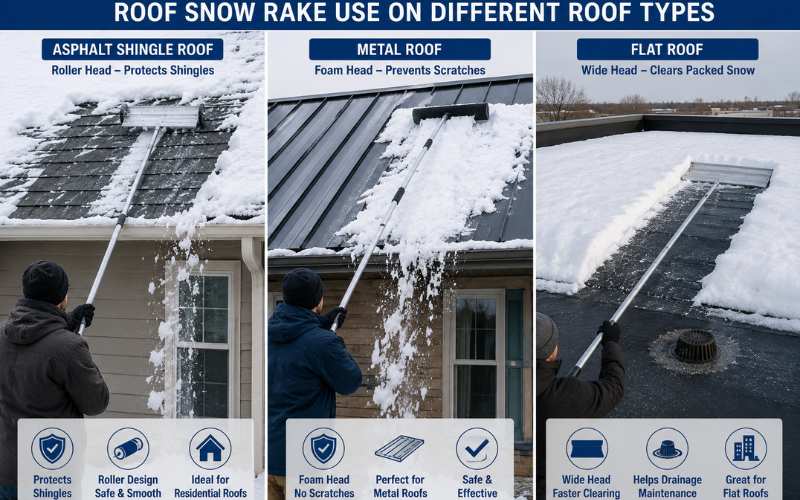
Different roofs need different handling.
Asphalt Shingle Roofs
Asphalt shingles are the easiest to damage with aggressive scraping.
Use:
- Roller-style rake heads
- Foam bumpers
- Light downward pressure
- Short pulling strokes
Leave a thin snow layer behind. This protects the shingle granules.
Metal Roofs
Metal roofs often shed snow faster than asphalt roofs.
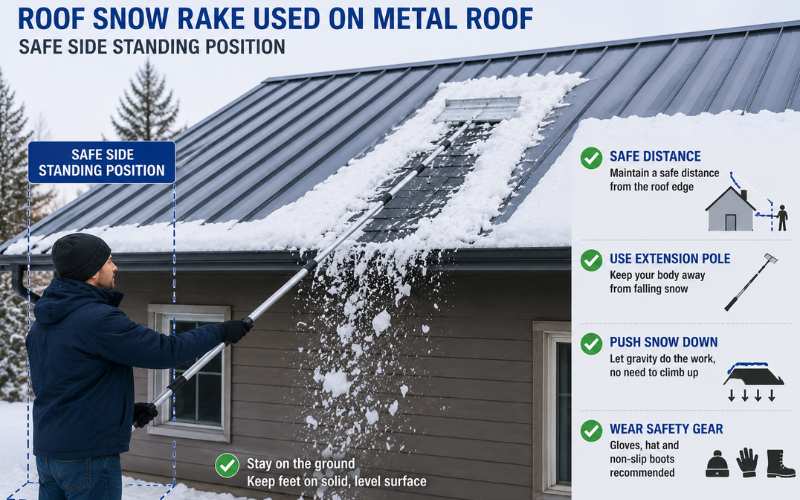
That can be helpful, but it also creates danger. Snow may slide suddenly in large sheets.
For metal roofs:
- Stand to the side when possible
- Do not stand under the snow load
- Use foam or roller heads
- Expect sudden movement
- Clear the roof edge first
Flat and Low-Slope Roofs
Flat roofs hold snow longer. They also drain more slowly.
Watch for:
- Compacted snow
- Blocked drains
- Standing meltwater
- Ice around drainage points
If snow is deep, wet, or compacted across a flat roof, consider professional inspection. Flat roof overload risk can rise faster than homeowners expect.
Aluminum vs Fiberglass Roof Snow Rake Poles
Both aluminum and fiberglass poles appear in roof snow rake systems. Aluminum is more common in premium telescopic snow rake poles because it offers strong rigidity with lower weight.
| Feature | Aluminum Pole | Fiberglass Pole |
|---|---|---|
| Weight | Lighter | Heavier |
| Rigidity | Higher | Moderate |
| Extension stability | Better | More flex |
| User fatigue | Lower | Higher |
| Surface finish options | More | Limited |
| Corrosion resistance | Excellent with anodizing | Good |
| OEM customization | Easier | More limited |
Why Aluminum Works Well for Roof Snow Rakes
Roof snow removal uses overhead leverage. The farther the pole extends, the more every small movement matters.
Aluminum telescopic poles help because they:
- Track straighter
- Twist less under load
- Reduce arm fatigue
- Support longer reach
- Accept anodized finishes
For long snow rake systems, the material must balance weight and rigidity. A pole that is strong but too heavy becomes tiring. A pole that is light but too flexible becomes difficult to control.
Suggested Tube Dimensions for Roof Snow Rake Poles
Actual dimensions depend on product design, but common commercial ranges include:
| Pole Section | Common Diameter Range |
|---|---|
| Base tube | 32–38 mm |
| Middle tube | 25–32 mm |
| Top tube | 19–25 mm |
For many roof snow rake systems:
| Pole Length | Suggested Wall Thickness |
|---|---|
| 12–16 ft | 0.8–1.0 mm |
| 18–20 ft | 1.0–1.2 mm |
| 20–24 ft | 1.1–1.3 mm |
Longer poles usually need stronger lock structures, better tube straightness, and tighter section fit.
Why Tube Tolerances Matter
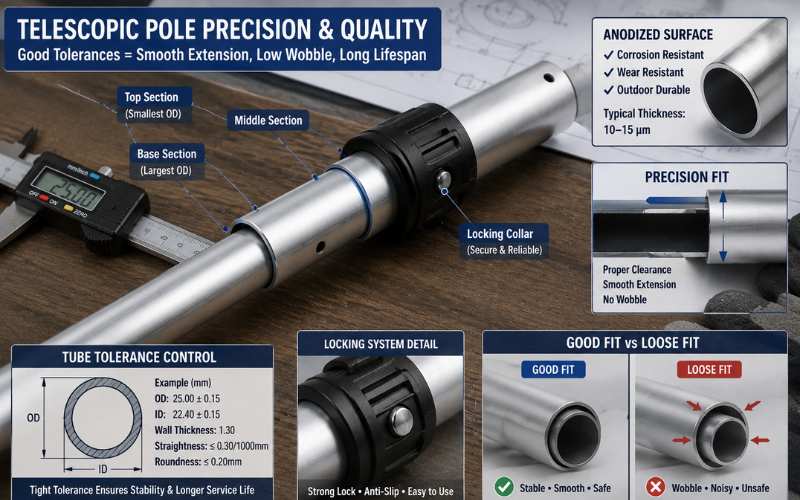
A telescopic pole is several tubes sliding inside one another.
If the fit is too loose, the pole wobbles.
If the fit is too tight, the sections may stick in cold weather, especially after moisture freezes inside the tube.
Good telescopic pole manufacturing balances:
- Smooth extension
- Low wobble
- Lock alignment
- Anodizing thickness
- Cold-weather clearance
Outdoor telescopic poles often use anodized coatings around 10–15 μm to improve corrosion resistance and surface durability.
How OEM Roof Snow Rake Poles Are Manufactured
Most roof snow rake articles talk about the rake head. The real user experience often comes from the telescopic pole system.
A weak pole makes the tool feel frustrating. A stable pole makes the same task feel controlled.
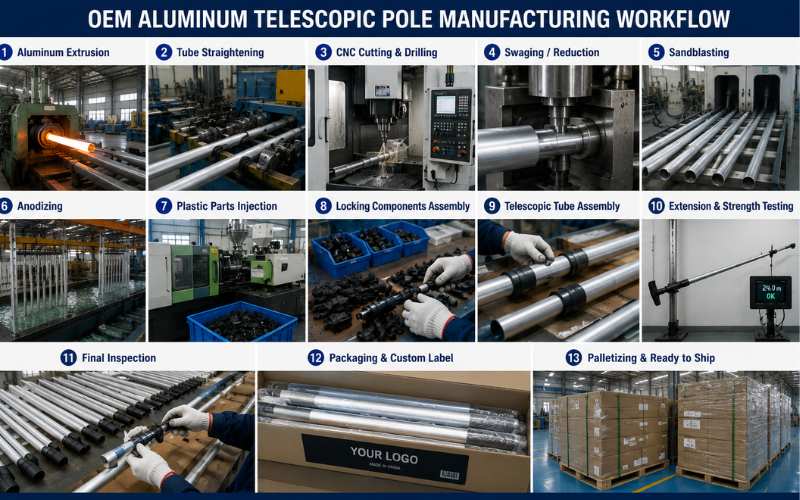
Typical Manufacturing Workflow
OEM roof snow rake pole production usually includes:
- Aluminum billet preparation
- Extrusion
- Tube straightening
- Tube cutting
- CNC drilling and slotting
- Swaging or reduction
- Sandblasting
- Anodizing
- Plastic lock production
- Lock integration
- Extension testing
- Final assembly
- Packaging and logo customization
Small errors in any step can affect final pole performance.
For example, anodizing improves corrosion resistance, but coating thickness also changes surface dimensions slightly. If the tube design does not account for this, sections may feel too tight or too loose after finishing.
Why Integrated Manufacturing Improves Stability
Many suppliers only produce aluminum tubes. Others only make plastic connectors.
That split can create problems.
When tubes and locks come from different suppliers, small dimensional inconsistencies may appear during assembly. On a short pole, the issue may be minor. On a 20-foot telescopic snow rake, the same mismatch can become visible wobble near the rake head.
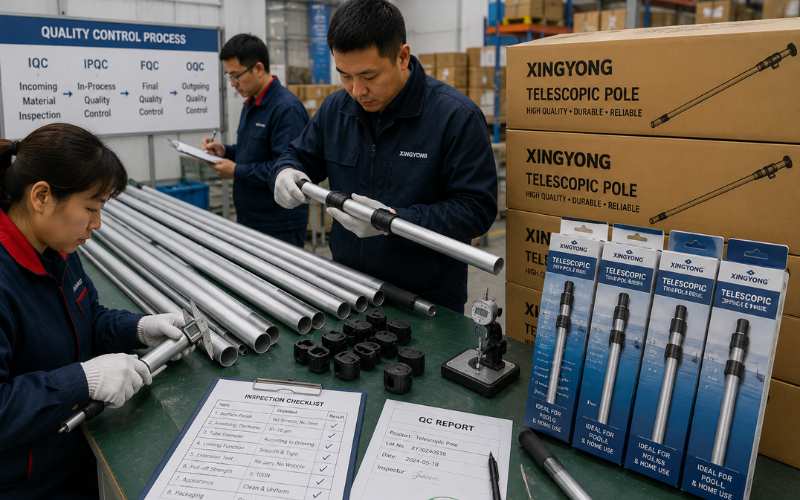
Xingyong telescopic pole manufacturing specializes in integrated OEM production for aluminum telescopic systems.
Xingyong supports:
- Aluminum tube extrusion
- Plastic connector production
- CNC machining
- Anodizing
- Sandblasting
- Precision finishing
- Telescopic tube assembly
- Custom packaging
- Logo customization
Because aluminum tubes and plastic locking components are developed within the same production system, Xingyong can better control:
- Tube dimensions
- Connector matching
- Locking structure
- Assembly precision
- Final product stability
Material Selection and Batch Control
Xingyong uses high-quality aluminum alloys including:
- 6061
- 6005
- 6063
- 7075
- 6065
Different alloys support different design goals.
| Alloy | Typical Advantage |
|---|---|
| 6063 | Smooth extrusion surface |
| 6061 | Higher structural strength |
| 6005 | Good rigidity and extrusion stability |
| 7075 | High-strength specialty use |
| 6065 | Balanced forming performance |
For OEM snow rake pole projects, alloy selection depends on required length, stiffness, weight, surface finish, and cost target.
Xingyong also retains and tests raw material samples from every production batch. Each batch receives traceability records to reduce quality variation in repeat orders.
That matters for distributors and brands. Seasonal tools often generate complaints when one batch extends smoothly and the next batch feels loose or sticky.
Choosing the Right Roof Snow Rake Pole Length
Pole length affects both reach and control.
A pole that is too short may force unsafe ladder use. A pole that is too long may become hard to stabilize.
| Roof Type | Suggested Pole Length |
|---|---|
| Single-story home | 12–16 ft |
| Tall single-story roof | 18 ft |
| Two-story home | 20–24 ft |
| Commercial roof edge | 24 ft+ |
Use the shortest pole that safely reaches the work area.
Overextension increases:
- Pole bending
- Shoulder fatigue
- Lock stress
- User instability
What to Look for in a Good Roof Snow Rake Pole
Choose a pole with:
- Anodized aluminum tubing
- Reinforced locking joints
- Cold-resistant plastic connectors
- Anti-slip grip
- Smooth telescopic movement
- Replaceable rake head
- Stable section fit
For OEM buyers, lock durability is especially important. Many warranty complaints come from cracked locks, slipping joints, or unstable rake head connections after repeated freezing cycles.
Buyer Notes for Importers, Brands, and Distributors
A roof snow rake is a seasonal product. That makes quality consistency even more important.
If one winter shipment has unstable poles or brittle locks, retailers may receive complaints during the exact peak sales period.
Commercial buyers should check:
| Buyer Concern | What to Confirm |
|---|---|
| Pole wobble | Tube tolerance and lock fit |
| Cold cracking | Plastic material performance |
| Surface durability | Anodizing quality |
| Assembly stability | Head-to-pole connector design |
| Repeat order consistency | Batch traceability |
| Retail readiness | Packaging and logo quality |
A slightly stronger lock or thicker tube may reduce returns more effectively than a cheaper lightweight design.
For private-label winter tools, the pole is not only a handle. It is the part users feel during every pull.
Roof Snow Removal Safety Tips
Roof snow removal should prioritize control over speed.
Never Walk on a Snow-Covered Roof
Snow hides:
- Ice
- Skylights
- Weak roof areas
- Roof edges
Ground-based snow removal is much safer.
Work With Another Person When Possible
A second person can:
- Watch falling snow
- Check footing hazards
- Assist during emergencies
- Help reposition equipment
Take Breaks
Roof snow removal uses repeated overhead movement.
Long sessions can strain:
- Shoulders
- Wrists
- Lower back
If the snow is wet, heavy, or layered with ice, work gradually.
How to Maintain a Roof Snow Rake
A snow rake lasts longer when the pole and locks stay clean and dry.
Dry the Pole After Use
Moisture trapped inside telescopic tubes can freeze later.
After each use:
- Extend all sections
- Wipe the tubing dry
- Clean lock collars
- Remove packed snow
- Store under cover
Inspect Locks Before Winter
Check for:
- Cracked plastic parts
- Loose fasteners
- Bent tubing
- Worn locks
- Rough extension
Replace worn parts before heavy snow arrives.
Store the Pole Correctly
Store roof snow rakes:
- Horizontally when possible
- Away from standing moisture
- Out of direct sun
- With lock tension released
Good storage helps preserve tube straightness and extension smoothness.
Frequently Asked Questions
Can a roof snow rake damage shingles?
Yes. A roof snow rake can damage shingles if you scrape too hard or use a metal edge directly against the roof. Leave 1–2 inches of snow behind to protect shingle granules.
How much snow is dangerous for a roof?
Wet snow becomes risky much faster than dry powder snow. Many homeowners remove roof snow after 6–8 inches of wet snow or 12+ inches of packed snow.
Should you remove all snow from your roof?
No. You should reduce excessive snow load, not expose the bare roof surface. A thin snow layer helps protect shingles and coatings.
Can roof snow collapse gutters?
Yes. Packed snow and ice near the roof edge can overload gutters and mounting hardware.
Is aluminum better than fiberglass for snow rake poles?
Aluminum is often better for long roof snow rake poles because it offers strong rigidity with lower weight.
Why do telescopic snow rake poles wobble?
Most wobble comes from loose tube tolerances, thin tube walls, weak lock collars, or poor connector fit.
Can I use a snow rake on solar panels?
Use caution. Solar panels scratch easily, and snow removal may void some warranties. Use a soft head, avoid hard scraping, and follow the panel manufacturer’s guidance.
Small Winter Roof Problems Usually Start Quietly
By late winter, most roof problems no longer come from one dramatic snowfall. They come from weeks of melting, refreezing, trapped moisture, and extra pressure around roof edges.
A roof snow rake gives you a simple way to reduce that pressure before small problems become expensive repairs. The safest results come from good timing, gentle technique, and a stable telescopic pole that does not fight you during every pull.
Remove snow early. Leave a protective layer. Stay on the ground.
That simple routine can protect the roof, the gutters, and the person holding the pole.
Need OEM Telescopic Snow Rake Pole Manufacturing?
Xingyong custom telescopic pole production manufactures aluminum telescopic tubes, extension pole assemblies, and integrated locking components for OEM winter tool projects.
Xingyong provides one-stop OEM manufacturing from:
- Product design
- Mold development
- Aluminum tube extrusion
- Plastic connector production
- Surface treatment
- Precision machining
- Telescopic tube assembly
- Packaging customization
- Logo branding
Unlike suppliers that only manufacture aluminum tubes or only produce plastic fittings, Xingyong controls both the aluminum telescopic tube system and matching plastic connection parts. This helps improve tube fit, lock stability, assembly precision, and final product consistency.
The factory supports wholesalers, brands, importers, industrial buyers, and retail distributors that need custom telescopic snow rake poles with stable quality across repeat orders.
Related Guides & Resources
Keep Reading
Telescopic Pole · Pool Pole · Extension Pole · Source Telescopic Poles OEM · Square Tubing Vs Round Tubing · Telescopic Pole Vs Extension Pole Wholesale Manufacturing · Telescopic Vs Fixed Extension Pole · Top Flight Telescoping Flagpole OEM · What Are Aluminum Telescopic Poles Used For · What Is An Extension Pole · Aluminum Extension Pole Moq Lead Time
Related products: Explore related products and review matching solutions.

 English
  Español
  Français
  Deutsch
  Português