
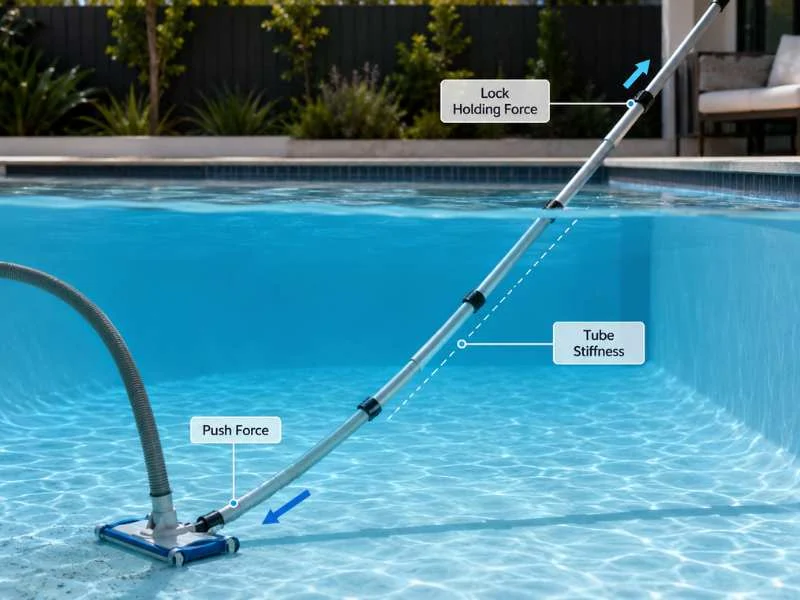
A pool pole for vacuum head applications should not be judged by length alone. Vacuuming creates push-pull resistance, floor drag, turning force, lock pressure and connection stress at the vacuum head handle. A good pole must fit the vacuum head securely, hold its length under force and stay stable when fully extended.
This guide focuses only on vacuum head applications. It covers five buyer checks: vacuum head connection fit, push-pull resistance, lock holding force, tube stiffness at full extension and testing with a real vacuum head sample.
If buyers still need to compare the broader pole range, tube styles or general OEM options, they can compare the main pool pole options after confirming the vacuum head requirements.
What a Pool Pole for Vacuum Head Must Do
A manual pool vacuum usually works through a vacuum head, telescoping pole, vacuum hose and skimmer-side connection. Lowe’s explains that a handheld pool vacuum can use a vacuum head attached to a telescoping pole and connected through a vacuum hose to the pool skimmer. Buyers can review this practical reference on a manual pool vacuum setup.
For OEM and wholesale buyers, the pole must do more than extend. It must transfer force from the user’s hands to the vacuum head without bending, shortening, rattling or loosening at the connection.
| Vacuum Pole Requirement | Why It Matters | Buyer Check |
|---|---|---|
| Vacuum head fit | A loose connection creates steering problems and user complaints. | Test the pole end with the real vacuum head sample. |
| Push-pull resistance | Vacuuming creates drag across the pool floor. | Push and pull the head underwater or in a wet simulation. |
| Lock holding force | A weak lock lets the pole shorten during vacuuming. | Test the lock at working length under repeated force. |
| Tube stiffness | A flexible pole makes the vacuum head hard to control. | Check bending and shaking at full extension. |
| Sample validation | Drawings do not reveal every fit and force issue. | Approve the pole only after real vacuum head testing. |
Vacuum Head Connection Fit
The first requirement is simple: the pole must fit the vacuum head securely. In real production, this depends on pole-end inner diameter, spring-button position, hole quality, burr removal and how deeply the button engages the vacuum head handle.
“Standard fit” is not enough for bulk orders. A small change in hole position or tube-end size can make the vacuum head rattle, fail to lock or feel unstable during cleaning.
| Fit Check | What to Confirm | Common Failure | Better Specification |
|---|---|---|---|
| Pole-end inner diameter | Match the pole end with the actual vacuum head handle. | Loose fit, rattling or failed assembly. | Confirm ID using the buyer’s vacuum head sample. |
| Spring-button hole | Check hole diameter and distance from tube end. | Poor button engagement or accidental release. | Control drilling tolerance and deburr the hole. |
| Button engagement depth | Check how deeply the spring button locks into position. | Button appears locked but slips during use. | Test with repeated push-pull movement. |
| Vacuum head handle type | Check spring clip, swivel handle or fixed handle structure. | Wrong compatibility assumption. | Use the real vacuum head for sample approval. |
| Swivel clearance | Confirm movement after pole and vacuum head assembly. | Hard steering or limited turning angle. | Check swivel movement before bulk production. |
| Tube end strength | Review wall thickness around drilled or punched holes. | Tube deformation near the connection point. | Reinforce the tube end if the vacuum head is heavy. |
A reliable pool pole for vacuum head use should pass a real fit test. A drawing helps, but a vacuum head sample is more useful than a long compatibility claim.
Push-Pull Resistance During Vacuuming
A vacuum head creates more resistance than a skimmer net. It moves across the pool floor, touches corners, pulls against water and debris, and may use wheels, brushes or weighted plates. This makes the pole work under repeated pushing, pulling, turning and downward force.
That is why a pole that works for light skimming may fail during vacuuming.
| Vacuuming Force | Where It Happens | What Buyers Should Test |
|---|---|---|
| Forward pushing force | When the user pushes the vacuum head across the pool floor. | Check whether the pole bends or shortens. |
| Pull-back force | When the vacuum head is pulled back through water and debris. | Check lock holding and section movement. |
| Downward pressure | When the user keeps the vacuum head in contact with the floor. | Check tube stiffness and hand control. |
| Turning force | When the user steers around corners, steps or curved areas. | Check connection looseness and swivel control. |
| Full-extension bending load | When the pole is used near its maximum length. | Check vibration, wobble and steering accuracy. |
The real test is force transfer. A good telescopic pole for pool vacuum head use should move the vacuum head without excessive bending, shaking or shortening.
Lock Holding Force for Pool Vacuum Use
The lock is one of the most important parts of a pool vacuum pole. During vacuuming, the user repeatedly pushes and pulls the pole. If the lock cannot hold axial force, the pole may shorten during use.
A lock that works for a skimmer net may not be strong enough for a vacuum head. Buyers should test the lock under wet, loaded and repeated movement, not only with a dry hand test.
| Lock Test | How to Test | Failure Signal | Pass Requirement |
|---|---|---|---|
| Full-extension hold | Extend the pole to working length and push the vacuum head forward. | Pole shortens under pressure. | Lock holds without visible sliding. |
| Wet-hand operation | Tighten, release and retighten the lock with wet hands. | Lock is hard to grip or cannot tighten enough. | User can operate it without excessive force. |
| Repeated push-pull cycle | Push and pull the vacuum head repeatedly at working length. | Lock loosens after several cycles. | Lock remains stable after repeated movement. |
| Twist and steering load | Turn the vacuum head left and right while the pole is extended. | Sections rotate or rattle too much. | Pole maintains control during steering. |
| Sand or debris exposure | Check lock behavior after exposure to poolside dirt or fine debris. | Lock jams, scratches the tube or loses grip. | Lock continues to operate smoothly. |
A good lock should feel simple to the end user. Behind that simple feeling, the plastic geometry, tube tolerance and friction design must be correct.
Tube Stiffness at Full Extension
Tube stiffness decides whether the user can control the vacuum head at working length. A pole may look strong when closed, but weakness becomes obvious at 12 ft, 16 ft or longer.
For longer aluminum pole structures, buyers should not evaluate length alone. Tube diameter, wall thickness, section overlap, roundness and straightness all affect vacuuming performance. ASTM B221 is a useful technical reference for buyers evaluating aluminum extruded tubes.
| Tube Factor | Effect on Vacuuming | Risk if Ignored | Buyer Check |
|---|---|---|---|
| Outer diameter | Affects overall stiffness and hand feel. | Pole feels weak or unstable at full extension. | Compare diameter with length and tool load. |
| Inner diameter | Affects vacuum head fit and telescopic nesting. | Loose connection or poor tube fit. | Confirm ID with the actual vacuum head sample. |
| Wall thickness | Affects bending resistance and tube-end strength. | Tube bends or deforms near drilled holes. | Test under push-pull load, not only by weight. |
| Section overlap | Affects stability between telescopic sections. | Shaking and poor force transfer. | Review overlap at the required working length. |
| Roundness | Affects sliding, rotation and lock contact. | Hard movement or uneven locking. | Inspect tube matching before and after finishing. |
| Straightness | Affects steering and full-length control. | Vacuum head feels hard to guide. | Check the full pole assembly, not only one tube. |
If buyers need to understand how tube production, finishing and final assembly are controlled before placing a larger order, they can review how the factory controls tube production and assembly.
Vacuum Head Length Planning
For vacuum head use, length should be judged by pool size, floor reach, push-pull stability and carton limit.
The safest rule is to choose the shortest length that reaches the cleaning area with stable control.
| Pool Type | Vacuum Pole Length | Why This Range Works | Risk to Check |
|---|---|---|---|
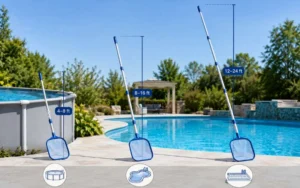
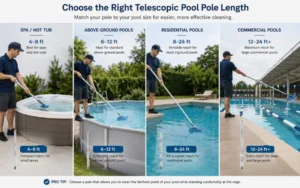
| Spa or small pool | 4–8 ft | Enough reach for compact floor cleaning. | Avoid overbuilding the SKU and carton size. |
| Above ground pool | 6–12 ft | Good balance of reach, cost and handling. | Test with the actual vacuum head, not only a skimmer. |
| Residential inground pool | 8–16 ft | Mainstream range for floor vacuuming. | Confirm lock holding and tube stiffness at working length. |
| Large residential pool | 12–18 ft | Better reach for deep ends and far corners. | Check bending and section overlap carefully. |
| Commercial pool | 12–24 ft or custom | Supports longer reach and repeated cleaning. | Treat as a professional-use pole, not a light retail SKU. |
A longer pool vacuum pole is not automatically better. If the tube and lock are weak, a poorly built 16 ft pole can feel worse than a stronger 12 ft pole.
Material and Finish Notes for Vacuum Head Applications
For pool vacuum poles, aluminum is commonly used because it offers a practical balance of weight, rigidity, surface finish and cost. Fiberglass and plastic can work in some cases, but the buyer should evaluate them against the vacuuming force, target price and sales channel.
| Material | Vacuum Head Advantage | Main Risk | Best Use |
|---|---|---|---|
| Aluminum | Good strength-to-weight balance and clean anodized appearance. | Poor tolerance control can cause wobble or loose fit. | Mainstream OEM and wholesale pool vacuum poles. |
| Fiberglass | Can provide stiffness and non-conductive properties. | Higher cost and different damage behavior. | Specialty or premium-positioned pole programs. |
| Plastic | Low cost and light weight. | Weak for longer vacuuming reach. | Short, low-duty pool tools or small kits. |
For anodized aluminum finishes, buyers can reference the Aluminum Anodizers Council explanation of what anodizing does to aluminum surfaces. For this page, the key point is simple: finish should support corrosion resistance, sliding feel, hand contact and retail appearance without disturbing telescopic movement.
Real Vacuum Head Sample Testing
A pool pole for vacuum head use should be approved with the real vacuum head sample. Do not approve the pole only from drawings, photos or unloaded extension tests.
The test should simulate how the buyer’s customer will actually use the product: extended pole, connected vacuum head, wet conditions, repeated push-pull movement and turning around the pool floor.
| Sample Test | How to Test | What Passes | What Fails |
|---|---|---|---|
| Connection fit | Attach the buyer’s vacuum head to the pole end. | Button locks securely without obvious rattling. | Loose fit, burrs, wrong hole position or unstable handle. |
| Push-pull movement | Move the vacuum head forward and backward repeatedly. | Pole transfers force without shortening. | Lock slips or sections shift under load. |
| Full-extension control | Use the pole near maximum working length. | Acceptable stiffness and steering control. | Excessive bending, shaking or delayed head response. |
| Turning control | Turn the vacuum head around corners or simulated obstacles. | Head follows direction without connection looseness. | Handle twists loosely or pole feels hard to guide. |
| Wet-hand lock operation | Operate the lock with wet hands after several cycles. | Lock remains easy to tighten and release. | Lock jams, slips or becomes hard to operate. |
| Carton and packing check | Review collapsed length, carton size and protection. | Pole is protected without excessive carton size. | Carton is too weak, too long or poorly protected. |
When collapsed length increases carton size, packaging risk should be checked before shipment. Buyers can reference ISTA package testing procedures when evaluating carton strength, vibration risk and shipping damage control.
Common Failure Symptoms During Vacuuming
Most vacuum pole problems show up during real use, not when the pole is displayed or extended on a workbench. Buyers should connect each symptom to a specific technical cause.
| Failure Symptom | Likely Cause | Buyer Action |
|---|---|---|
| Vacuum head rattles | Loose pole-end fit, poor hole position or weak button engagement. | Retest with the actual vacuum head and adjust the pole-end structure. |
| Pole shortens during pushing | Lock cannot hold axial force under vacuum load. | Improve lock design or tube-lock matching. |
| Pole bends at full length | Tube diameter, wall thickness or overlap is too weak. | Increase stiffness or shorten the working length. |
| Vacuum head does not steer well | Poor force transfer, loose connection or excessive flex. | Test turning movement and improve connection stability. |
| Tube sections shake | Poor telescopic clearance, roundness or section overlap. | Review tube tolerance and assembly fit. |
| Button area deforms | Thin tube wall or weak drilling area. | Strengthen the tube end and control hole processing. |
| User complains about weak feel | The pole passes appearance checks but fails force checks. | Use a loaded vacuum head test before approval. |
This is the main difference between a general pool pole and a pool pole for vacuum head applications. Vacuuming exposes problems that light skimming may not reveal.
Vacuum Head Sample Checklist
Do not use a general pool pole RFQ checklist for this page. For a pool vacuum pole, the buyer should send the vacuum head sample or at least the handle drawing, connection photo and key dimensions.
| Sample Information | What to Send | Why It Matters |
|---|---|---|
| Vacuum head sample | One real vacuum head or handle sample. | Confirms actual fit, button engagement and steering feel. |
| Connection dimensions | Handle diameter, hole position and engagement depth. | Reduces loose connection and assembly mismatch. |
| Target pole length | 4–8 ft, 6–12 ft, 8–16 ft, 12–24 ft or custom. | Controls tube structure, overlap and lock requirement. |
| Main pool type | Above ground, residential inground, large pool or commercial pool. | Helps match reach and stiffness to real use. |
| Vacuum head weight and structure | Weighted head, wheels, brush type or swivel handle details. | A heavier head creates more end load. |
| Lock preference | Twist lock, cam lock, push button or custom lock request. | Controls user operation and holding force. |
| Packaging limit | Collapsed length limit, carton requirement or retail pack format. | Prevents oversized cartons and shipping damage. |
| Test standard | Push-pull test, full-extension test and connection test requirement. | Makes sample approval measurable. |
If the buyer only sends “quote pool pole for vacuum head,” the supplier has to guess the connection, length, load and packaging. A better sample request gives the factory enough information to test the product as a real vacuum pole.
FAQ About Pool Pole for Vacuum Head
What kind of pool pole fits a vacuum head?
A pool pole for vacuum head use should match the vacuum head handle, spring-button connection and pole-end inner diameter. For bulk orders, buyers should test the pole with the real vacuum head sample before approval.
Why does a pool vacuum pole collapse during use?
A pool vacuum pole usually collapses because the lock cannot hold repeated push-pull force. Vacuuming creates more axial load than surface skimming, so the lock must be tested at working length with the vacuum head attached.
Why does a pool pole bend when vacuuming?
A pool pole bends during vacuuming when the tube diameter, wall thickness, section overlap or material stiffness is not enough for the working length and tool load. The problem becomes more visible at full extension.
What is the best length for a pool pole used with a vacuum head?
For many residential inground pools, 8–16 ft is the most practical range. Above ground pools may use 6–12 ft, while large or commercial pools may require 12–24 ft or a custom length.
Should I approve a vacuum pole sample without the vacuum head?
No. A pool pole for vacuum head applications should be tested with the actual vacuum head. Fit, steering, lock force and tube stiffness cannot be fully confirmed from the pole alone.
Is aluminum good for a pool vacuum pole?
Yes, aluminum is commonly used for pool vacuum poles because it offers a practical balance of strength, weight, surface finish and production cost. The key is controlling tube dimensions, wall thickness, finish and lock fit.
What should OEM buyers send before sampling?
OEM buyers should send the vacuum head sample, handle dimensions, target pole length, pool type, vacuum head weight, lock preference, packaging limit and required sample tests.
Send Your Vacuum Head Sample for Pole Fit Testing
A pool pole for vacuum head applications should be approved by fit and force, not by length alone. The most important checks are connection fit, push-pull resistance, lock holding force, tube stiffness at full extension and testing with the real vacuum head sample.
Send Xingyong your vacuum head sample, target pole length, connection dimensions, tool weight, packaging limit and expected order quantity. Our team can help check whether the pole structure, lock design and tube stiffness are suitable before bulk production.
Related Products
Pool Poles & More from Xingyong
Pool Poles · Pool Pole For Skimmer Net · Pool Pole Hanger · Pool Vacuum Pole · Pool Skimmer Pole · Swimming Pool Net Pole · Pool Cover Reel · Everything You Need To Know About Pool Poles · How Pool Vacuum Poles Are Made
Discuss an OEM Pool Pole for Vacuum Head Project
For an OEM project based on Pool Pole for Vacuum Head, send the target length, tube diameter, wall thickness, section count, lock or connector, working load and annual quantity. Xingyong can review the structure and prepare an OEM quotation based on the intended tool and market.
Related products: Explore related products and review matching solutions.

 English
  Español
  Français
  Deutsch
  Português