
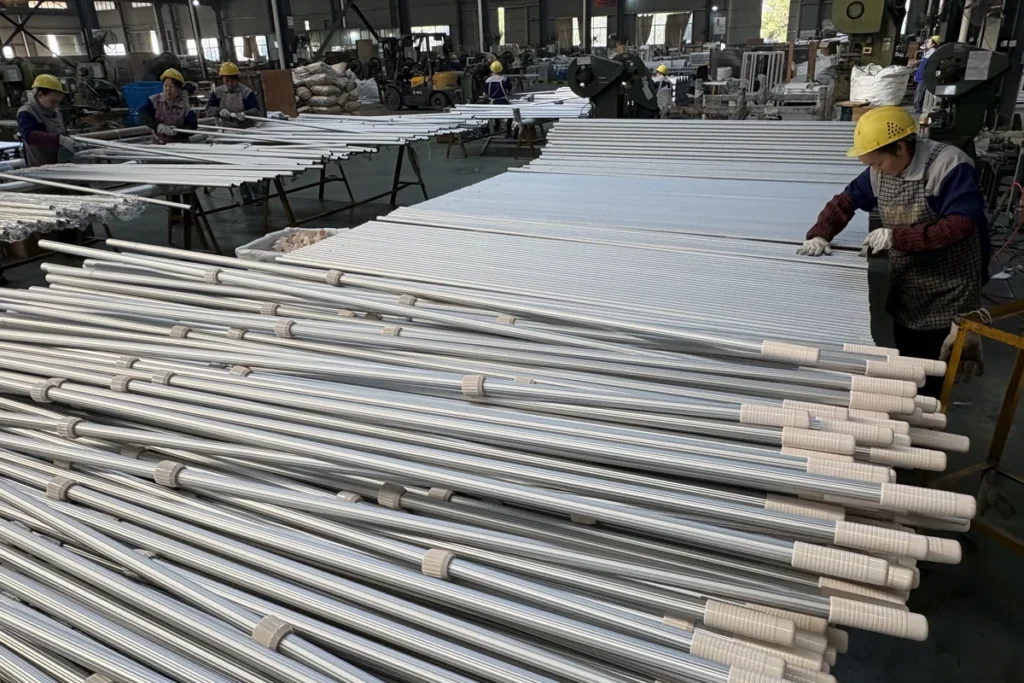
Aluminum becomes “too hot” for a telescopic pole when the complete product can no longer meet its required load, locking, dimensional, surface, or safety performance. That point is normally far below aluminum’s melting temperature and cannot be reduced to one universal number.
A consumer pole is an assembly of aluminum tubes, plastic locks, grips, fasteners, adhesives, labels, coatings, and packaging. In many designs, a polymer part, adhesive joint, printed label, or tight telescoping clearance reaches its limit before the aluminum tube does. Buyers should therefore specify the real exposure and validate the finished product—not approve it from a melting-point fact.
Why Aluminum’s Melting Point Is the Wrong Limit
Aluminum melts at roughly 660°C (1220°F), depending on alloy composition. That value explains when the metal changes from solid to liquid; it does not define an acceptable working, storage, or shipping temperature for an OEM pole.
Long before melting, temperature can change material strength, stiffness, dimensions, coating appearance, adhesive behavior, and the fit between moving sections. A product can remain visibly solid yet fail its functional requirements: the lock may slip, a grip may loosen, nested tubes may bind, or a label may lift.
There Is No Universal “Maximum Safe Temperature”
A defensible limit depends on the exact alloy and temper, wall thickness, length, applied load, exposure time, heating rate, cooling cycle, and required safety margin. It also depends on every non-aluminum component in the assembly.
The Aluminum Association’s Aluminum Standards & Data reference covers alloy and temper properties and product tolerances. Those material data support engineering decisions, but they do not certify a finished telescopic pole at a buyer-selected temperature.
| Question | Why it matters | What the buyer should define |
|---|---|---|
| How hot? | Peak temperature affects materials and fit | Target and allowable range, measured at stated locations |
| For how long? | A short excursion differs from continuous exposure | Duration, frequency, and total cycles |
| Under what load? | Heat and mechanical load interact | Extension length, attachment, force, and orientation |
| What happens afterward? | Recovery may be incomplete | Required function after cooling and conditioning |
| Which assembly? | Small component changes can move the limit | Production materials, suppliers, colors, and processes |
How Heat Affects the Aluminum Tubes
Temperature affects aluminum gradually. As a tube heats, it expands; its mechanical properties also change with temperature and exposure history. The relevant result is not merely whether the tube survives, but whether it still carries the specified load without unacceptable deflection, permanent set, ovalization, or loss of alignment.
Alloy and temper matter. A 6063 tube selected for surface quality and extrudability does not automatically have the same elevated-temperature behavior as another alloy or temper. Repeated or prolonged heating can also affect a heat-treated temper differently from a short exposure. Do not transfer a temperature claim from “aluminum” in general to a specific pole without supporting data.
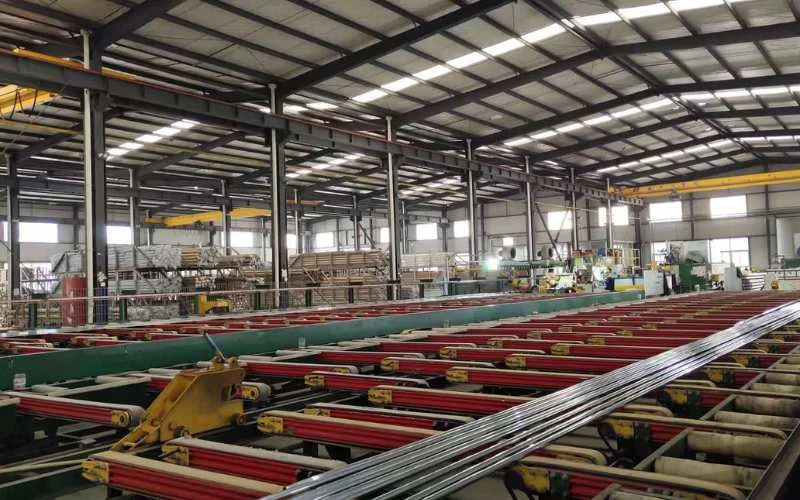
Thermal Expansion Can Change Telescoping Fit
Aluminum expands when heated and contracts when cooled. NIST publishes reference data for the linear thermal expansion of aluminum, but a finished pole contains parts with different expansion behavior.
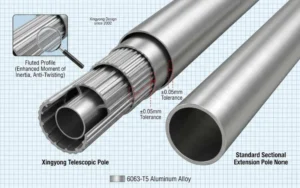
An outer aluminum tube, inner tube, plastic bushing, cam lock, collar, and adhesive layer do not necessarily change size at the same rate. Clearances that work at room temperature may tighten or loosen at another temperature. Dirt, tube ovality, coating thickness, and tolerance stack-up can amplify the effect.
For a telescopic product, check more than overall length. Verify extension force, collapse force, rotation, lock engagement, slip resistance, and release after hot and cold conditioning. If the pole must operate across a wide climate range, test at both ends of that range using production-representative parts.
Plastic Locks and Bushings Often Set the Limit
Locking assemblies may include engineering plastics, elastomers, springs, pins, and lubricants. Heat can soften a polymer, reduce its stiffness, change friction, accelerate creep, or cause a molded part to distort under sustained clamp load. Cooling can make some materials less compliant or change the force needed to operate the lock.
A polymer name alone is not enough. Grade, reinforcement, colorant, moisture condition, molding quality, wall section, and applied stress all matter. A generic online temperature range for “nylon,” “ABS,” or “PP” is not a product rating. Obtain grade-specific data from the component supplier and validate the molded part in the assembled pole.
Grips, Adhesives, Labels, and Lubricants
Soft grips can expand, soften, migrate, shrink after cooling, or lose retention. Pressure-sensitive labels and tapes can curl, slide, or leave residue. Adhesives may lose strength at heat or become brittle after repeated thermal cycles. Lubricants can thin, migrate onto cosmetic surfaces, or interact with plastic parts.
These are not secondary details. A loosened grip creates a handling hazard; a missing warning label creates a compliance and liability concern; migrated lubricant can cause a locking problem. The approved bill of materials should name the actual grades and suppliers used for validation so that an apparently minor substitution does not invalidate the result.
Do Anodizing and Powder Coating Increase Heat Resistance?
Anodizing and powder coating can improve appearance, wear behavior, or corrosion protection, but they do not automatically raise the safe operating temperature of the complete pole. The aluminum substrate still expands and its properties still respond to heat.
Finish appearance can also change. Dye system, sealing, coating resin, pigment, gloss, film thickness, exposure time, and contaminants influence color retention. Avoid promising that an anodized or coated pole will never discolor. If appearance after heat exposure is important, compare conditioned samples with an approved physical color standard under defined lighting. The aluminum color and finish-control guide explains how to define that approval method.
Direct Sunlight Is Not the Same as Air Temperature
A pole in sunlight can become warmer than the surrounding air. Surface color, gloss, angle, wind, contact with a hot deck or vehicle, and exposure time affect the actual part temperature. A dark grip or black coating may absorb heat differently from a light metallic finish.
Do not validate outdoor use from a weather-app temperature alone. Measure representative tube, lock, grip, and package temperatures in the relevant condition or reproduce a justified worst case in a controlled test. Also evaluate whether the product is comfortable to touch and whether a hot surface needs a user warning for the destination market.
Storage and Container Shipping Can Be More Severe Than Use
A product may spend hours in use but weeks in a warehouse, truck, or shipping container. Closed vehicles and containers exposed to sun can create high temperatures and temperature gradients. Cartons at different positions may experience different conditions, while sustained stacking load acts on softened packaging and plastic components.
Shipping validation should use the actual retail pack, master carton, separators, protective films, accessories, and pallet pattern. After conditioning, inspect not only the carton but also tube straightness, finish marks, label position, grip retention, lock operation, and slip performance. Coordinate this work with the pool-pole shipping-damage guide.
| Exposure stage | Typical concern | Post-exposure check |
|---|---|---|
| Outdoor use | Hot surfaces, lock behavior, expansion, color | Operate at temperature and inspect after cooling |
| Vehicle or container | Prolonged heat, stacking load, package movement | Carton integrity, straightness, cosmetics, and function |
| Warehouse storage | Duration, humidity, adhesive and label aging | Retention, legibility, corrosion, and assembly condition |
| Cold-to-hot transition | Condensation and differential expansion | Drying, finish condition, fit, and locking |
| Repeated cycles | Progressive loosening, creep, or fatigue | Compare functional measurements across cycles |
Short Exposure vs Continuous Exposure
“The pole survived 30 minutes” does not establish a continuous-use rating. Time at temperature changes the result, especially for polymers, adhesives, coatings, and loaded joints. Repeated daily exposure can create progressive change that a single cycle misses.
Write separate requirements where necessary:
- Operating range: the product must function while exposed.
- Storage range: the packaged product must remain acceptable after conditioning.
- Transport excursion: a defined short event followed by recovery and inspection.
- Touch-temperature requirement: a user-safety criterion separate from structural survival.
- Appearance requirement: permitted color, gloss, label, and deformation change.
How to Validate a Complete Telescopic Pole
- Define the exposure: temperature profile, tolerance, humidity, duration, cycles, and recovery period.
- Use production-representative samples: correct alloy, temper, finish, plastics, adhesives, labels, accessories, and packaging.
- Record baseline performance: dimensions, straightness, operating force, lock slip, grip retention, appearance, and load behavior.
- Condition the product: test collapsed and extended configurations when both are relevant.
- Measure while hot or cold: if the product must function at that temperature, room-temperature inspection alone is insufficient.
- Recheck after recovery: look for permanent deformation, loosening, cracking, color change, residue, and lost label adhesion.
- Document acceptance criteria: pass/fail conditions must be agreed before testing.
Temperature testing should be combined with the intended mechanical load. A pole that cycles freely without an attachment may behave differently when fully extended with a brush, skimmer, squeegee, or cleaning head. Review the mechanical baseline in the stable-performance guide.
What to Include in the RFQ
- Intended use, environment, destination market, and expected service life
- Operating, storage, and transport temperature profiles
- Exposure duration, number of cycles, humidity, sunlight, and chemical contact
- Pole length, tube dimensions, alloy, temper, finish, and wall thickness
- All attachments and the load applied while extended
- Lock, bushing, grip, adhesive, lubricant, label, and packaging requirements
- Functions that must work during exposure and after recovery
- Dimensional, mechanical, cosmetic, packaging, and safety acceptance criteria
If the limit is unknown, send the real use and shipping conditions rather than selecting a temperature from a generic material chart. Use the engineering inquiry form to request an assembly-level review and a validation plan.
Frequently Asked Questions
Will an aluminum pool pole melt in the sun?
No normal sunlight exposure approaches aluminum’s melting point. The practical concerns are hot-touch risk, expansion, polymer behavior, adhesive retention, coating appearance, and complete-product function.
What is the maximum safe temperature for a 6063 aluminum pole?
There is no universal finished-product limit based only on 6063. Temper, load, exposure time, tube design, locks, grips, adhesives, finishes, and acceptance criteria must all be considered.
Can anodizing protect a pole from high temperatures?
Anodizing is primarily a surface finish. It does not establish a higher operating-temperature rating for the tube or the assembled pole.
Why can a telescopic pole stick when it gets hot?
Aluminum tubes and plastic guides can expand differently. Tight tolerances, coating thickness, dirt, ovality, and lock geometry may turn that difference into increased operating force or binding.
Should temperature tests be performed with the pole extended?
Yes, when the pole must operate extended at temperature. Test the relevant collapsed and extended conditions, attachment load, orientation, and operating cycle.
Can a successful hot-storage test cover container shipping?
Only if its profile, duration, humidity, load, packaging, and acceptance criteria represent the shipping risk. A bare-product chamber test does not validate a packed container shipment.
Which component usually determines the temperature limit?
It depends on the design. Plastic locks, grips, adhesives, labels, lubricants, finishes, packaging, or tube fit may become limiting before the aluminum loses the required performance.


 English
  Español
  Français
  Deutsch
  Português