
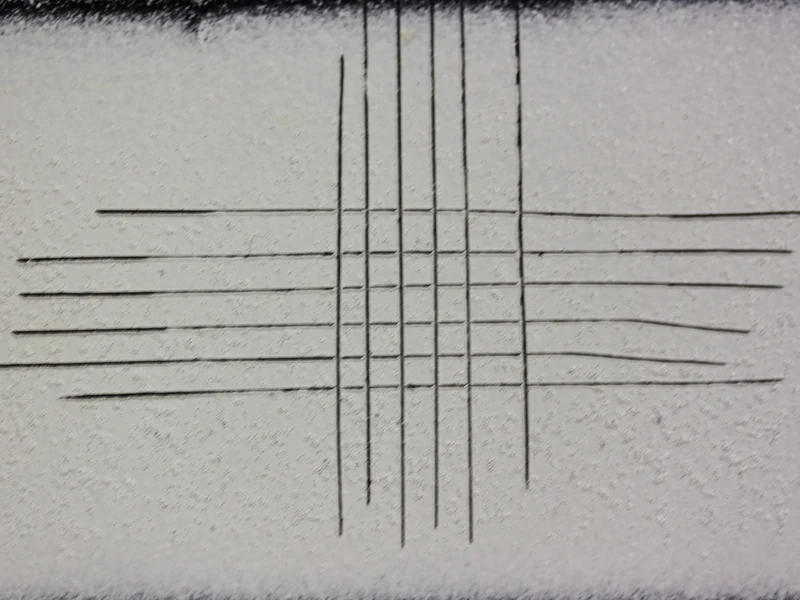
ASTM D3359 gives an OEM buyer a way to rate how a coating resists removal by tape after a defined cut. For a powder-coated aluminum tube, the useful question is not simply “Did it pass?” Ask which method was used, what was tested, what rating was agreed in advance, and whether the sample represents the production order. The tape test is qualitative; it does not measure bond strength in newtons or predict years of outdoor service.
Header photo: an illustrative cross-cut specimen from Wikimedia Commons (CC0). It is not a Xingyong sample or a verified ASTM D3359 result.
What does ASTM D3359 actually measure?
ASTM D3359-23 covers tape-test methods for relatively ductile coating films on metal. The tester cuts through the film, applies and removes pressure-sensitive tape, then classifies the visible coating removal. The standard distinguishes Method A, an X-cut, from Method B, a cross-cut lattice. Its ratings indicate whether a specified minimum level was met; they are not a precise measurement of adhesion strength.
This distinction matters when comparing suppliers. A report saying “excellent adhesion” or “5B” without the test method, specimen and acceptance requirement is hard to audit. A good rating on a flat coupon also does not prove that a tube end, drilled hole, collar interface or another difficult feature has the same coating condition.
Choose the method and specimen before coating begins
The current ASTM scope primarily places Method B with total film thickness below 125 µm and Method A above 125 µm. Method B on a thicker film needs wider-spaced cuts and explicit buyer–seller agreement. The test provider should select the method from the actual coating system and measured dry-film thickness, then follow the full edition named in the purchase specification. A DeFelsko method guide illustrates why blade selection, a sound cut and tape handling affect the result.
A small round pole may not offer a stable, flat test area for a lattice cutter. Agree whether testing will use an accessible location on the finished part, a representative coated tube section or a flat process coupon. If a coupon is used, identify its alloy, pretreatment, powder, cure run and lot relationship to the order. Do not silently substitute an unrelated panel for the supplied poles.
The cuts damage the finish. Plan a sacrificial sample or an agreed nonfunctional test area rather than cutting a saleable visible surface and then treating that part as untouched stock. For telescoping assemblies, also specify which finished surfaces must remain smooth and free of coating buildup.
What should the OEM test request and report contain?
| Item to agree | What the record should identify |
|---|---|
| Method | ASTM D3359 edition, Method A or B, and any agreed deviation |
| Specimen | Finished tube, tube section or coupon; part ID, lot and coating system |
| Condition | Dry-film thickness, cure state, test location and any prior exposure |
| Execution | Cutting tool and spacing, tape identity, test count and operator or lab |
| Result | Individual ratings, photographs, failure location and the agreed pass limit |
| Decision | Who holds, retests, reworks or rejects a lot outside the agreed limit |
Set the pass limit and sampling plan before production; ASTM D3359 does not choose one universal acceptance grade for every OEM pole. Keep the test photos with the drawing revision and finish sample so a later supplier or batch can be compared on the same basis. If the test is a first-article requirement, connect its result to the first article inspection record.
Read the result alongside other finish checks
A tape-test rating addresses resistance to separation at the tested cut. It does not replace cured-film thickness, appearance, masking, assembled sliding fit or corrosion checks. For tube and finish options, see the powder-coated aluminum tubing range; the purchase drawing still needs to define the actual finish and acceptance rules for the order.
Do not treat an ISO 2409 class as an automatic translation of an ASTM D3359 rating. ASTM says the two methods are similar but not technically equivalent. The ISO 2409:2020 abstract also says its cross-cut procedure is an empirical resistance-to-separation test, not a direct measurement of adhesion. Name the selected standard and edition rather than mixing classification scales in one acceptance sheet.
Frequently asked questions
Does every powder-coated aluminum tube need a 5B result?
No universal grade follows from the tube material alone. The buyer and supplier should agree on the applicable method, representative specimen and pass limit before the coating run.
Can a flat coupon stand in for a finished pole?
It can be useful for process control when its alloy, pretreatment, powder and cure are traceable to the order. It does not by itself verify coating at pole ends, holes or sliding interfaces.
Does a cross-hatch pass prove the coating will resist corrosion?
No. Tape-test classification and corrosion performance answer different questions. Specify any exposure test, specimen preparation and acceptance criteria separately.

 English
 Español
 Français
 Deutsch
 Português