
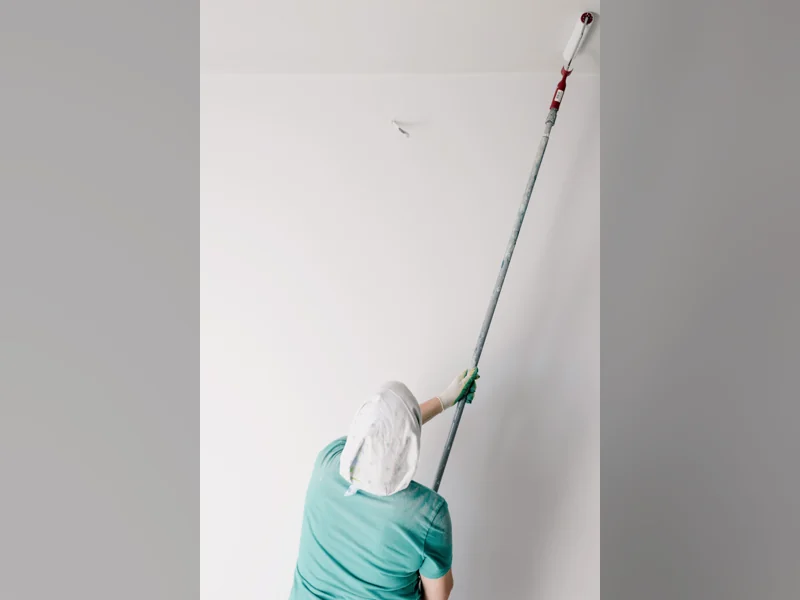
How to paint high ceilings: use an extension pole and roller for the open ceiling, then handle edges and fixtures separately. Check that the roller frame fits, the pole stays locked, and you can walk on a level floor while guiding it. If the work requires leaning over stairs or reaching around a fixture, use proper access equipment or a professional painter.
Choose a Pole You Can Control at Working Height
Test the pole with the roller attached before loading paint. Measure the ceiling height, then hold the frame at a comfortable hand position. The distance the pole must cover depends on your hand height and the angle at which you hold it. Maximum catalog length is not the same as useful working reach.
Extend the pole only as far as needed. With both feet on a level floor, move the dry roller across the area you intend to paint. You should be able to keep the cover flat against the ceiling and walk with it. If the shaft bends enough for the roller to bounce, shorten it or change your standing position. If you need every section fully extended and still have to lean, the pole is the wrong access method.
The same dry run shows whether you can clear lights, fans, and beams. Mark where you will reload and where the floor covering ends. For more on working reach, see Xingyong’s extension pole length guide.
Check the Roller Frame and Lock
The roller frame should thread on squarely and stay tight through a change of direction. Fit the exact frame you plan to use, with its cover installed. Make several dry passes overhead. If the frame rocks at the tip, reseat it or use a compatible pole. A loose connection makes a straight pass difficult even when the shaft feels stiff.
Now watch the telescoping sections. If one slides inward under normal rolling pressure, stop and inspect the lock. If the tip rotates while the pole stays still, inspect the tip joint. If the whole pole bows, shorten the extension. Tightening the frame will not fix a slipping lock, and tightening the lock will not fix poor frame fit.
Xingyong’s paint roller extension pole range uses a 3/4-inch ACME interface on fixed and telescoping builds. For an OEM order, test the actual roller frame that will be sold with the pole; a thread label alone cannot confirm fit.
Prepare the Edges, Then Roll the Open Ceiling
Finish surface preparation and plan the edges before you extend the roller. Protect the floor and furniture. Check for dust, loose paint, cracks, and water damage; correct problems that new paint cannot hide. Follow the paint maker’s instructions for cleaning, primer, roller cover, and drying time.
“Cutting in” means brushing the narrow perimeter and the spaces around fixtures that a broad roller cannot cover neatly. A brush holder on a pole may work on an accessible straight edge. Detailed molding, deep recesses, and fixture bases may require closer access. Do not improvise a platform on stairs to reach them. Benjamin Moore recommends professional help for demanding high-ceiling and stairwell work.
Load the roller evenly. Starting beside the cut-in area, cover a section you can finish while its edge remains wet. Guide the pole with two hands rather than pushing hard; heavy pressure can bend the shaft and leave uneven coverage. Walk along the floor as you work, reload before the cover runs dry, and adjust the pole length when the ceiling angle changes. Sherwin-Williams also advises cutting in first and using an extension pole for the open field in its ceiling painting guide.
| What happens | Check | Action |
|---|---|---|
| Roller frame turns | Thread or tip joint | Stop and refit the frame. |
| Pole gets shorter | Telescoping lock | Stop and inspect the lock. |
| Roller skips at full reach | Pole angle or bend | Shorten the pole or move closer. |
| Overlapping bands show | Paint load or drying edge | Work in smaller sections. |
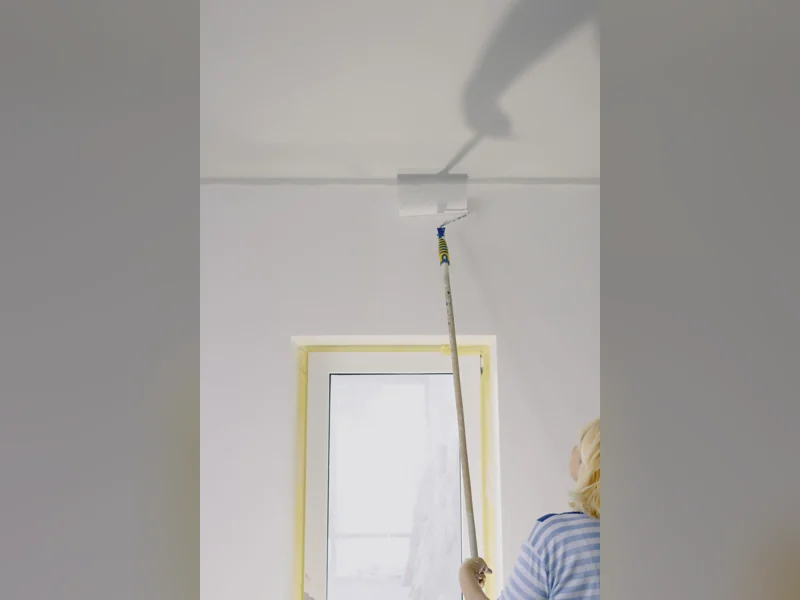
Know When to Stop
Stop if you cannot keep stable footing and controlled contact between the roller and ceiling. Stairwells, steep vaults, and deep recesses may require a suitable platform and a qualified painter. A longer pole does not solve an unsafe stance or make detailed edge work reachable.
Keep an aluminum pole away from electrical fittings. Turn off the relevant circuit before painting near a fixture; if wiring is exposed or uncertain, have a qualified person assess it. Aluminum conducts electricity and is not a protective tool. Older coatings may pose a separate preparation hazard. In the United States, disturbing paint in a pre-1978 home or child-occupied facility may trigger the EPA’s lead-safe renovation requirements.
What Paint-Tool Buyers Should Specify
Approve the pole and roller frame as one working assembly. Send the supplier the frame that will ship with the product, the intended ceiling task, the desired length range, and the packaging plan. At sample review, thread on the frame, make dry passes at the intended working length, change direction, and check for tip rotation, lock slip, and excessive bend. Record the frame model and setup so later production samples can be compared with the approved one.
Xingyong makes aluminum tubes and matching plastic parts and assembles its paint poles in-house. Its roller-pole line offers fixed and telescoping 2–24 ft shelf classes; those classes do not imply that the longest version suits every ceiling. For brush and decorator heads, see the separate painting extension pole range. For roller-frame fit, start with the paint roller pole range.
Frequently Asked Questions
Can I paint a high ceiling from the floor?
Yes, if you can stand on level ground, control the loaded roller, and reach the open area. Plan edges and fixtures separately.
How long should the extension pole be?
Use the shortest length that reaches the ceiling at a controllable angle. Test it with your roller frame; package length alone is not a working-reach guarantee.
Why does the roller wobble?
Check frame fit, the tip joint, the lock, and shaft bend at working length. Test each separately because one adjustment will not fix every cause.
Is a 3/4-inch ACME tip enough to guarantee roller-frame fit?
No. Fit the actual frame that will be sold or used with the pole and test it while changing rolling direction.
What should an OEM buyer test before approving a sample?
Check frame seating, tip rotation, lock holding, roller tracking, collapsed length, and packaging against the agreed specification.



 English
 Español
 Français
 Deutsch
 Português