
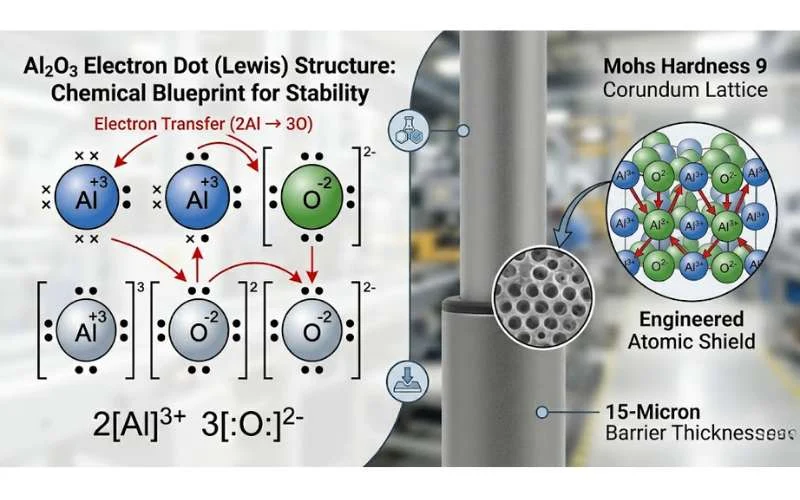
Manufacturing high-end aluminum products isn’t just about heavy machinery; it is about mastering the atomic reality of the materials we shape. Since 2010 at XingyongI have seen procurement managers focus on wall thickness and alloy grades, yet the real battle against corrosion is won or lost at the sub-atomic level. If the aluminum oxide (Al₂O₃) layer on your telescopic pole isn’t chemically stable, the product will fail in the field. Understanding the electron dot structure of this compound is the first step in recognizing a superior B2B supplier.
To make the article actionable, convert the key takeaway into an RFQ line item, compare it against anodizing and surface finish optionsand use batch quality and traceability controls for the production route. For external technical context, use Aluminum Association material resources.
What is the Electron Dot Structure for Aluminum Oxide?
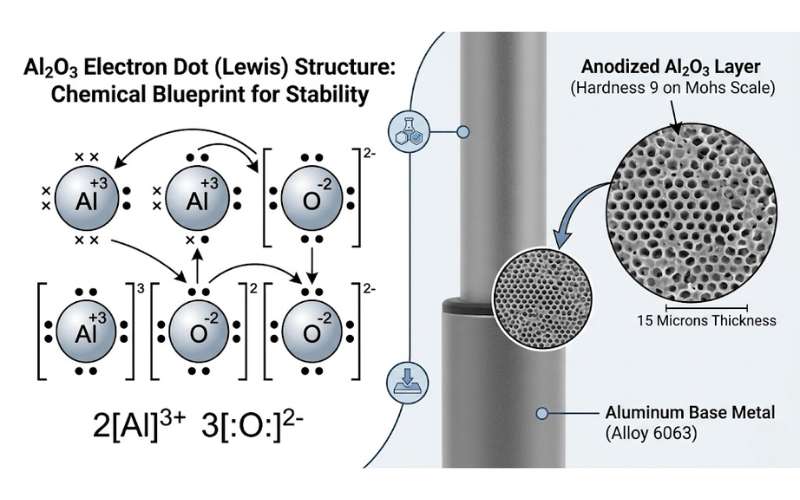
The electron dot structure (or Lewis structure) for aluminum oxide (Al₂O₃) represents the transfer of valence electrons from aluminum atoms to oxygen atoms to achieve a stable chemical state. In this ionic bondtwo aluminum atoms each lose three electrons, becoming Al³⁺ cations. These six total electrons are captured by three oxygen atomswhich each gain two electrons to become O²⁻ anions.
The final configuration is formally expressed as:
2[Al]³⁺ 3[O]²⁻
This specific arrangement ensures that every atom satisfies the octet rulecreating a crystal lattice that is incredibly hard and chemically inert. This atomic stability is exactly why we rely on Al₂O₃ to protect the underlying metal in our professional telescopic poles. Without this precise electron exchange, the aluminum remains vulnerable to environmental degradation and structural pitting.

The Valence Shell Mechanics: Why Al and O Form a Stable Bond
To understand why our products withstand harsh UV and chlorine exposure, we have to look at the energetic “hunger” of the atoms. Aluminum, in Group 13, has a configuration of [Ne] 3s² 3p¹. It is much more energetically favorable for it to shed those three valence electrons than to try and gain five more.
Conversely, Oxygen (Group 16) has six valence electrons and is highly electronegative. It “wants” two more electrons to fill its 2p subshell. When we initiate the anodizing process in our 14-press extrusion facility, we are essentially forcing this electron exchange to happen in a controlled, uniform manner across the entire surface of the profile. According to NIST Material Datathe cohesive energy of this bond is what gives the oxide its legendary stability.
| Element | Initial Valence Electrons | Change | Final Ion Charge | Electron Configuration |
|---|---|---|---|---|
| Aluminum (Al) | 3 | Lose 3 | Al₂O₃ | [Ne] (Stable) |
| Oxygen (O) | 6 | Gain 2 | O²⁻ | [Ne] (Stable) |
From Atoms to Anodizing: Why Al2O3 is the “Secret Sauce”
In my experience on the factory floor, I’ve seen many “budget” suppliers skip the nuances of the ionic lattice. They produce a natural oxide layer that is thin, porous, and disorganized. At Xingyongwe use Lewis structure principles to engineer a superior barrier.
The Hardness of the Ionic Lattice
Because the electrostatic attraction between Al₂O₃ and O²⁻ is so intense, the resulting Al2O3 layer (also known as Corundum in its mineral form) has a Mohs hardness of 9. This is just below diamond. When a procurement manager buys our heavy-duty telescopic polesthey aren’t just buying metal; they are buying a ceramic-like shield that resists scratching and wear from constant sliding adjustments.
Engineering the Electron Transfer in the Lab
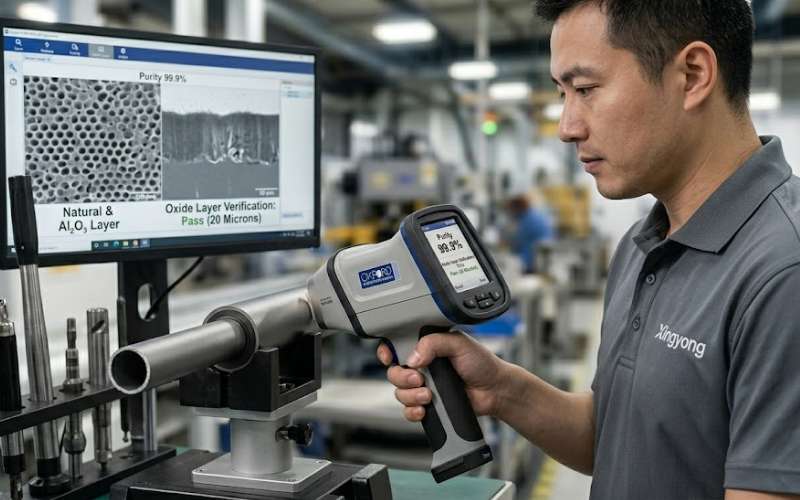
At our testing centerwe don’t guess—we verify. We use Oxford spectrometers to confirm the alloy purity before extrusion, ensuring there are no stray elements that could disrupt the ionic bonding of the oxide layer. If the electron transfer is blocked by impurities like excess Copper or Iron, the “skin” of the pole will be weak, leading to the “white rust” that plagues lower-quality brands in the Home Depot or Walmart supply chains.
Industrial Production vs. Natural Oxidation: A Manufacturer’s Insight
A common misconception among buyers is that “all aluminum is rust-proof.” While aluminum naturally forms an Al₂O₃ layer, that natural layer is only about 2-3 nanometers thick. It’s like a piece of tissue paper protecting a fortress.
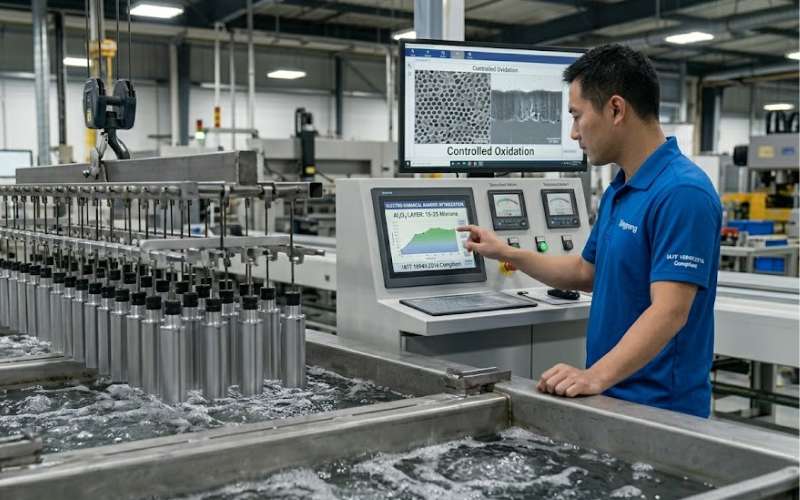
In our anodizing workshopwe use two massive automatic lines to grow this layer through electrolytic oxidation. We increase that thickness to 20-25 microns. We are essentially stacking the crystal lattice described in the electron dot structure thousands of times over. This creates a surface that is:
- Non-conductive: Important for safety around electrical pool equipment.
- Porosity-controlled: Allowing us to trap dyes for vibrant, fade-resistant colors.
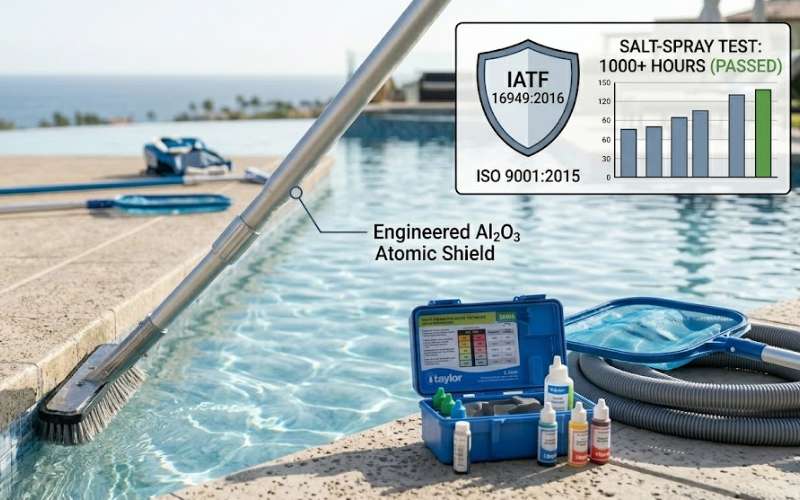
- Corrosion-resistant: Tested via salt spray to withstand the high-salinity environments of coastal regions.
Why This Atomic Stability Means Profit for Distributors
If you are a brand owner or a supply chain managerthe electron dot structure of your product is your best insurance policy. A stable chemical bond translates directly to your bottom line.
- Reduced Return Rates: When the Al₂O₃ layer is correctly formed, the poles don’t “seize” or pit. This eliminates the #1 complaint from end-users in the pool maintenance industry.
- Shipping Resilience: Many factories struggle with “sea salt corrosion” during trans-pacific shipping. Because we master the electrochemistry of the oxide layer, our products arrive at your warehouse in the same pristine condition they left our Huai’an facility.
- Market Authority: Selling a product that you can explain—from its ISO 9001:2015 certification down to its atomic durability—positions you as an expert, not just a middleman.
Atomic Precision in Every Shipment
The electron dot structure for aluminum oxide isn’t just a chemistry lesson—it is the blueprint for the world’s most durable aluminum products. By understanding how Al₂O₃ and O²⁻ ions interlock, we at Xingyong have optimized our 14 extrusion presses and 2 anodizing lines to produce 3,000 tons of high-performance material every month. We don’t just “make poles”; we engineer chemical barriers.
Let’s Secure Your Supply Chain
If you are looking to upgrade your OEM manufacturing or need a partner who understands the technical demands of the ISO 9001 standard, we are ready to help. At Xingyongwe offer full customization—from drawing to final packaging. Contact our engineering team today to request a technical sample and see the difference that 16 years of metallurgical expertise makes.
Related Guides & Resources
Keep Reading
GlossaryWhat Is The Aluminum DensityAnnealing Aluminum ExplainedAre Aluminum Ingots Valuable And How Much Money Are They WorDoes Aluminum RustElectrical Conductivity Of AluminumHow Hot Is Too Hot For AluminumIs Aluminum ConductiveIs Aluminum Magnetic · Melting Point Of Aluminum
Related products: Explore related products and review matching solutions.


 English
  Español
  Français
  Deutsch
  Português