Buying managers for global brands often face a high-stakes dilemma: choosing between the raw power of steel and the lightweight efficiency of aluminum. Selecting the wrong material leads to catastrophic product failure, high shipping surcharges, or premature corrosion in the field. This engineering guide, backed by Xingyong’s 24 years of extrusion expertise, breaks down the technical reality of aluminum’s strength to help you make a data-driven sourcing decision.
Is Aluminum Really “Weaker” Than Steel?
The short answer is: No, not when you calculate the strength-to-weight ratio. While structural steel has a higher absolute tensile strength, aluminum is approximately one-third the density of steel ($2.70g/cm vs $7.85tg/cm. In B2B manufacturing, we focus on Specific Strength, which measures a material’s strength divided by its density.
At Xingyong, we often replace heavy steel components with high-grade 7075-T6 aluminum, which offers a yield strength of roughly $503 MPa—surpassing many common mild steels while remaining significantly lighter. For volume buyers, this transition isn’t just about physics; it’s about reducing logistics costs and improving end-user ergonomics.
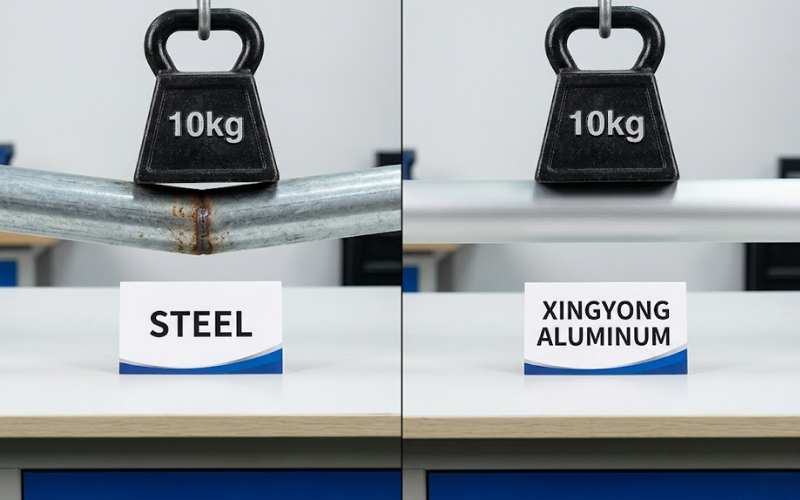
Comparative Strength Data: Aluminum vs. Steel Grades
| Material Grade | Yield Strength (MPa) | Ultimate Tensile Strength (MPa) | Density ($g/cm^3$) |
|---|---|---|---|
| Mild Steel (A36) | 250 | 400 | 7.85 |
| Stainless Steel (304) | 215 | 505 | 8.00 |
| Aluminum 6061-T6 | 276 | 310 | 2.70 |
| Aluminum 7075-T6 | 503 | 572 | 2.81 |
The Engineering Mechanics of B2B Product Durability
Yield Strength vs. Tensile Strength
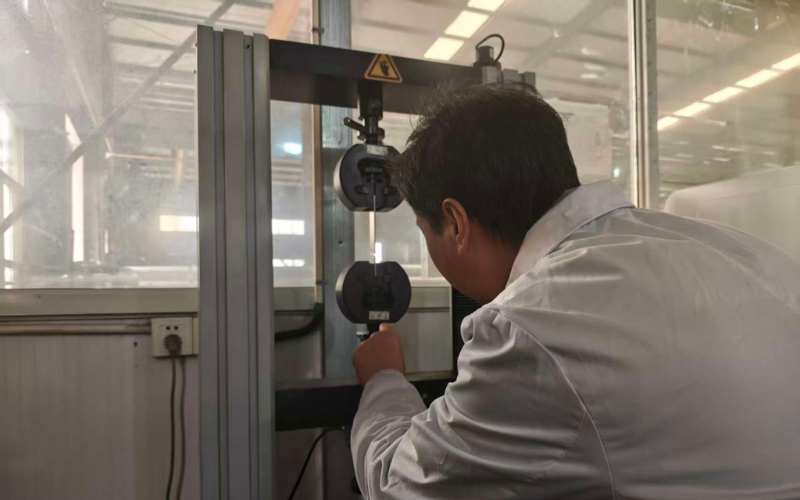
In the context of a telescopic pool pole, the Yield Strength is your most critical metric. This is the point where the metal permanently deforms. If a professional cleaner extends a 16-foot pole and it remains bent, the yield strength was exceeded. We utilize ISO 9001:2015 certified testing to ensure our 6000-series extrusions maintain a high elastic limit.
Engineer’s Field Lesson: I once saw a batch of “budget” 6063 poles from a competitor fail in a North American winter. Why? They skimped on the T6 tempering process. Without precise precipitation hardening, the aluminum became brittle in sub-zero temperatures. At Xingyong, we use our 14 automated extrusion presses to ensure the grain structure is locked, preventing “cold-snapping.”
Stiffness and Young’s Modulus
A common critique of aluminum is its lower Young’s Modulus (stiffness). Aluminum has a modulus of approximately $70 \text{ GPa}$, while steel is $200 \text{ GPa}$. However, we solve this through Geometry. By increasing the outer diameter or using a custom reinforced rib profile, we create an aluminum tube that is just as rigid as a steel one but still 50% lighter.
The Fatigue Limit Reality
Unlike steel, aluminum does not have an infinite fatigue limit. Every stress cycle brings aluminum closer to failure. To combat this in high-use tools like pool cover reels, Xingyong employs a dual-step aging process. This stabilizes the alloy against Corrosion Fatigue, especially critical in high-chlorine environments where steel would rust and aluminum could otherwise crack.
The “Distributor Profit” Logic: The ROI of Lightweighting
For a brand owner or a buyer for Walmart or Home Depot, the “strength” of a material includes its financial impact on the balance sheet.
1. The Landed Cost Advantage
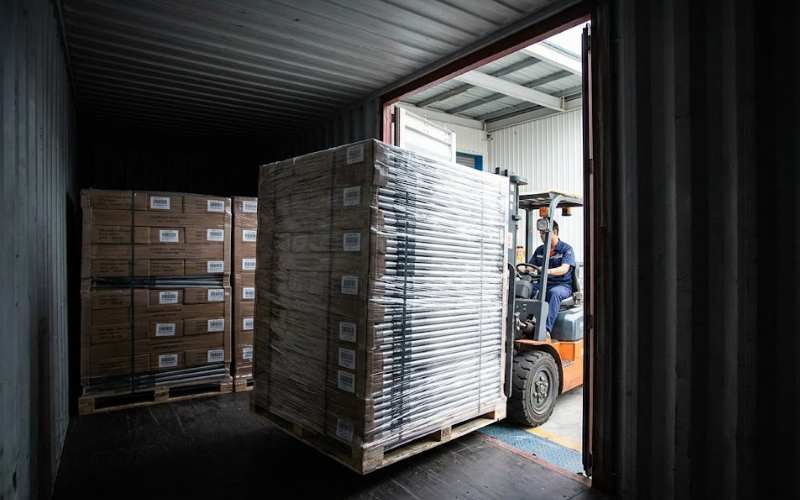
Consider a shipment of 5,000 professional-grade extension poles.
- Steel Version: Weighs ~12,500 kg. High risk of hitting container weight limits before filling the volume.
- Xingyong Aluminum Version: Weighs ~4,300 kg.
Result: You can triple your unit count per 40HQ container, effectively cutting your per-unit sea freight cost by nearly 60%.
2. Zero-Maintenance Lifecycle
Steel requires expensive powder coating or galvanization. Once the coating is scratched—common in warehouse handling—the structural integrity begins to rot. Aluminum naturally forms an oxide layer that heals itself. For B2B clients, this means fewer warranty claims and higher customer lifetime value.
How Xingyong Guarantees Industrial-Grade Strength
We don’t just “produce” aluminum; we engineer it. Our facility integrates the entire value chain to ensure the E-E-A-T (Experience, Expertise, Authoritativeness, Trustworthiness) standards your brand requires.
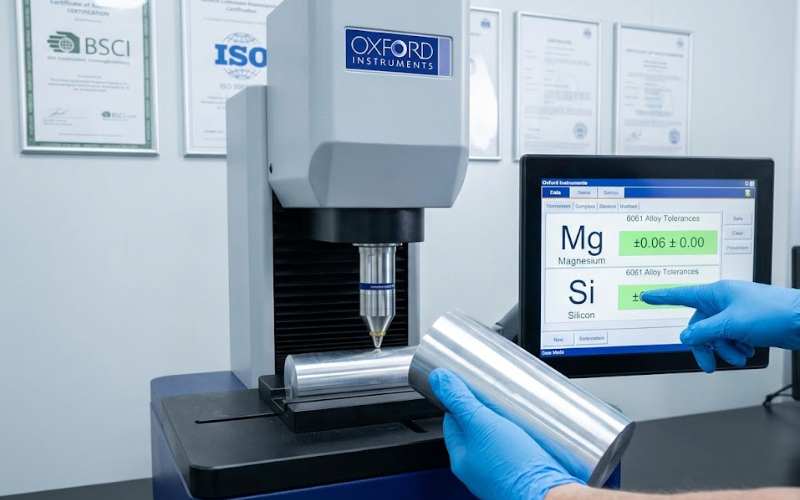
- Chemical Integrity: Every billet is verified using our Oxford Instruments Spectrometer. If the magnesium or silicon levels vary by even 0.01%, the strength is compromised.
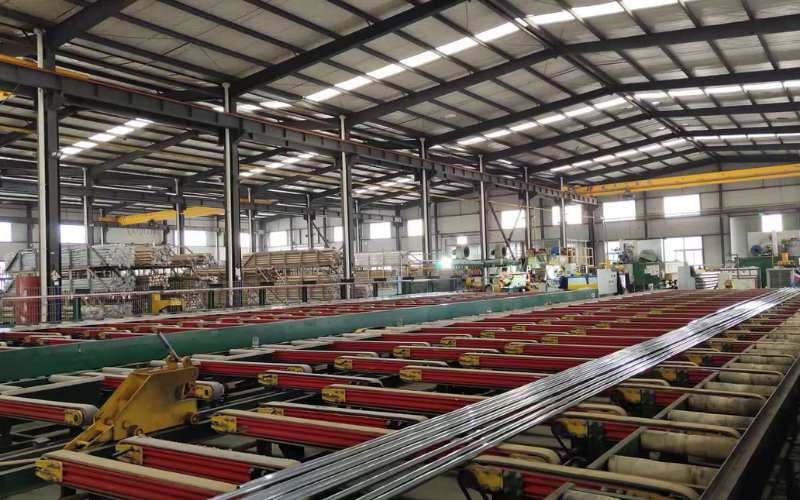
- Extrusion Power: Our 2000T forward/reverse extrusion presses allow us to produce high-density profiles with consistent wall thickness, minimizing the “thin-wall” weak points common in low-tier factories.
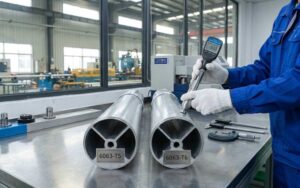
- Precision Finishing: With 2 automatic oxidation lines, we ensure the surface hardness (measured via Webster Hardness Testers) is consistent across the entire 6-meter length.
- Rigorous Testing: Our lab provides a Material Test Report (MTR) for every shipment, documenting tensile strength, elongation, and yield points.
Technical Comparison: When to Switch
| Project Requirement | Material Choice | The “Why” |
|---|---|---|
| Maximum Impact Resistance | Structural Steel | Higher density provides better resistance to blunt force. |
| Manual Labor Tools (Poles) | 6061-T6 Aluminum | Prevents user fatigue while offering yield strength above 240 MPa. |
| Saltwater/Pool Chemical Use | Anodized Aluminum | Steel will suffer from pitting corrosion without constant coating. |
| High-Precision Telescoping | 6063-T5/T6 Aluminum | Easier to extrude into complex, tight-tolerance interlocking shapes than steel. |
The Verdict for Sourcing Managers
Selecting between aluminum and steel isn’t about which metal is “better”—it’s about which metal makes your business more profitable. For the majority of B2B applications in the outdoor, cleaning, and residential sectors, aluminum’s specific strength and life-cycle durability far outweigh the raw density of steel.
At Xingyong, we provide the IATF 16949:2016 and BSCI certified manufacturing depth to ensure that when we say our aluminum is “strong,” we have the data, the machinery, and the 22-year track record to prove it.
Upgrade Your Material Strategy
If you are currently sourcing steel components and struggling with weight-related shipping costs or rust-driven returns, it is time to re-engineer. We offer OEM/ODM services including drawing-to-part production and material optimization.
Consult a Xingyong Engineer today for a technical review of your current specs. Let’s build a product that is lighter, stronger, and more profitable.