Inside the Plant · Huai'an, Jiangsu

Factory Tour: How Your Aluminum Pole Gets Made

This page walks one pole through our plant, in the order it actually happens — billet to press, press to anodizing, anodizing to machining, then assembly, inspection and the container. The plant is run by Jiangsu Xingyong Aluminum Technology Co., Ltd, a direct aluminum extruder in Huai'an, Jiangsu since 2010.

  • 14 extrusion presses, 350T to 2,000T — forward and reverse, so a new cross-section is a tooling decision, not a supplier hunt.
  • Every step under one roof — extrusion, anodizing, machining, molding, assembly and packing on one site, with 300+ staff.
  • ~3,000 tonnes a month — capacity sized for retail programs, not sample runs.
See Production Capacity
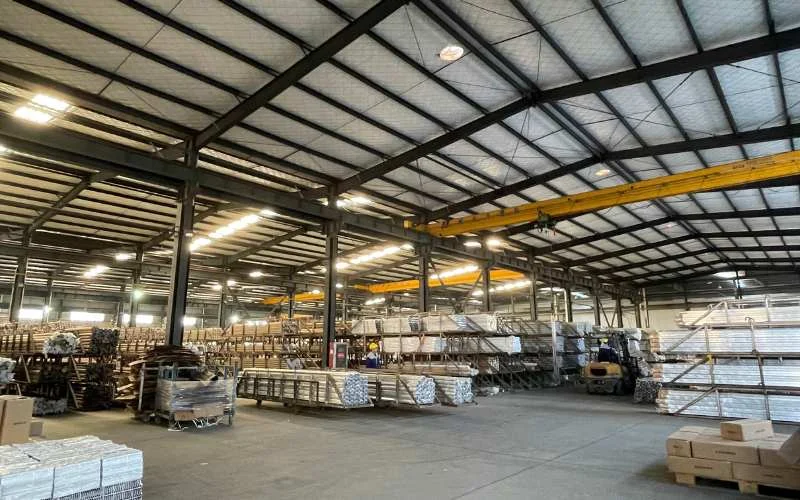
Wholesale Aluminum Poles Warehouse Logistics at Xingyong aluminum pole factory
2010Extruding Aluminum Since
14Extrusion Presses (350T–2000T)
3,000 tPer Month
300+Staff On Site
Why This Page Exists

What a Buyer Is Actually Checking on a Factory Tour

Most sourcing managers arrive with the same three questions, and none of them are about machines: is this a factory or a trading desk, does the quality come from a process or from sorting at the end, and can it hold a schedule when a retail program lands. The walk below is arranged to answer those three, in that order. If you would rather see it live, we run video walkthroughs on request — a phone camera on the shop floor, in your time zone, no edit. Visits to Huai'an are welcome any working day.
Billet In, Alloy Confirmed Before It Reaches the Press
Step 1 · Material

Billet In, Alloy Confirmed Before It Reaches the Press

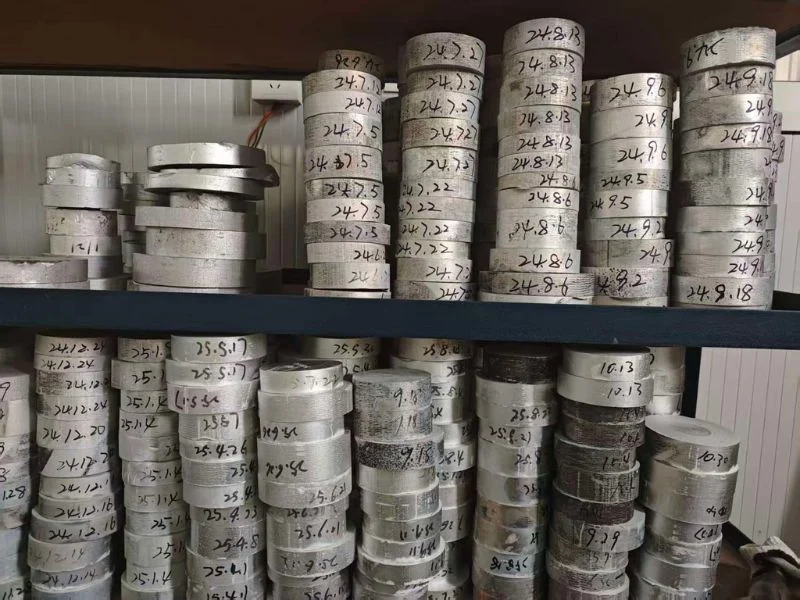
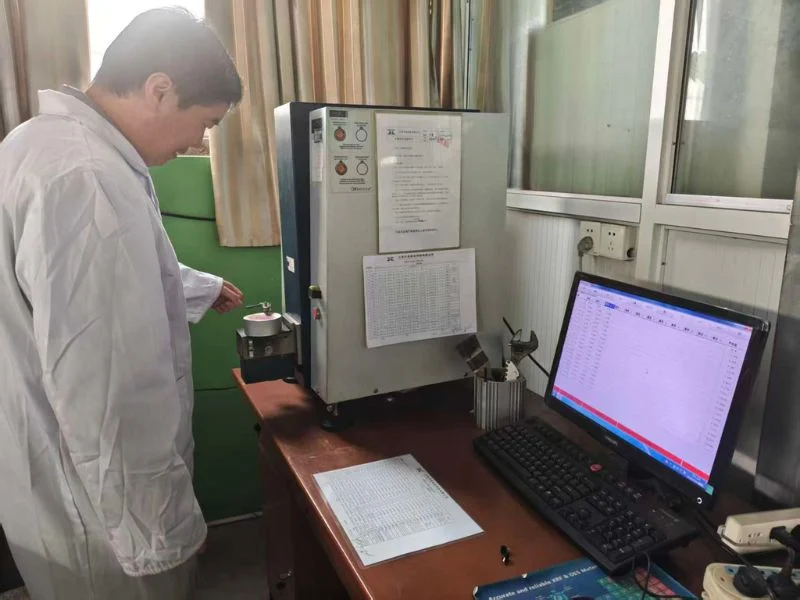
Poles are built from 6061, 6063, 6065 and 7075 — the wrought designations maintained by The Aluminum Association — depending on what the part has to survive. Billet arrives racked by grade, and composition is confirmed on our own optical emission spectrometer rather than taken from a supplier's certificate alone. That check matters commercially, not just technically: a pole sold as 6063-T5 that is not 6063-T5 fails at the customer, months after the container cleared.
Step 2 · Extrusion

14 Presses From 350T to 2,000T, Forward and Reverse

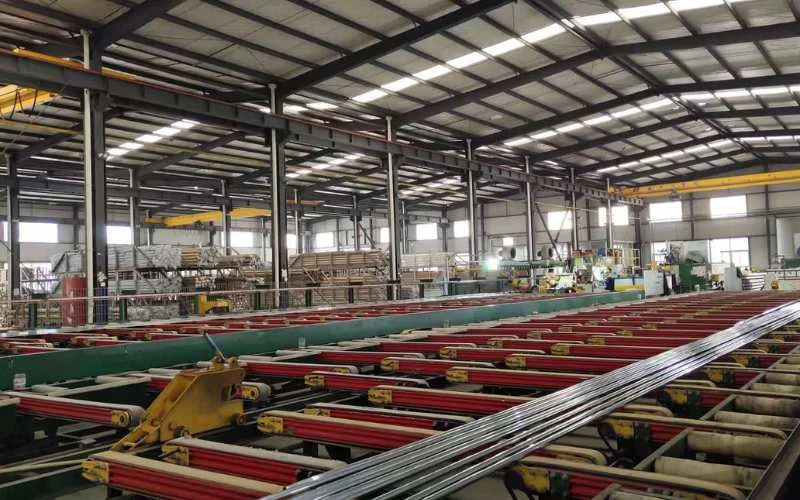
The press line is the reason this factory exists. Fourteen presses spanning 350, 500, 600, 800, 1,400 and 2,000 tonnes, in both forward and reverse configurations, cover everything from a thin-wall 20 mm pole section to a heavy structural profile. What that range buys a buyer is scheduling freedom. A small section does not have to wait behind a large program on the only big press, and a new die can be trialed without stopping a production run. Dies are our own. Changing a cross-section is a tooling decision made in this building — see custom spec and tooling for how a new profile moves from drawing to first article.
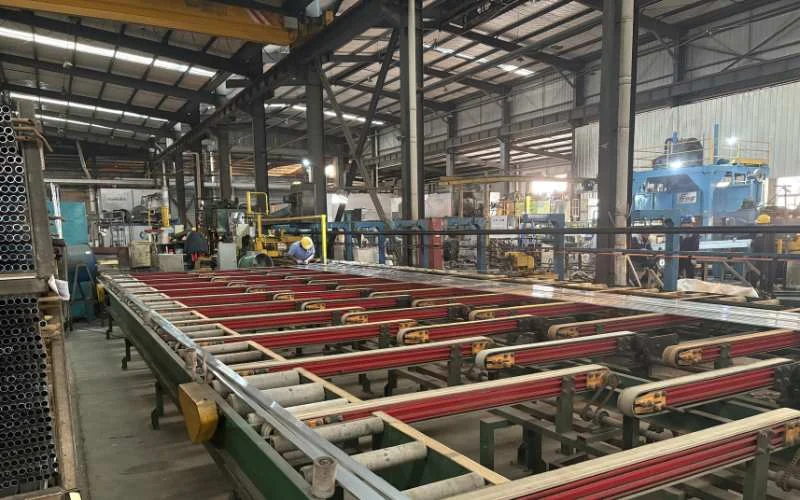
Aluminum Extrusion Press Telescopic Pole Productionextrusion Workshop at Xingyong aluminum pole factory
Xingyong Extrusion Press 2000t Aluminum Profile Production at Xingyong aluminum pole factory
Step 3 · Temper & Sizing

Aging, Straightening and Cut-to-Length

Off the run-out table, profiles are aged to temper, straightened and cut to length. This is the quiet step that decides whether a three-section pole slides cleanly or binds halfway. Straightness and length tolerance are agreed per program before sampling, because a telescopic pole is a tolerance stack: every section that runs loose or tight shows up at the lock.
Step 4 · Surface

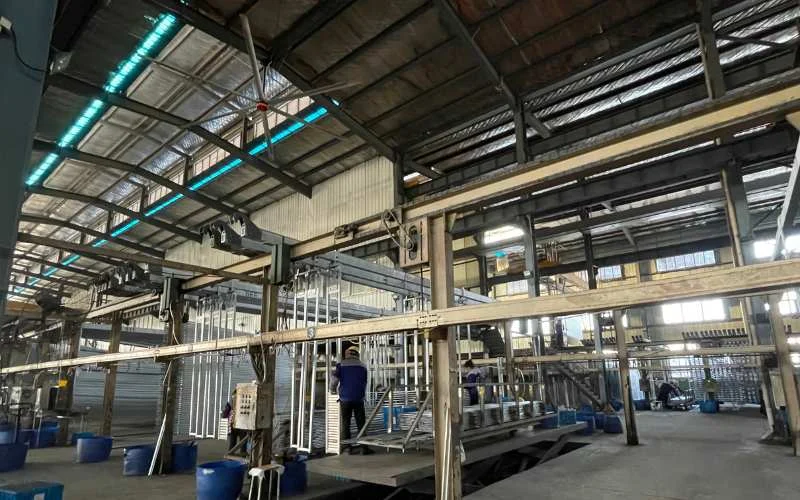
Two Automatic Anodizing Lines, Plus Blasting and Water Treatment

Surface finishing runs on two large automatic anodizing lines capable of a full color range, supported by three long-part and two short-part sandblasting machines for matte and textured finishes. The site also runs its own wastewater treatment station. That is an environmental requirement, but it is also a supply-chain one: buyers whose retail customers audit their chain need the finishing step to be inside an audited facility, not subcontracted to a workshop nobody has seen. Finish options and film behavior are covered on anodizing and surface finishes.
Xingyong Automated Anodizing Production Line at Xingyong aluminum pole factory
Step 5 · Machining & Molding

Where a Tube Becomes a Pole Part

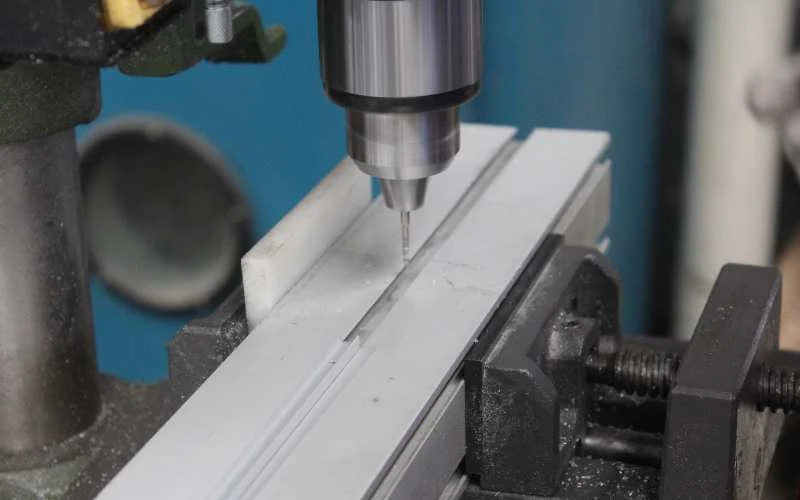
A cut tube is not a product. This shop turns it into one: CNC centers, saws, punches, milling, planing, turning, drawing, bending, polishing, necking and flaring machines, laser marking, and carton packing equipment — dozens of machines covering everything between extrusion and assembly.
Xingyong Cnc Machining Workshop Aluminum Parts at Xingyong aluminum pole factory

CNC and Secondary Machining

Necking, flaring, drilling and slotting are done here, so tube ends match the lock and the tool interface your kit already uses.

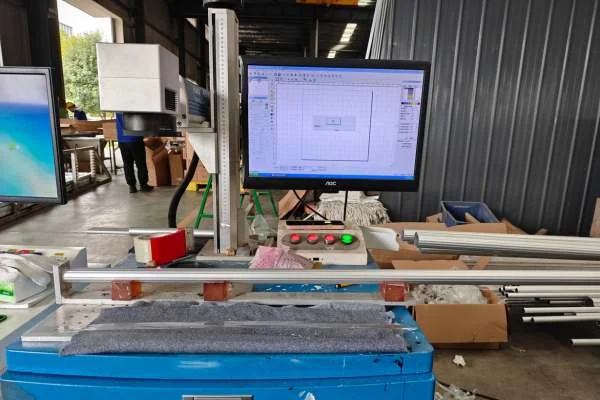
Custom Laser Marking Aluminum Pole for OEM aluminum pole manufacturing

Laser Marking and Branding

Brand marks, size markings and batch codes go on in house, which keeps private-label identity out of a third party's hands.
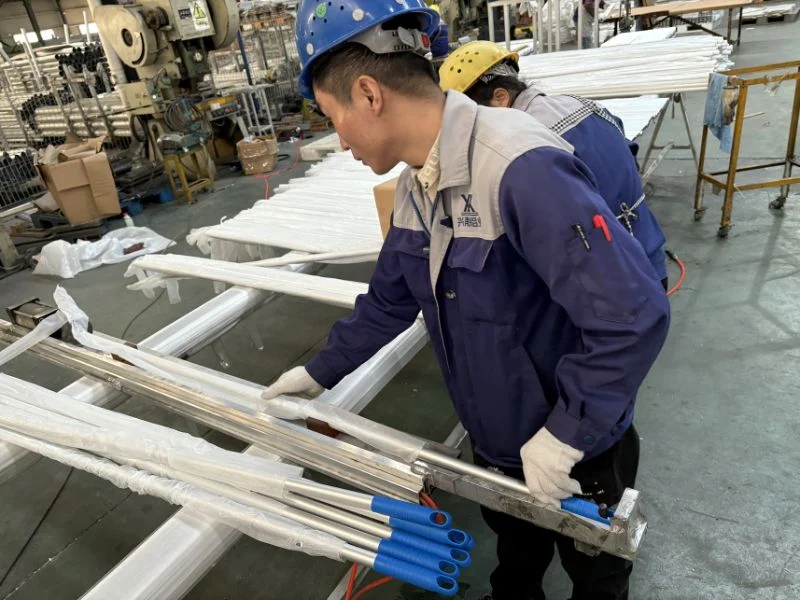
Injection Molding of Plastic Parts

Injection Molding of Plastic Parts

Locks, grips and end caps are molded on site in brand colors — most custom tube factories stop at the cut tube and leave you to source these.

More on how tube and lock are matched: plastic lock and connector matching.
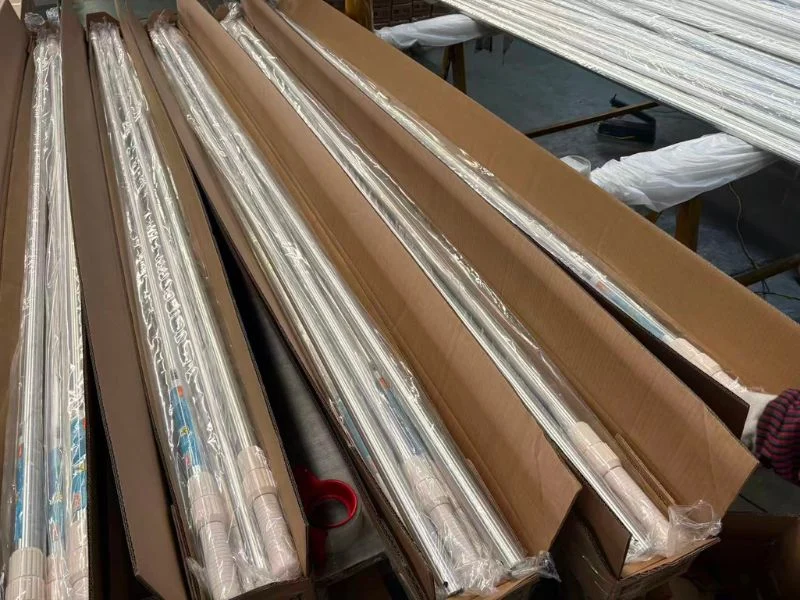
Complete Poles Leave Assembled, Not as Parts
Step 6 · Assembly

Complete Poles Leave Assembled, Not as Parts

Sections, locks, grips and end fittings come together on the assembly line, and finished poles are function-checked before they are packed. This is the step that separates a pole supplier from a tube supplier. Assembly depth is set per order: bare tube, part-fitted, or retail-ready in your own carton. Whichever you choose, one factory owns the result — there is no second vendor to referee when a lock does not match a tube.
Step 7 · Inspection

The Inspection Center Behind Every Number We Publish

Quality that comes from sorting at the end is expensive and unreliable. These instruments exist so that problems are caught as process drift, not as a customer complaint.
spectrometer

Composition

Oxford optical emission spectrometer plus wet chemistry, so the alloy on the order is the alloy in the tube.
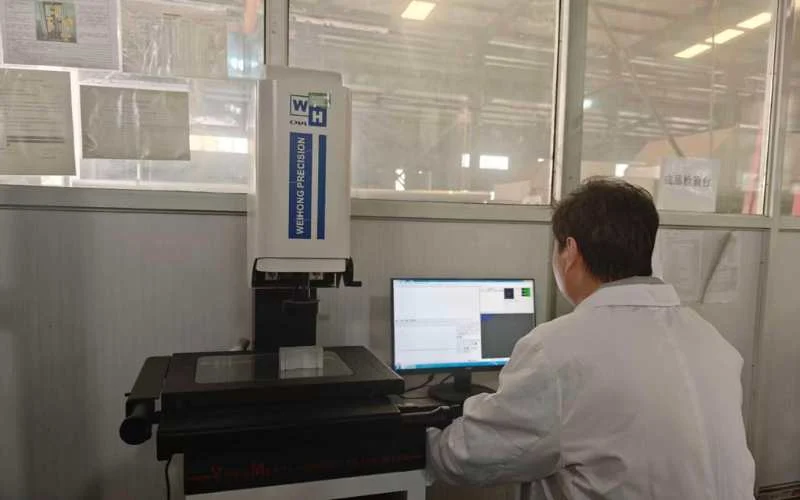
Aluminum Telescopic Tube Hardness Test iatf16949 Xingyong certificate for Xingyong manufacturing compliance

Dimensions and Section

Profile projector, metallurgical microscope, a Lemet section scanner, universal angle and depth gauges for the tolerance stack.
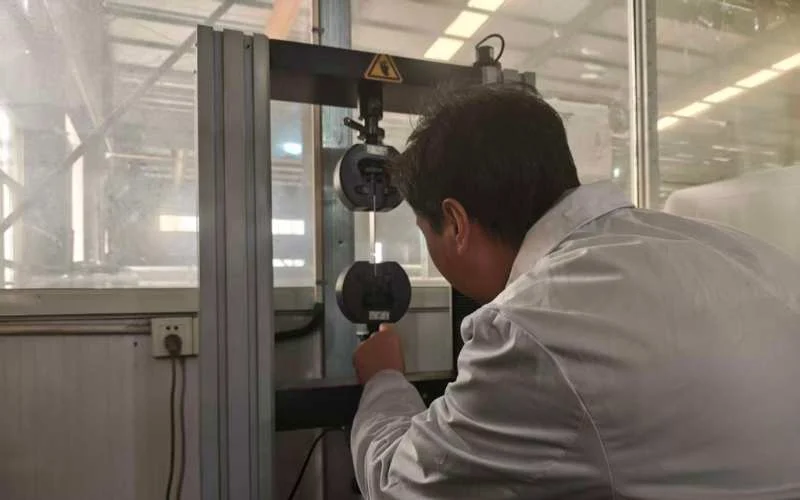
Aluminum Pole Tensile Strength Testing at Xingyong aluminum pole factory

Mechanical and Finish

Tensile testing, Barcol, Webster and Rockwell hardness, coating thickness gauges and a color-matching light box.

Batch records tie results back to a production run — see batch quality and traceability and quality assurance.
Step 8 · Packing

Packed for the Shelf It Is Going To, Not for the Warehouse

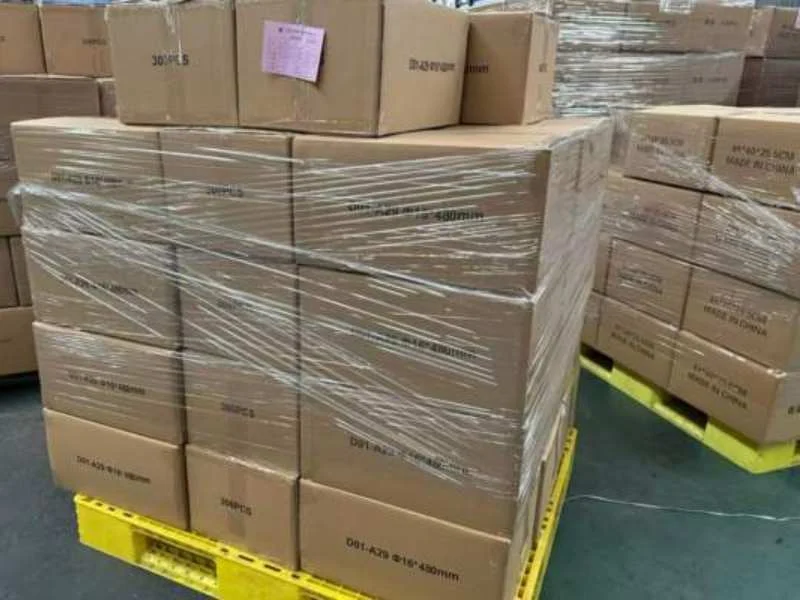
Poles are packed to the format the program needs: bulk for further assembly, printed cartons for distribution, or retail-ready packaging with your barcodes and inserts. Cartons are packed on site with our own equipment. Packaging specification and retail documentation are handled on retail-ready packaging and US retail compliance.
Pallet of shrink-wrapped retail cartons for private-label aluminum pool poles
Who Walks This Floor

The Buyers This Plant Was Built For

Pole Brands and OEM Manufacturers

Owners and product managers who need a shelf SKU cloned or improved without changing what the customer sees.

Pool and Cleaning Distributors

Purchasing managers stocking a season, who care more about on-time containers than about a headline price.

Buyers Supplying Major Retail

Buyers and supply-chain managers whose programs land at Walmart, The Home Depot and Ross, where audits and consistency decide renewal.

We work to drawing, to sample, or on materials you supply. Certifications on site: ISO 9001:2015, ISO 14001:2015, ISO 45001:2018, ISO 50001:2018 energy management, IATF 16949:2016, plus amfori BSCI and social audits — the full list is on certifications and compliance, and shipped programs are on case studies.

Before You Visit

Frequently Asked Questions

Can we visit the factory, and what does a visit cover?Yes, any working day. A standard visit runs the same route as this page — press line, anodizing, machining and molding, assembly, then the inspection center — and ends with your own samples on the table. Tell us your program and we will have the relevant tooling and parts staged before you land.
We cannot travel. What is the next best thing?A live video walkthrough on your schedule, unedited, with the camera going where you point it. We also send batch inspection data and photos against a running order, so verification does not depend on being in the room.
Is this your own plant, or do you sub-contract the extrusion?It is our own. Extrusion, anodizing, machining, injection molding, assembly and packing are on one site under one company, Jiangsu Xingyong Aluminum Technology Co., Ltd. Nothing in the route above is outsourced, which is why a spec change can be answered the same day.
What can this factory do that a tube supplier cannot?Ship a finished pole. Most custom tube factories supply cut tube and leave locks, grips, assembly and retail packing to you and to two or three other vendors. Here it is one supplier, one MOQ and one quality owner from billet to carton.
Our retail customer audits its supply chain. Are you prepared for that?Yes. The site holds ISO 9001, 14001, 45001 and 50001 certification, IATF 16949, and has been through amfori BSCI and social audits. Audit reports are available before you commit a program rather than after a problem.
How fast can a new profile go from drawing to first article?It depends on die complexity and press availability, which is exactly why fourteen presses matter. Send the drawing or a sample and we will come back with a tooling plan and a sampling date — quotes are returned within 24 hours of a complete spec.

Come See It, or Have Us Walk It for You

Send your product, target volumes and the dates you are working to. We will arrange a visit in Huai'an or a live walkthrough, and stage your samples before either one.

Contact Us