
⚠ 本文施工单 —— 发布前把这一整段删掉
此段前台不应出现。助理配完图、负责人打完分之后,从这里到「施工单结束」全部删除,再发布。
① 一句话定位
这篇教高天花板换灯泡的人「杆要买多长、为什么会晃、什么时候不能用铝杆」,顺带把设施采购和零售私标买家的选型条款讲清楚。不讲灯具选型、不讲电工接线、不讲我们的灯杆(light mast)产品——那是 /telescoping-light-pole/ 的地盘,两回事,别混。
② 四道选题闸门结论(Blog-SOP v2.0 §一)
| 闸 | 结论 | 实测依据(2026-08-17) |
|---|---|---|
| G1 词量 | 过 | kp.py 实测:主词 how to change a light bulb in a high ceiling = 590/mo,HIGH,出价 $1.35-5.77;同簇 light bulb changer 2,400 / light bulb changer pole 1,300 |
| G2 SERP 类型 | 过 | serp.py:前排 = Reddit + extend-a-reach.com(杆厂 how-to 文)+ seuslighting + diy.stackexchange = 文章位,厂商站能排上 |
| G3 蚕食 | 过 | 站内 98 篇 + 250 slug 检索 bulb / light bulb changer:无同簇文章。/telescoping-light-pole/ 是灯杆(light mast)不是换灯泡杆,不冲突 |
| G4 ICP | 过(引流层) | 主 ICP = 清洁工具品牌/分销商(存量仅 6 篇,最薄的一条线)+ 设施采购;席位 = 私标位 / volume 定价 / QA 退货线,落在末段 + 3 条 FAQ |
主场集合页:/light-bulb-changer-pole/(18140,2026-08-17 已建,草稿)。正文现在链的是 /extension-pole/(8746,已发布)——18140 发布后,把正文末段那条主场内链改指 18140(现在改是死链)。18140 的 Support 段已填本文计划 slug,本文发布后那张卡自动亮。
③ 配图清单
本文 5 张图全部已配媒体库真图,助理无需换图,只需核对下表 alt 与图内容相符。
| 位置 | 现用 ID | 图片内容 | title(中文,媒体库搜索用) | alt(英文,原样粘贴) | |
|---|---|---|---|---|---|
| 开篇 / 特色图 | 13583 | 伸缩杆清洁高天花板角落 | 伸缩杆清洁高天花板角落 13583 | Telescoping aluminum extension pole reaching a high ceiling corner from floor level | |
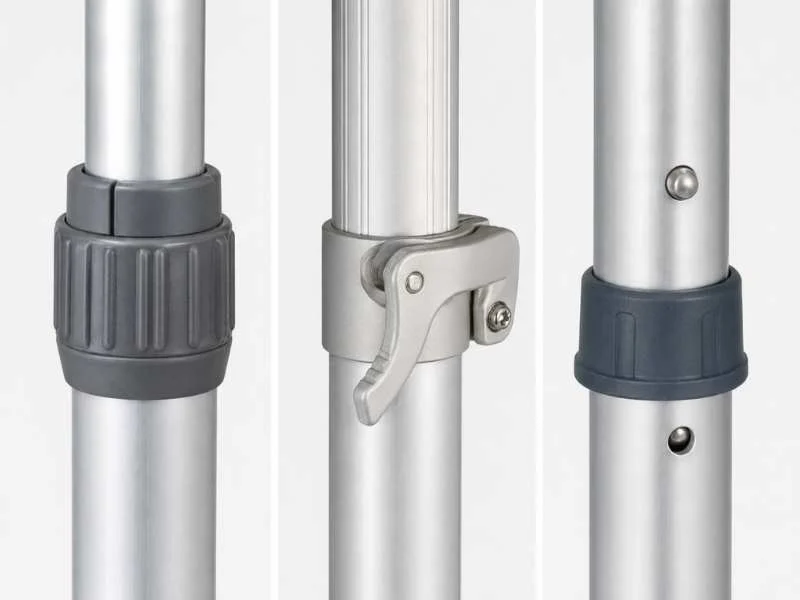
| 晃动段 | 13602 | 三种锁型对比实拍 | 泳池杆锁型对比 twist/flip/button 13602 | Twist lock, flip lock and push-button lock sections compared side by side | |
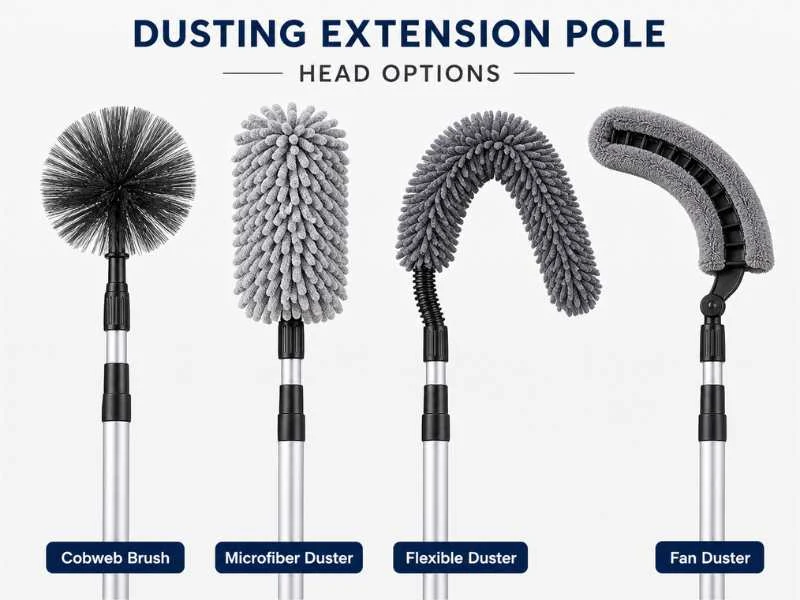
| 接口段 | 13586 | 杆头附件组(除尘/蛛网/超细纤维) | 除尘杆头附件组 13586 | Interchangeable pole head attachments that thread onto the same tapered tip | |
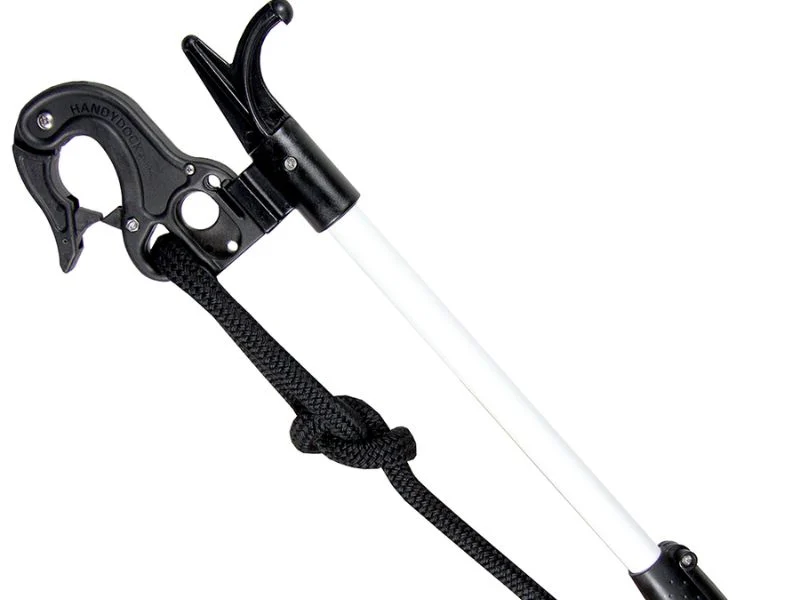
| 规格段 | 18101 | 自有注塑车间的杆头、握把、端盖 | 自有注塑车间杆头握把端盖 18101 | Molded hook heads, grips and end caps produced in our own injection shop | |
| 末段 | 占位 50(要拍) | 整杆装配工位实拍 —— 原用 17916 已撤:该图 slug 叫 kit-assembly-line,但实际画面是刮水器在擦玻璃,图文不符 | factory-pole-assembly-line.webp | 整杆装配线工位实拍 | Workers assembling telescopic pole sections and packing finished kits on the line |
④ 最值钱的一张图(待补,不阻塞发布)
灯泡更换头装在伸缩杆顶端的实拍(弹簧爪 / 吸盘 / 筒灯杯三种头各一张最好)。全站没有这张图,同行也少;补上之后「接口段」的说服力和图片 SEO 都能再上一档。拍摄要求:800×600 webp,头与杆顶螺纹接口要看得清。
⑤ 不要改的地方(附理由)
- OSHA 1910.333(c)(6) 那段和三条边界——这是本文信息增益和责任边界的核心,也是同行不写的部分。措辞是照法规原文核过的,别改宽也别删。
- 刚度表的五行数字——由 I = π(D⁴−d⁴)/64 实算(OD32×1.0 = 11,711 mm⁴ 为基准),公式已写进正文。改数字必须重算,不许估。
- 「7075 不能解决晃动」那句——弹性模量与合金无关是本文最反直觉的一条,AI 摘录最可能引它。
- ÷0.8 的选杆余量规则——全文选型表都建在它上面,改了表就作废。
⑥ meta 与发布
title(56 字符):How to Change a Light Bulb in a High Ceiling: Pole Chart
desc(153 字符):A 16 ft ceiling needs an 11-12 ft pole. Get the reach formula, a ceiling-to-pole chart, the section math behind pole wobble, and when aluminum is unsafe.
分类:Application Solutions(70)|特色图:13583|字数 ~2,450(指南型 2,000-2,500)
发布后:① 把本文写进 /extension-pole/ 的 Technical Support 段(闭合 )② cf.py purge ③ 4-8 周后 gsc.py 回看主词。
⑦ 考核评分(Blog-SOP v2.0,作者自评,待第二人复核后生效)
| 项 | 得分 | 依据 |
|---|---|---|
| 4.1 可核验规格实据 | 12 / 16 | 3 张表、变量≥4、来源全标(I 公式实算 + OSHA 条款 + 假设条件写明);但规格级那张表只有 5 行,且全站没有一条产线实测数据,够不到 16 分档 |
| 4.2 失败边界 | 12 / 12 | 三处带阈值:铝杆电气边界(OSHA 三条硬线)/顶节 25 mm 刚度只有底节 46%、20 ft 以上改升降设备/吸盘头在磨砂玻璃上会掉灯泡 |
| 4.3 量化案例 | 7 / 10 | 引 2 个真实案例页(以色列 12 万支 4 节 · 韩国 80 万支按压锁),数字与链接齐;但本文不是案例主场,缺规格与时间线 |
| 4.4 一手实拍图 | 6 / 7 | 4 张媒体库真图 + 1 张占位;扣 1 分:接口段用的是除尘杆头图,贴合度打折。2026-08-17 复核撤下 17916(slug 写 kit-assembly-line,实际画面是刮水器擦玻璃)——媒体库 slug 不可信,用图前必须肉眼看 |
| L2 可摘录性 | 25 / 25 | 每个 H2 首段加粗直答 · 3 张 .hs-pg-compare 表 · FAQ 6 条 · PAS 开篇 101 词 |
| L3 实体绑定 | 12 / 12 | 6063-T5/6061-T6 与 OD/壁厚都写了「为什么是它」· 2000T 挤压 + 自有注塑 + 一厂装配 + ISO/IATF/BSCI · 5 条内链含主场页 /extension-pole/ |
| L4 可信度 | 7 / 8 | 公司事实与 /about/ 一致、无编造;扣 1 分:弹性模量 ≈69 GPa 这条只链了 aluminum.org 首页,没落到具体数据页 |
| L5 CTR 关卡 | 10 / 10 | title 56 字符含 exact 主词 + Pole Chart 钩子;desc 153 字符首句直接给答案(16 ft → 11-12 ft) |
| 合计 | 91 / 100 | 否决项 F1-F8 未命中 → 处置:发布 |
要拿到 95+ 只差两件事,都不在写手手上:① 一次挠度/锁滑实测台账(4.1 补 4 分)② 一张灯泡更换头装在杆顶的实拍(4.4 补 1 分)。参见 Blog-SOP v2.0 §十三。
—— 施工单结束,以下为正文 ——
A burned-out light bulb in a high ceiling is not a ladder problem. It is a reach problem.
Most people solve it by dragging out an extension ladder, which is how a two-minute bulb swap turns into a fall report. A telescoping pole with the right changer head does the same job from the floor — but only if the pole is long enough, stiff enough at full extension, and safe for the fixture you are standing under.
This guide gives you the reach formula, the pole-length chart, the section math behind wobble, and the point where an aluminum pole becomes the wrong tool for a high-ceiling light bulb.
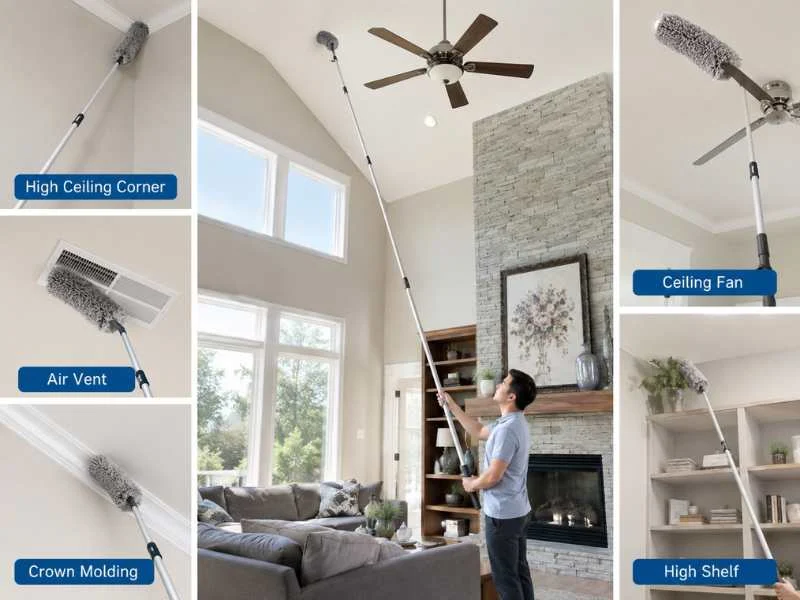
The Short Answer: Change a High-Ceiling Light Bulb With a Changer Head on a Telescoping Pole
To change a light bulb in a high ceiling, cut the power at the breaker, screw a bulb changer head onto a telescoping extension pole, and pick a pole long enough to put the head at the fixture while the pole is still about 80% extended. That last condition is the one most buyers miss, and it is why a pole that is technically “long enough” still feels unusable.
Three variables decide whether the job works from the floor:
- Erreichen — the gap between the fixture and how high you can hold your hands, not the ceiling height alone.
- Stiffness at extension — a pole droops and shakes at the tip long before it is anywhere near failing. Stiffness comes from tube geometry, not from the alloy name on the spec sheet.
- Fixture type — an enclosed globe, a recessed can and an open lampholder each need a different head, and one of them needs a non-conductive pole.
Note what is nicht on that list: the wattage, the brand of the fixture, or the alloy grade printed on the pole. Changing a light bulb in a high ceiling is a reach-and-stiffness problem with an electrical constraint attached, and the three variables above are the only ones that change the outcome.
Everything below is those three variables in order. If you are specifying poles for a building portfolio or a retail program rather than for one bulb, skip to the specification section — the same physics decides your return rate.
Reach Math: How Long a Pole Your High Ceiling Actually Needs
Pole length = (fixture height − your standing overhead reach) ÷ 0.8. An adult of about 5 ft 9 in can hold a tool roughly 7 ft off the floor without stretching, so a 16 ft ceiling leaves a gap of roughly 9 ft, which calls for an 11 to 12 ft pole. Substitute your own reach if you are much taller or shorter — the formula matters more than the table.
The ÷ 0.8 is the part worth explaining. You want to finish the job with about 20% of the pole still collapsed, for two reasons: the thinnest, most flexible section is the last one to come out, and you rarely work straight overhead — you angle the pole, which costs vertical reach. Sizing a pole to its maximum extension is how buyers end up with a tool that technically reaches and practically shakes the bulb out of the changer cup.
| Ceiling height | Gap above a 7 ft overhead reach | Pole length to buy | Typical sections |
|---|---|---|---|
| 10 Fuß (3,0 m) | 2.7 ft | 4 Fuß | 2 |
| 12 ft (3.7 m) | 4.7 ft | 6 Fuß | 2 |
| 14 ft (4.3 m) | 6.7 ft | 8–9 Fuß | 2–3 |
| 16 ft (4.9 m) | 8.7 ft | 11–12 ft | 3 |
| 18 ft (5.5 m) | 10.7 ft | 13–14 ft | 3 |
| 20 ft (6.1 m) | 12.7 ft | 16 Fuß | 3–4 |
| 25 Fuß (7,6 m) | 17.7 ft | 22–24 ft | 4–5 |
Assumptions: flush or semi-flush fixture with the lamp sitting about 4 in below the ceiling, 7 ft standing overhead reach, and the ÷ 0.8 extension reserve. A pendant or chandelier hangs lower, so measure to the lamp, not to the ceiling — that often drops you a whole pole size and gives you a much steadier tool.
Above 20 ft, the honest answer changes. At that height a bulb change is a scheduled maintenance task, not a household chore, and the pole becomes a two-handed tool that needs a second person spotting. Our telescopic pole load capacity guide covers how tip loads behave once you are past that point.
When an Aluminum Pole Is the Wrong Tool for a Light Fixture
Do not put an aluminum pole near exposed live parts. Aluminum conducts electricity well, and a telescoping pole is exactly the kind of object safety regulators single out. OSHA’s rule on conductive materials, 29 CFR 1910.333(c)(6), requires that long dimensional conductive objects handled near exposed live parts be managed with work practices such as insulation, guarding or specific handling techniques. The same section requires portable ladders used near exposed energized parts to have non-conductive siderails, and a 16 ft metal pole in your hands is not a safer object than a ladder.
In practice that gives you three hard boundaries:
- Kill the circuit at the breaker first, not at the wall switch. A switch can be wired on the neutral, leaving the lampholder live.
- Cracked, open or damaged fixtures with visible wiring or an exposed lampholder shell: use a fiberglass pole, not aluminum, even with the breaker off.
- Anything near an outdoor service drop or overhead line: aluminum is out, no exceptions, and the clearance rules for the line take priority over the bulb.
For enclosed fixtures on a de-energized circuit — the ordinary high-ceiling case — aluminum is the better material: it is stiffer per gram than fiberglass at the same weight budget, so it shakes less at 16 ft. We wrote up the material behavior in detail in ist Aluminium leitfähig. If a single pole has to cover both cases in a facility, buy two: one aluminum for routine relamping and one fiberglass tagged for anything electrical. It is cheaper than the incident.
Why the Pole Wobbles at Full Extension — the Top Section Decides
Wobble is a geometry problem, not an alloy problem. Every aluminum alloy has effectively the same stiffness — the elastic modulus sits near 69 GPa whether you order 6063-T5 or 7075-T6, as the Aluminiumverband material data shows. A stronger alloy resists bending permanently; it does not resist bending elastically. Specifying 7075 to stop a pole shaking is money spent on the wrong property.
What does change stiffness is the tube section. For a round tube, the second moment of area is I = π(D⁴ − d⁴) / 64, where D is the outside diameter and d the inside. Because the diameter is raised to the fourth power, small increases in OD beat large increases in wall thickness. Here is the same calculation run on four common pole sections, all figures calculated from that formula:
| Section (OD × wall) | I, calculated (mm⁴) | Metal in the section (mm²) | vs 32 × 1.0 mm |
|---|---|---|---|
| 25 × 1.0 mm | 5,438 | 75.4 | −54% stiffness, −23% metal |
| 32 × 1.0 mm | 11,711 | 97.4 | baseline |
| 32 × 1.2 mm | 13,790 | 116.1 | +18% stiffness, +19% metal |
| 35 × 1.0 mm | 15,448 | 106.8 | +32% stiffness, +10% metal |
| 32 × 1.5 mm | 16,753 | 143.7 | +43% stiffness, +48% metal |
Read the last two rows together. Going up 3 mm in diameter buys 32% more stiffness for 10% more metal; adding 0.5 mm of wall buys 43% for 48% more metal. Diameter is the cheap way to stop wobble, wall thickness is the expensive way — which is why a well-designed 16 ft pole is fat at the base rather than heavy everywhere.
The first row is the one that decides how a pole feels. A 25 mm top section has 46% of the stiffness of a 32 mm base, so the last section out is always the one that shakes. Add the cantilever rule — tip deflection scales with the cube of the working length, so doubling your extension multiplies droop by eight — and you can see why the difference between a 12 ft pole used at 9 ft and the same pole used at 12 ft is not subtle. If a pole feels dead at full extension, the fix is a larger top section or one more section of moderate diameter, not a stronger alloy and not a tighter grip.
Locks are the other half of the feel. A twist lock that slips under a 300 g changer head reads to the user as a flimsy pole even when the tube is right. Our guide to telescoping pole locking mechanisms compares twist, flip and push-button behavior under load.
Light Bulb Changer Heads and the Threaded Tip That Has to Match
The head has to match the lamp, and the tip has to match the head — a mismatch at either end is the most common reason a bulb changer kit gets returned. In the North American market most heads screw onto a tapered threaded tip, commonly called an acme tip, which is why a paint roller, a duster and a bulb changer usually share one pole. That convention is not universal: quick-release and proprietary tips exist, and European tool lines often use their own interface.
| Head type | What it grips | Where it fails |
|---|---|---|
| Suction cup | Smooth glass globes and A-lamps | Will not hold dusty, textured or ribbed glass — the bulb drops |
| Spring cage / finger gripper | Most A19, globe and flood lamps | Too wide for a deep recessed can; fingers splay on hot lamps |
| Recessed flood cup | BR and PAR lamps in recessed cans | Needs the cup diameter matched to the can, or it spins |
| Pin / bayonet adapter | Pin-base and specialty lampholders | Fixture-specific; not interchangeable across a mixed building |
Two practical notes. First, let the lamp cool: a spring cage on a hot halogen or a recently switched-off enclosed LED will mark or crack the envelope. Second, load the head onto the lamp before you rotate — the changer must turn the bulb, not the bulb turn inside the changer, which is exactly what happens when the cup is one size too large.
For a building with mixed fixtures, buy the pole once and the heads as a set. The pole is the durable asset; heads are consumables that get lost, and matching them later to an unusual tip is a problem nobody wants twice.
Specifying Light Bulb Changer Poles for a Facility Fleet or a Retail Program
If you are buying these poles by the thousand rather than by the one, two line items on the spec sheet decide your return rate: the lock and the tip. Tube diameter and finish drive the unit cost, but returns come from a lock that slips on the second season and a tip that will not accept the heads the end user already owns. Both are components, and both are where cheap programs are cut.
A spec sheet that holds up in a bulk program pins down six things: alloy and temper per section (6063-T5 where anodized finish matters, 6061-T6 where load matters), OD and wall for each section rather than an overall length only, lock type and its grip rating, tip thread standard, surface finish, and retail packaging. Leave any one of those open and the quotes you compare are not comparable.
Xingyong extrudes the tube on our own 2000-tonne press in Huai’an, molds the plastic locks, grips and end caps in our own injection shop, and assembles finished poles in the same plant — so the lock and the tube are matched by one supplier instead of two. Most custom tube factories supply bare tube and leave the assembly to you. We have been a direct manufacturer since 2010, not a trading company, and run ISO 9001, IATF 16949 and amfori BSCI audits.
Two programs from the same line show what that looks like in practice: 120,000 custom 4-section poles for an Israeli outdoor brand, where the section taper had to hold rigidity at full extension, and 800,000 push-button poles for a Korean cleaning-tools brand, where the lock was the specified component rather than an afterthought. Programs typically run 120,000 to 1.6 million pieces; we quote within 24 hours and deliver samples in 25 to 35 days. The full range of tube diameters, section counts and lock options sits on our Aluminium-Verlängerungsstange Seite.

Häufig gestellte Fragen
What is the longest pole I can safely use to change a light bulb?
About 24 ft for one person, and only with a light head. Tip deflection scales with the cube of the working length, so a pole that feels steady at 12 ft droops eight times as much at 24 ft. Past that point the practical limits are your grip and the head weight, not the tube — which is why high-bay relamping is usually done from a lift instead.
Can I use an aluminum pole near a live light fixture?
No. Aluminum conducts, and OSHA 29 CFR 1910.333(c)(6) requires protective work practices for long conductive objects handled near exposed live parts. Cut the circuit at the breaker before any relamping, and keep a fiberglass pole for damaged fixtures, exposed lampholders and anything near an outdoor service drop.
Do light bulb changer heads fit all extension poles?
No — thread mismatch is the most common fitment complaint. Most North American heads screw onto a tapered acme tip, but quick-release and proprietary tips are common on imported tool lines. Check the tip standard before ordering heads, and for a mixed building, standardize the tip across every pole you buy.
Can we put our own brand on a bulb-changer pole kit?
Yes. Private-label programs typically cover anodized or powder-coated color, printed or laser-marked branding on the tube, molded grips and end caps in your color, and your retail packaging. Because we mould the plastic parts in house, brand-specific grips and caps do not need a separate supplier or a second MOQ.
How is an OEM bulb-changer pole priced at volume?
Four factors move the number: alloy and section count, wall thickness, finish, and lock type. Wall thickness and finish usually move price more than length does. We quote within 24 hours of a spec sheet and deliver samples in 25 to 35 days; programs run from roughly 120,000 pieces, and one die can serve several SKUs, which is how the entry point stays low.
What causes returns on retail light bulb changer poles?
Lock slip and tip mismatch, in that order. A lock that holds a duster will slip under a changer head loaded off-axis, and a non-standard tip strands the customer with heads that will not fit. Specifying the lock by grip rating and the tip by thread standard removes most of the return volume before the first container ships.



 English
  Español
  Français
  Deutsch
  Português