
Pole banner programs fail at the hardware, not the artwork.
Cities and campuses order beautiful banners, then watch them shred in the first storm — because sizes were picked from a catalog and brackets from another, with nobody doing the wind math between them.
This guide lists the standard sizes, explains bracket systems, and shows how banner area drives every hardware decision downstream.
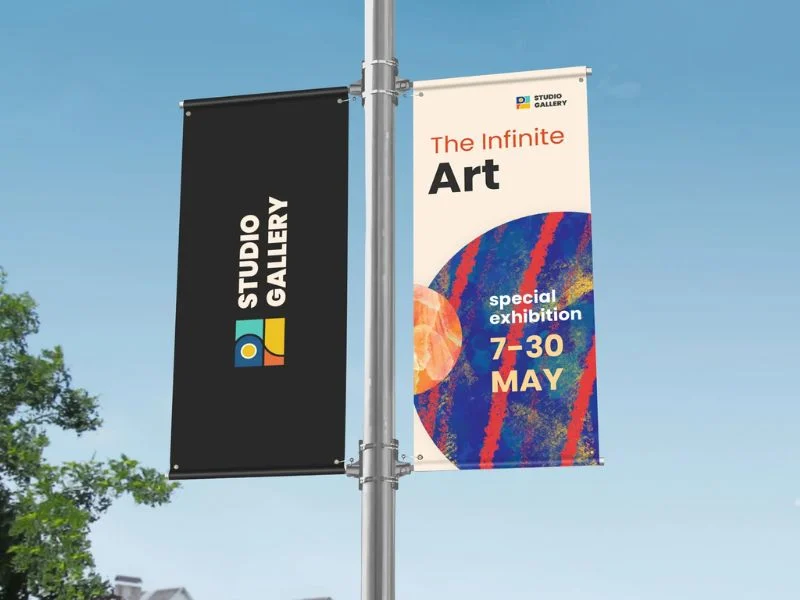
Standard Pole Banner Sizes
The common range runs from 18×36 in for small districts to 30×94 in for boulevard poles — with 24×48 and 30×60 the workhorse sizes. Sizing is a visibility-versus-wind trade: every added square foot is both readability and sail area.
| Banner size | Utilisation typique | Approx. area | Wind demand |
|---|---|---|---|
| 18×36 in | Small streets, campuses | 4.5 sq ft | Lumière |
| 24×48 in | Main streets | 8 sq ft | Modéré |
| 30×60 in | Boulevards | 12.5 sq ft | Haut |
| 30×94 in | Tall poles, gateways | 19.6 sq ft | Très haut |
Sign-industry references such as the International Sign Association treat size selection as a wind-zone decision first and a design decision second — the order most programs get backwards.
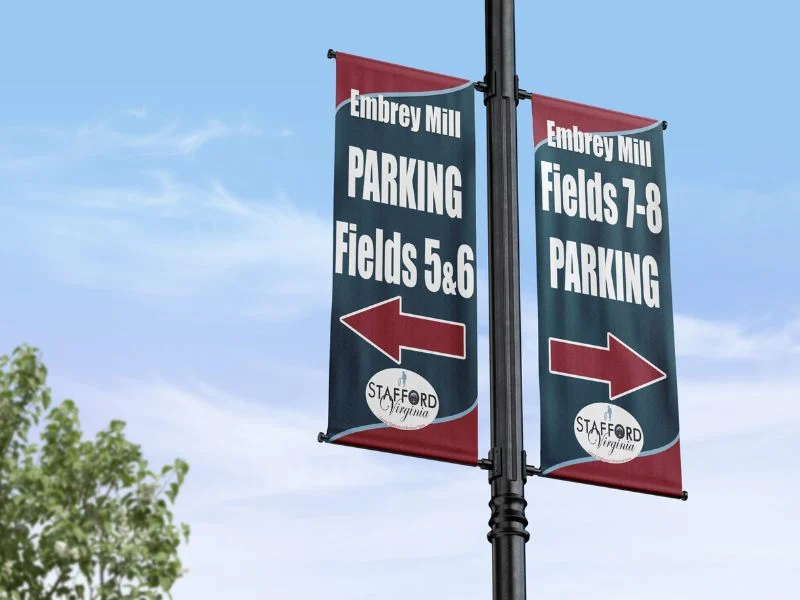
How Bracket Systems Work
A bracket set is two arms, two pole bands and tensioning hardware; the arms hold the banner’s pockets taut so the fabric loads the pole instead of flapping itself apart.
Fiberglass-arm systems flex to spill gusts; rigid aluminum arms hold graphics flatter but pass more load to the band. Either way the failure points are the same: undersized bands slipping on the pole, and arm sockets working loose. Banding must match pole diameter — a bracket rated for 4 in steel light poles will not seat on a 3 in aluminum pole without the right adapter.
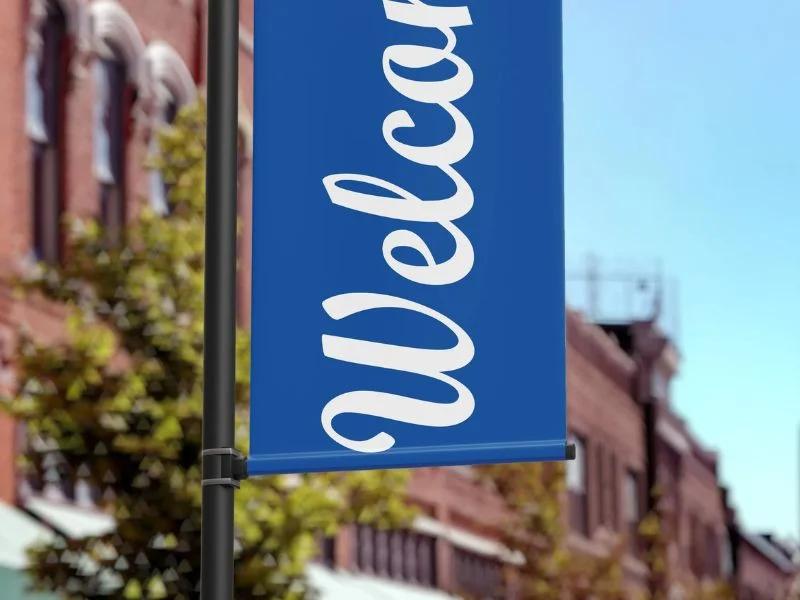
Banner Area Sets the Pole Spec
Wind load scales with banner area, so the fabric size chosen in a design meeting quietly writes the pole’s wall-thickness spec. A 30×60 banner on a windy corridor demands roughly triple the resistance of an 18×36 on a side street.
For dedicated banner poles — gateways, plazas, parade sets — this is where the order should start: send banner sizes first, get the pole engineered to them. That sequence is how our aluminum banner pole program quotes: area → wind load → wall and bracket fit, not the reverse.
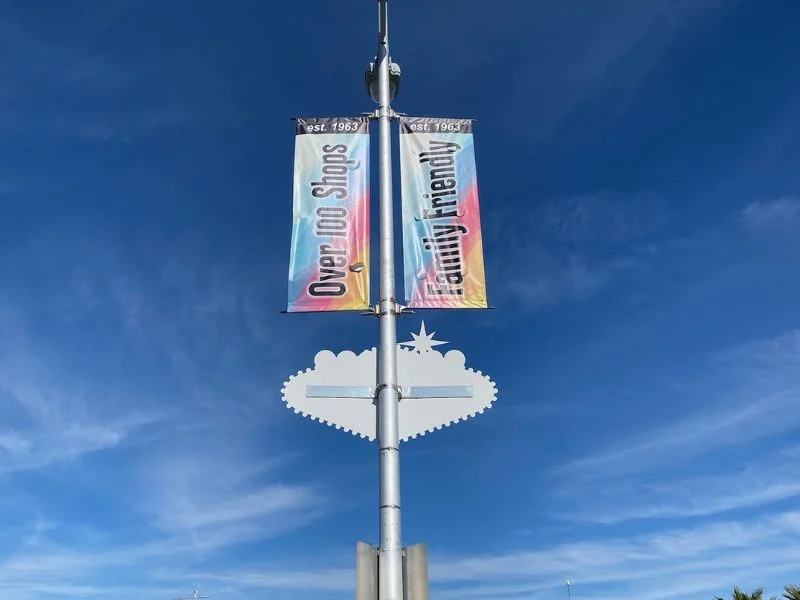
Installation and Seasonal Practice
Install with the top band bearing the weight, tension bottom pockets second, and schedule seasonal swaps — fabric left through storm seasons ages the hardware with it.
Programs that rotate banners quarterly report longer bracket life for a simple reason: every swap is also an inspection. Loose bands, cracked arm sockets and frayed pockets get caught at ladder height instead of discovered on the pavement.
Reading Wind Load Without an Engineering Degree
Wind force grows with banner area and with the square of wind speed — double the fabric and you double the load; double the wind and you quadruple it. That one relationship explains most banner failures and most oversizing mistakes alike.
You do not need the full calculation to order sensibly; you need the two questions it answers. First: what is the largest banner this pole-and-bracket set will ever carry? Spec to that banner, not the launch banner — programs grow, and the hardware bought for 18×36 in fabric meets a 30×60 in ambition within two seasons. Second: what does local weather actually do? A coastal main street and a sheltered campus quad are different wind regimes wearing the same zip code.
Mesh and vented banners change the math in your favor — wind bleeds through instead of loading the pole — which is why windy corridors often run mesh at sizes solid vinyl could never survive. If a program insists on large solid fabric in open wind, the answer is wall thickness and bracket rating, not hope.
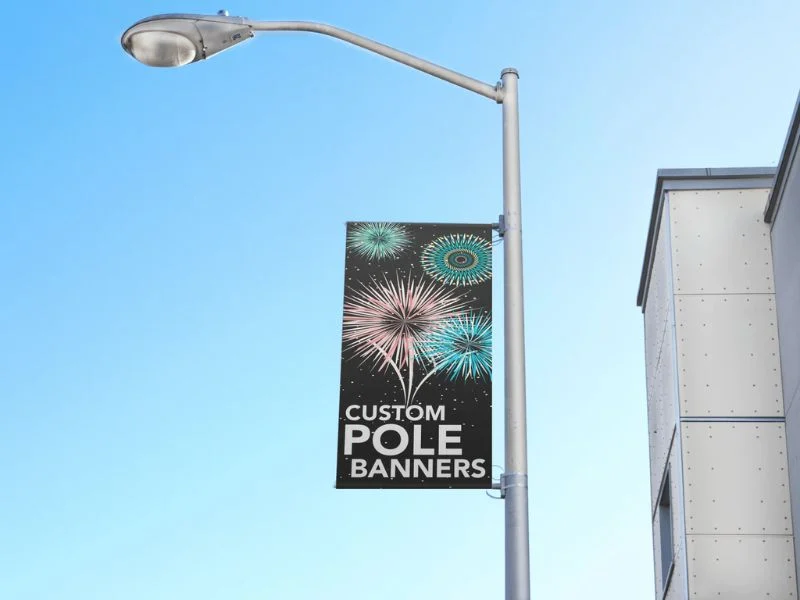
Bracket Hardware, Bolt by Bolt
A street-banner set is two arms, two pole bands and tensioning hardware; the failure points are band slip and arm-socket wear, and both are decided when you match hardware to pole diameter.
Bands come first: they must match the pole’s outside diameter and material, because a band sized for 4 in steel will not seat on a 3 in aluminum pole no matter how hard the installer cranks it. Arms next: fiberglass arms flex to spill gusts and are kinder to the band; rigid aluminum arms hold graphics flatter and pass more load through. Neither is wrong — they are tuned for different wind stories.
The tensioning hardware is where cheap sets economize and programs pay later: spring-loaded tensioners keep fabric taut as it stretches through a season, while fixed ties go slack, let the banner luff, and turn every gust into a hammer blow on the arm sockets. When our OEM program quotes poles and brackets together, this is the fit logic being bought — one spec sheet, no diameter surprises at the top of a ladder.
The Program Ordering Checklist
Order in this sequence: banner sizes → wind zone → pole wall and diameter → bracket set → mount standard → quantities with spares. Programs that order poles first and fabric later run the sequence backwards and pay for it in returns.
Quantities deserve the last word. Parade sets need matched pairs plus spares — a parade with 49 working poles out of 50 reads as a failure to everyone watching — and street programs need bracket spares in the maintenance shed, because one van strike should not wait eight weeks for a replacement band. The working rule from event suppliers: order five percent over, never less than two spare sets.
Put delivery dates in the same conversation. Banner programs anchor to immovable calendar dates — festivals, openings, civic seasons — and hardware that arrives the week after the parade has no salvage value until next year. Confirm production and freight against the event date, then add the buffer your customs broker wishes you always added.
Seasonal Rotation as an Operating Habit
Swap banners quarterly and the hardware inspects itself: every fabric change is a forced close-up of bands, arms and tensioners at ladder height, where problems are caught instead of collected.
Programs that rotate report longer bracket life for exactly this reason — loose bands and cracked sockets get found in week one, not in the storm that finishes them. Rotation also spreads UV wear across a banner library instead of concentrating it on one heroic vinyl, which is how a two-year fabric budget quietly becomes a four-year one.
Put storm removal in the same operating habit: fabric comes down ahead of named weather, poles stay up. It is the cheapest insurance in the category, and the poles are engineered on the assumption someone will actually do it.
Hand-Carried Parade Sets: The Human Factor Spec
Parade poles add one spec street hardware never sees: a person carries them for two miles — so weight per pole, grip comfort and quick fabric changes become engineering requirements, not niceties.
Aluminum earns the parade category almost by default; the same banner on steel doubles the marcher’s afternoon. Two-piece takedown builds pack into a van without an inch of wasted floor, molded grips keep bare hands comfortable in October weather, and quick-release fabric hardware means one volunteer can re-rig fifty banners the night before instead of a committee doing it at dawn.
Order matched pairs by height as well as count — a banner carried at two different arm heights reads crooked in every photograph, and parade organizers notice photographs.
Finish Choices: Anodized, Powder or Both
Anodized finishes win on scratch traffic and zero maintenance; powder-coat wins on exact brand-color matching — mixed programs often anodize street poles and powder-coat parade sets touched by hands and vans.
The choice is exposure math. A street pole lives untouched at height where UV and rain are the whole story — anodizing’s sealed surface runs years without attention. Parade hardware gets loaded, stacked and leaned against trailers weekly; powder’s thicker film shrugs off handling scuffs and can hit a municipal PMS color exactly. Specify per format rather than per program, and the finish line item stops being a compromise.
Foire aux questions
What sizes do pole banners come in?
The standard range runs 18×36, 24×48, 30×60 and 30×94 inches — pick by pole height and wind zone, since every square foot adds sail load.
What brackets hold a pole banner?
Two-arm bracket sets: pole bands clamp the pole, arms tension the banner’s pockets. Flexible arms spill gusts; rigid arms hold graphics flatter but load the bands harder.
How windy is too windy for pole banners?
It is a sizing question, not a weather one: match banner area and bracket rating to the local wind zone, and remove fabric ahead of named storms regardless.
Do brackets fit any pole?
No — bands are sized to pole diameter and material. Confirm pole OD before ordering brackets, or spec pole and brackets together as one program.
How long do pole banners last?
Fabric typically one to three seasons depending on sun and wind; hardware many years if bands stay tight and swaps double as inspections.
 English
  Español
  Français
  Deutsch
  Português