
Respuesta rápida: An anodized aluminum pool pole is the best all-around choice for most homeowners and high-volume retail programs because it is light, affordable, easy to handle, and widely compatible with pool-cleaning attachments. A fiberglass pool pole is often the better fit for commercial users who prioritize a stiffer feel, resistance to moisture, and reduced electrical conductivity. However, fiberglass is not a guarantee against electric shock, especially when it is wet, dirty, or damaged.
The material name alone does not determine whether a pole is good. Tube diameter, wall thickness, section overlap, lock quality, attachment fit, and maintenance can make a well-designed aluminum pole outperform a poorly built fiberglass one—and vice versa.
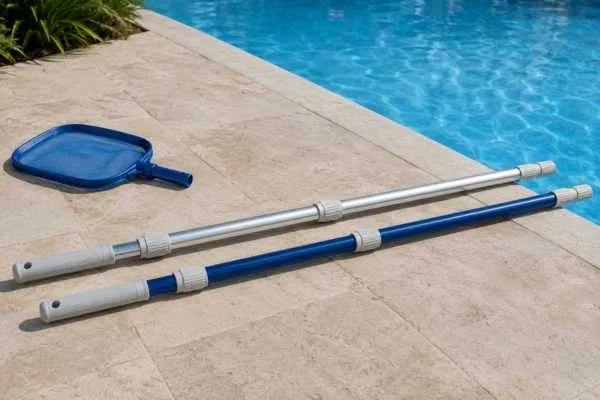
Aluminum vs Fiberglass Pool Pole at a Glance
| Factor | Poste de piscina de aluminio | Barra de piscina de fibra de vidrio | Practical winner |
|---|---|---|---|
| Weight and handling | Usually lighter and easier to maneuver | Often heavier at a similar length | Aluminio |
| Purchase price | Usually lower | Generalmente más alto | Aluminio |
| Electrical conductivity | Conductivo | Lower conductivity when clean, dry, and undamaged | Fiberglass, with important limits |
| Corrosion behavior | Does not rust, but may oxidize or pit; anodizing improves protection | Does not rust and generally handles moisture well | Fiberglass in very corrosive exposure; otherwise close |
| Daños por impacto | May dent or bend | Puede agrietarse, astillarse o dejar al descubierto las fibras. | Depends on construction and use |
| Surface aging | Finish can scratch or show oxidation | UV and abrasion can damage the resin surface | Depends on finish and care |
| Custom colors and branding | Many anodized and printed options | Available, but typically less flexible | Aluminio |
| Best fit | Most residential cleaning and scalable retail/OEM programs | Professional or specialty applications | Depends on buyer |
If you are still deciding on reach, sections, and lock style, this guide to choosing the right pool pole explains how material fits into the wider specification.
What Is an Aluminum Pool Pole?
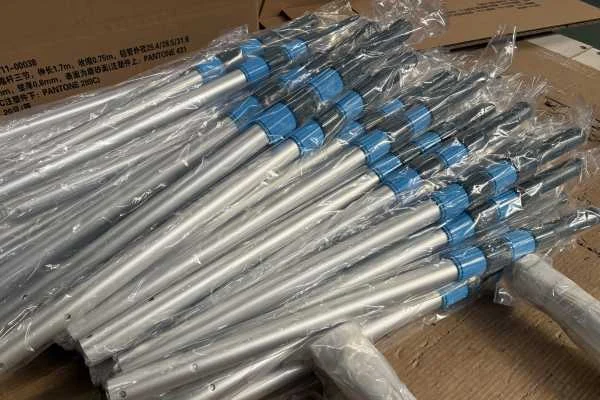
An aluminum pool pole is normally made from drawn or extruded aluminum tubing and built as a fixed-length or telescopic handle. Many quality models use an anodized finish. Anodizing grows a protective oxide layer on the surface rather than adding a coating that simply sits on top.
Aluminum is popular because it provides a useful balance of low weight, stiffness, cost, appearance, and manufacturability. La Asociación del Aluminio notes that alloying and processing affect aluminum’s strength, conductivity, and corrosion resistance. In other words, “aluminum” is a material family—not a complete product specification.
At Poolpole.com, aluminum is not treated as a one-size-fits-all tube. Buyers can specify length, section count, tube diameter, wall thickness, lock type, grip, anodized color, logo, and packaging for their intended market. This makes it possible to build a light residential skimmer pole and a reinforced commercial vacuum pole from different specifications instead of forcing both jobs into the same design.
Main advantages of aluminum
- Light and comfortable for routine skimming
- Cost-effective for homeowners, retailers, and distributors
- Easy to manufacture in telescoping sections
- Available with anodized colors and branded finishes
- Commonly compatible with skimmers, brushes, leaf rakes, and vacuum heads
Main limitations of aluminum
- Conducts electricity
- Thin tubes can bend or flex under brushing and vacuuming loads
- Scratched or low-quality finishes may show oxidation or pitting
- Salt and concentrated pool chemicals can accelerate surface damage
What Is a Fiberglass Pool Pole?
A fiberglass pool pole is a composite structure made with glass fibers held in a resin matrix. The fibers provide reinforcement, while the resin binds and protects them. Commercial models may also have a UV-resistant outer coating to slow weathering and help prevent exposed fibers.
Fiberglass poles are often selected for professional service, institutional pools, and applications where reduced electrical conductivity is an important consideration. In its maintenance and safety equipment catalog, Pentair describes commercial fiberglass poles with a UV-protective coating and positions them for professional areas where electrical-shock protection is required.
Main advantages of fiberglass
- Does not rust and generally resists wet environments
- Can provide a solid, stiff feel in heavy cleaning
- Lower electrical conductivity than metal when clean, dry, and intact
- Well suited to some commercial and professional workflows
Main limitations of fiberglass
- Often heavier and more expensive than aluminum
- Can crack, chip, or splinter after impact or prolonged surface wear
- Requires inspection for exposed fibers and coating damage
- Fewer finish and high-volume customization options in many supply programs
Image placeholder
File name:fiberglass-pool-pole-surface-detail.webp
Alt text: Fiberglass pool pole with smooth UV-protective surface shown in close-up
Which Pool Pole Is Lighter and Easier to Use?
For most comparable products, aluminum is the easier material to carry and maneuver. That difference becomes more noticeable when the pole is fully extended, because even a small amount of extra weight feels larger at the far end of a long lever.
Weight matters most when you:
- Skim several pools per day
- Work with a pole extended to 16 feet or more
- Clean from awkward positions around landscaping or pool furniture
- Experience shoulder, wrist, or back fatigue
Do not compare weight by material label alone. Check the actual product weight at the same extended length. A heavy-duty aluminum pole with thick walls may weigh more than a lightly built composite pole, while a long commercial fiberglass model may be considerably heavier than a residential aluminum one.
Best for easy everyday handling: aluminum.
For distributors building a mainstream product range, this handling advantage is one reason Poolpole.com focuses on configurable aluminum designs. A buyer can adjust wall thickness and tube overlap to reach the required stiffness without adding unnecessary weight to every SKU.
Which Is Stronger and More Durable?
There is no honest material-only winner. Aluminum and fiberglass fail differently, and product design changes the result.
An aluminum pole subjected to excessive side load may dent, permanently bend, or loosen at the telescoping joint. Fiberglass does not dent in the same way, but a hard impact can crack the resin, damage the laminate, or expose irritating glass fibers.
For real cleaning performance, evaluate:
- Diámetro del tubo y espesor de la pared
- Overlap between telescoping sections
- Lock design and clamping force
- Deflection at full extension
- Attachment fit and button-hole alignment
- The load created by the brush, rake, or vacuum head
A pole used only for a lightweight skimmer has a much easier job than one pushing a wide wall brush or pulling a submerged vacuum head. “Heavy duty” should therefore be supported by specifications or load testing, not treated as a decorative label.
For demanding vacuum applications, review how tube strength, fit, and lock force affect a pool vacuum pole. Poolpole.com can match the tube structure and locking system to the actual attachment rather than evaluating an unloaded pole in isolation.
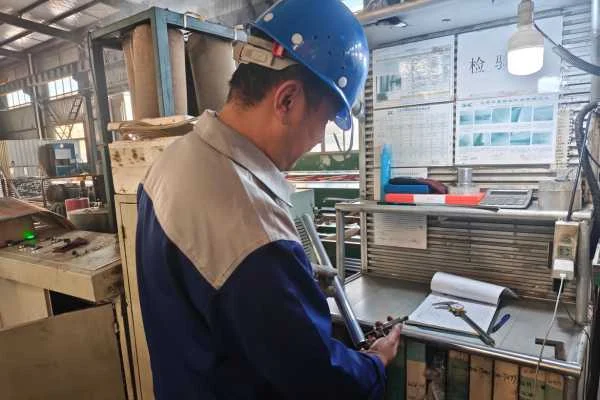
Best durability choice: the properly engineered pole for the intended load, regardless of material.
Corrosion, Chlorine, Saltwater, and UV Exposure
Aluminum does not rust like iron or steel, but it can corrode. Chlorides, salt deposits, chemical residue, scratches, and persistent moisture may cause staining, oxidation, or localized pitting. A well-applied anodized finish improves surface hardness and corrosion resistance, but it does not make aluminum immune to every pool environment. See the detailed explanation of how anodized aluminum performs in pool conditions before specifying a finish for chlorine or saltwater exposure.
Fiberglass is not subject to metal corrosion. That makes it attractive around saltwater and persistent moisture. Its weak point is different: sunlight, abrasion, impacts, and aging can degrade the resin or protective coating. A rough, chalky, cracked, or splintered surface is a reason to stop using the pole and inspect it.
For either material:
- Rinse the pole with fresh water after exposure to salt or concentrated chemicals.
- Let it dry before storage.
- Store it out of standing water and prolonged direct sun.
- Do not leave a telescoping pole immersed in the pool.
- Inspect the tube, lock, grip, and attachment end regularly.
Best for minimal metal-corrosion risk: fiberglass. Best balance of corrosion resistance, weight, and cost: quality anodized aluminum.
Is a Fiberglass Pool Pole Electrically Safe?
Fiberglass has a safety advantage over aluminum, but “non-conductive” must not be read as “shock-proof.” Aluminum conducts electricity. Clean, dry, undamaged fiberglass has much lower conductivity, which is why safety authorities and equipment manufacturers specify fiberglass in some electrical-risk applications.
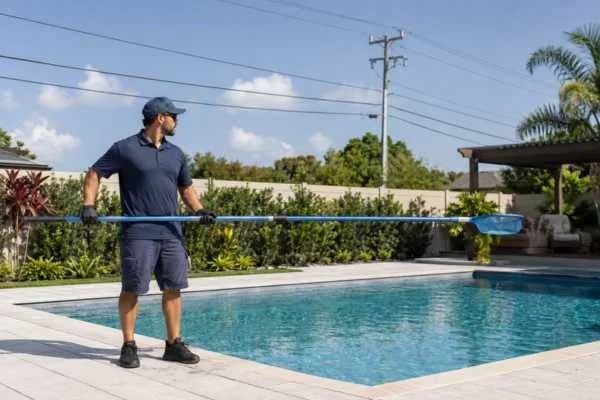
There are critical limits. OSHA’s electrical-safety guidance warns that fiberglass equipment can conduct electricity when it is dirty, wet, or damaged. Around a pool, wet hands, wet decking, and water increase the consequences of electrical faults. The U.S. Consumer Product Safety Commission also advises keeping long-handled pool tools away from utility lines and holding them as low to the ground as possible when moving them.
Always follow these rules:
- Keep every pool pole—aluminum or fiberglass—away from overhead power lines.
- Never rely on the pole material as your only electrical protection.
- Do not use a pole near damaged lights, wiring, junction boxes, cords, pumps, or other suspected electrical faults.
- Stop work, keep people out of the water, turn off power only if it is safe to do so, and contact a qualified electrician when a fault is suspected.
- Replace fiberglass poles that are cracked, wet internally, contaminated, or showing exposed fibers.
Best material where reduced conductivity is a specified requirement: properly rated and maintained fiberglass. No pool pole makes unsafe electrical conditions acceptable.
Which Pool Pole Costs Less?
Aluminum pool poles generally have a lower initial price and are available in a wider range of residential, commercial, and private-label configurations. Fiberglass usually commands a premium because of its composite construction and its position in professional or safety-focused product lines.
Initial price is only part of the buying decision. Total value also includes:
- Expected use frequency
- Worker fatigue
- Replacement rate
- Shipping weight and package length
- Lock and spare-part availability
- Damage during transport or storage
- Product returns caused by flex, slipping, or poor attachment fit
For a homeowner cleaning one pool, a quality anodized aluminum pole is often the most economical choice. For a service company, the better value may be the pole that survives the route, reduces fatigue, and meets its documented safety policy—even if it costs more initially.
For wholesale and private-label programs, Poolpole.com supports custom lengths, anodized colors, lock configurations, branding, and retail packaging. Keeping these variables within one aluminum platform can simplify SKU planning and make repeat orders more consistent.
Best Pool Pole by Use Case
| User or task | Recommended starting point | Por qué |
|---|---|---|
| Homeowner with a small or medium pool | Anodized aluminum, often 8–16 ft | Light, affordable, versatile |
| Routine skimming | Aluminio | Low tool load and easy handling |
| Repeated wall brushing | Heavy-duty aluminum or professional fiberglass | Stiffness, lock strength, and wall thickness matter |
| Vacuuming a large in-ground pool | Reinforced aluminum or commercial fiberglass | Needs good section overlap and a lock that will not slip |
| Saltwater or coastal environment | Quality anodized aluminum or coated fiberglass | Choose by weight, finish quality, and maintenance plan |
| Professional pool route | Compare actual product weight and deflection; fiberglass is common | Daily durability and company safety requirements matter |
| Electrical-risk policy requires reduced conductivity | Appropriately specified fiberglass | Lower conductivity, subject to inspection and dry/clean condition |
| Distributor or private-label program | Aluminum for most mainstream SKUs | Easier cost, finish, packaging, and customization control |
What Matters More Than the Material Name?
Before buying or specifying a pool pole, ask for these details:
1. Working and collapsed length
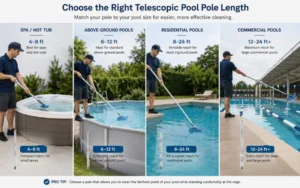
An 8–16 ft pole is a common general-purpose format, but the right reach depends on pool width, depth, deck access, and storage space. Avoid buying more reach than you can comfortably control.
2. Tube diameter and wall thickness
Larger diameter and thicker walls can improve rigidity, but they also add weight and cost. Compare complete product specifications rather than assuming that a particular alloy or composite is automatically stronger.
3. Locking mechanism
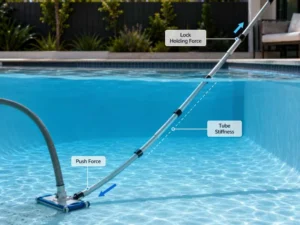
The lock is a frequent performance bottleneck. It should hold the pole under pushing, pulling, and twisting loads without requiring excessive hand force. Test it both dry and after normal water exposure.
4. Section overlap
A long pole with too little overlap may wobble or bend sharply near the joint. Manufacturers should define a safe maximum extension and design a stop that prevents overextension.
5. Attachment compatibility
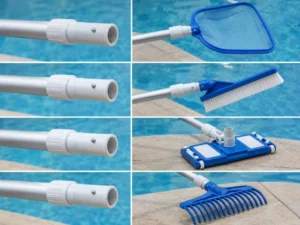
Confirm the tip diameter, button position, and fit with the actual skimmer, brush, rake, and vacuum head. “Universal” is useful shorthand, not a substitute for a fit test. Buyers developing a skimming range can compare these requirements with Poolpole.com’s swimming pool net pole specifications.
6. Finish and inspection requirements
For aluminum, look for an even anodized or protective finish. For fiberglass, look for a smooth, intact UV-resistant surface. Reject sharp edges, cracks, exposed fibers, sticking locks, or loose connectors.
Final Verdict: Aluminum or Fiberglass?
Choose an poste de piscina de aluminio anodizado if you want the best general balance of weight, price, attachment compatibility, appearance, and customization. It is the sensible default for most homeowners and mainstream pool-equipment programs.
Elige uno fiberglass pool pole when professional duty, moisture resistance, a stiffer feel, or a documented need for reduced electrical conductivity outweighs the extra weight and cost. Inspect and maintain it carefully; fiberglass is not an electrical force field.
The most reliable buying rule is simple: select the material for the environment, then verify the pole’s wall construction, overlap, lock, attachment fit, and full-extension performance. Those details determine how the pole behaves on the pool deck.
For retailers, distributors, and pool-equipment brands, Poolpole.com offers a practical advantage: the pole can be engineered around the target load, price level, finish, packaging, and attachment system. Instead of selecting from a fixed off-the-shelf format, buyers can develop postes telescópicos de aluminio hechos a medida for residential, professional, or private-label product lines.
Preguntas frecuentes
Is an aluminum or fiberglass pool pole better?
Aluminum is better for most homeowners because it is usually lighter, less expensive, and easy to use. Fiberglass is often better for professional or specialty applications where moisture resistance and reduced electrical conductivity are higher priorities. Construction quality can matter more than the material alone.
Do aluminum pool poles rust?
No. Aluminum does not form iron rust, but it can oxidize, stain, or pit when exposed to salt, chlorides, chemicals, or damaged finishes. Anodizing and routine rinsing improve its resistance.
Can fiberglass pool poles splinter?
Yes. Impact, abrasion, UV exposure, and surface aging can damage the resin and expose glass fibers. Stop using a pole that feels rough or shows cracks, chips, or exposed fibers.
Are fiberglass pool poles non-conductive?
Clean, dry, undamaged fiberglass has much lower electrical conductivity than aluminum. It can still become conductive when wet, dirty, contaminated, or damaged. Keep all pool poles away from power lines and faulty electrical equipment.
Which pole is best for a saltwater pool?
Both can work. Fiberglass avoids metal corrosion, while properly anodized aluminum offers a lighter and often less expensive option. Rinse either material with fresh water, let it dry, and do not store it in the pool.
What length pool pole should I buy?
Choose the shortest pole that comfortably reaches the pool’s farthest cleaning point. An 8–16 ft telescopic pole suits many in-ground pools, while small above-ground pools may need less reach. Larger or commercial pools may require longer, reinforced models.
Can the same pole hold a skimmer, brush, and vacuum head?
Many pool poles fit common quick-connect attachments, but compatibility is not guaranteed. Confirm the tip diameter, spring-button position, and load capacity with each attachment before purchase or production.
Build the Right Pool Pole for Your Market
Choosing between aluminum and fiberglass is only the first step. A successful pool pole also needs the right reach, tube strength, section overlap, lock, grip, finish, attachment fit, and packaging.
Poolpole.com works with distributors, retailers, and pool-equipment brands to develop customizable aluminum pool poles for different price points and cleaning loads. Share your target length, application, attachment, order quantity, and packaging requirements with our team. We can help turn them into a production-ready specification.
Request a custom pool pole quote or send us your drawing or sample to start your OEM project.
 English
  Español
  Français
  Deutsch
  Português