Most procurement managers view the “aluminum vs. copper” debate through a narrow lens of conductivity percentages. However, after 22 years on the Xingyong production floor, I’ve realized that the real question isn’t just “Is aluminum conductive?” but “How does aluminum’s conductivity impact your total cost of ownership, products safety, and brand reputation?” If you are sourcing for global retailers like Walmart or Home Depot, or manufacturing high-end professional postes telescópicos, understanding the electron-flow behavior of aluminum is the difference between a high-margin product line and a catastrophic product recall.
Is Aluminum Conductive?
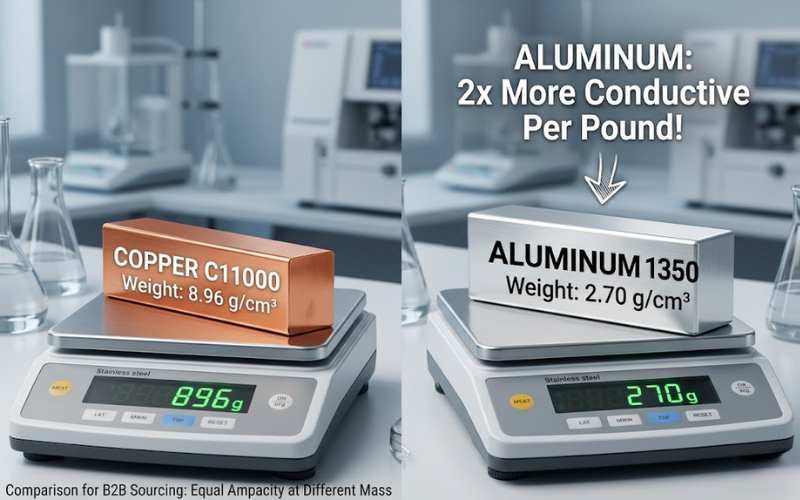
Aluminum is a highly conductive non-ferrous metal, boasting approximately 61% of the conductivity of copper by volume. Según el International Annealed Copper Standard (IACS), electrical-grade aluminum (1350 alloy) is the industry benchmark for lightweight power transmission. However, when measured by weight, aluminum is twice as effective as copper as a conductor. This unique specific conductivity property is why aluminum has replaced copper in over 90% of high-voltage transmission lines globally.
The “Specific Conductivity” Breakthrough
Como ingeniero en Xingyong, I prioritize “Specific Conductivity”—the ratio of conductivity to density.
- Aluminum Density: $2.70 g/cm³$
- Copper Density: $8.96 g/cm³$
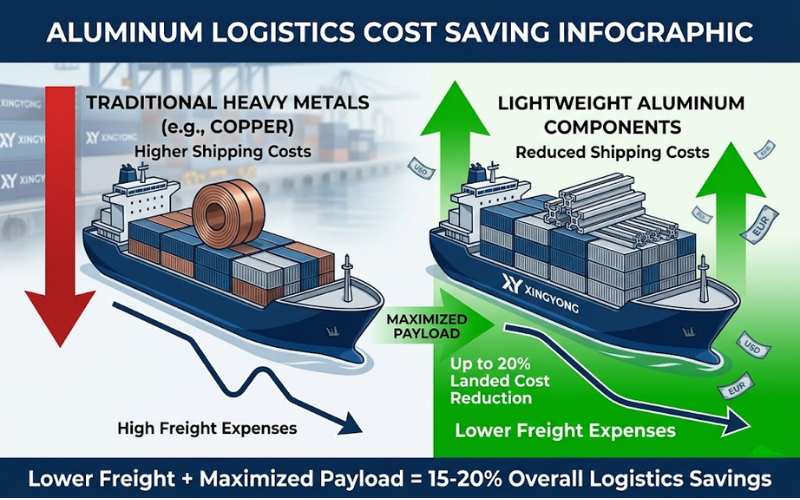
For the same electrical load, an aluminum conductor will be larger in diameter but 50% lighter than its copper equivalent. In the world of shipping and customs, this weight reduction directly translates into a 15-20% decrease in landed costs for bulk distributors, offering a significant competitive advantage.
Aluminum vs. Copper: A Strategic Comparison for Sourcing
Choosing between these two metals isn’t just about physics; it’s about optimizing the distributor’s margin and reducing supply chain volatility.
| Performance Metric | Aluminum (6063-T6) | Copper (C11000) | B2B Sourcing Advantage |
|---|---|---|---|
| Conductivity (% IACS) | 53% | 101% | Copper is more efficient per $mm^2$. |
| Weight for same Ampacity | 50% | 100% | Major Win: Reduced logistics costs & installation labor. |
| Thermal Expansion Coeff. | $23 \times 10^{-6}/K$ | $17 \times 10^{-6}/K$ | Aluminum requires specific termination. |
| Market Price Stability | Estable | High Volatility | LME Aluminum prices allow for better long-term budgeting. |
| Resistencia a la corrosión | Excellent (Self-healing) | Moderado | Aluminum thrives in outdoor/marine environments. |
The Engineer’s Insight: Why Alloy Selection Dictates Conductivity
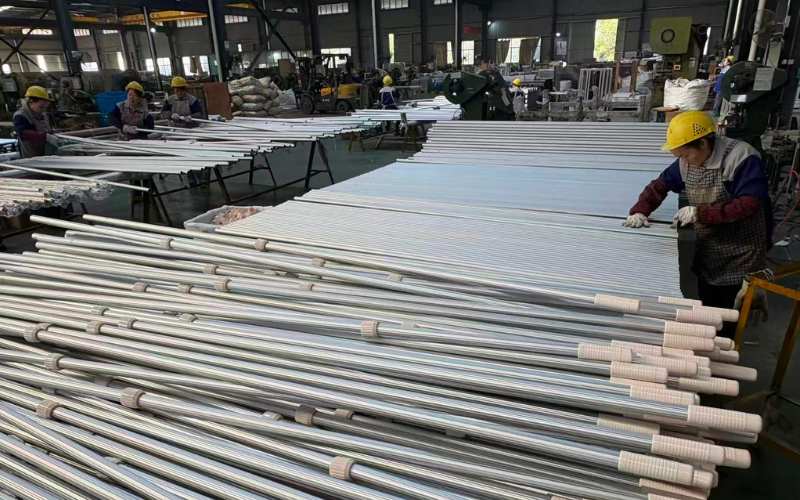
En nuestro IATF 16949:2016 certified facility, we operate 14 extrusion lines ranging from 350T to 2000T. I often see clients request the “strongest” alloy for conductive parts, which is a fundamental mistake. Conductivity is inversely proportional to the amount of alloying elements trapped in the aluminum lattice, a principle governed by Matthiessen’s Rule.
1. The Purity Grade (1xxx Series)
Used for electrical busbars. We ensure a purity of 99.5% to hit that 61% IACS mark. It’s too soft for structural use, but electrically unrivaled.
2. The Structural Balance (6xxx Series)
For our pool cleaning telescoping poles y carretes para cubiertas de piscina, we utilize 6061 and 6063.
- My Real-world Lesson: We once had a client whose professional-grade poles were sparking in high-static environments. We adjusted the Magnesium-to-Silicon ratio in our 6063 melt to ensure a consistent 53% IACS conductivity, allowing for safe static dissipation without sacrificing the T6 hardness required for heavy-duty use.
3. The Conductivity “Killer”: The 7xxx Series
Alloys like 7075 are aerospace-grade for strength but miserable for conductivity (approx. 30% IACS). If your component needs to heat up or ground current, avoid the 7xxx series despite its high tensile numbers.
The Silent Killer: Aluminum Oxide & Surface Treatments
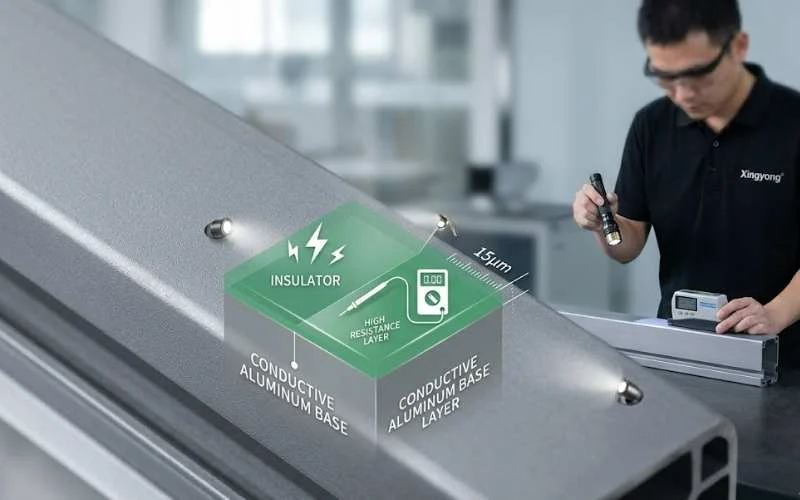
The biggest technical barrier in aluminum procurement isn’t the metal itself—it’s the Aluminum Oxide (Al₂O₃) layer. Within nanoseconds of exposure to air, aluminum forms a transparent oxide skin that is a powerful electrical insulator, resistant to currents up to several hundred volts.
- The Connection Risk: Unlike copper, aluminum oxide can lead to loose connections and potential arcing if not managed. This is due to its high dielectric strength (around 20-40 kV/mm).
- The Xingyong Solution: For conductive assemblies, we recommend chemical conversion coatings (like Alodine/Chromate). In our Xingyong oxidation workshop, we can mask specific contact zones before anodizado, ensuring the main body is protected from corrosion while the contact points remain 100% conductive.
- Surface Treatments: Remember, a standard Anodized Finish (ISO 7599:2018) turns your aluminum into an insulator. This is ideal for user safety on postes telescópicos para piscinas but fatal for electrical grounding components.

Critical Manufacturing Capabilities at Xingyong (Est. 2002)
To ensure the highest electrical and structural standards required by global brands, we operate within a comprehensive quality framework:
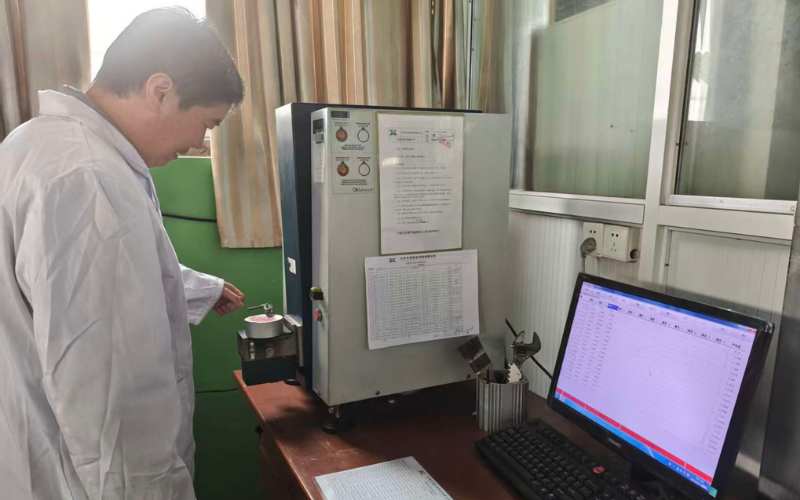
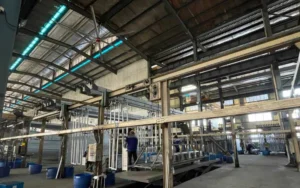
- Chemical Control: Nuestro equipo interno Espectrómetros de Oxford verify the alloy composition of every billet before extrusion. Even 0.1% too much Iron can drop your conductivity by 2%.
- Geometric Precision: Utilizamos Israel-imported Romidot section scanners to ensure uniform grain structure and precise wall thickness, critical for predictable electrical resistance in telescopic assemblies.
- Process Certification: Our facility is certified to ISO 9001:2015 for quality, ISO 14001:2015 for environment, and ISO 50001:2018 for energy management, ensuring your supply chain meets modern ESG requirements.
Strategic Material Intelligence: Bridging Physics and Profit
Understanding aluminum’s conductivity is about recognizing that Aluminum is the logic of efficiency. It offers the best ratio of conductivity to cost, weight, and corrosion resistance available in the industrial market today. By leveraging its light weight, you reduce shipping overhead; by selecting the right Xingyong 6xxx series alloy, you balance durability with safe electrical performance. The key is working with a manufacturer who understands the metallurgical trade-offs between tempering, anodizing, and IACS percentages.
Partner with Xingyong for High-Performance Aluminum
Ready to optimize your product’s conductivity and structural integrity? As a premier manufacturer with a Capacidad mensual de 3.000 toneladas, Xingyong provides the technical depth and production scale required by global brands and major retailers.
Whether you require custom OEM/ODM aluminum telescopic poles, complex extruded profiles, or integrated pool safety systems, our engineering team is ready to review your drawings.
Contact our technical department today to discuss alloy selection, IATF 16949 compliance, and how we can streamline your global supply chain logistics.
 English
  Español
  Français
  Deutsch
  Português