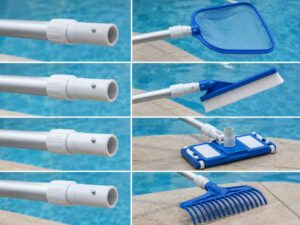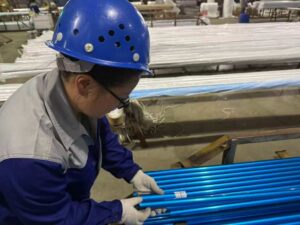
A pool pole for vacuum head is not chosen by length alone; buyers must check vacuum head fit, tube stiffness, lock holding force, and corrosion-resistant finish. Most standard vacuum heads fit telescopic pool poles with a compatible spring-button connection and a common 1.16–1.25 inch pole-end inner diameter. The best Pool-Staubsaugerstange should reach the pool floor without bending, slipping, rattling, or damaging the vacuum head connection. For OEM buyers and distributors, the right pole protects margin by reducing returns, bad reviews, carton damage, and replacement claims.
What Should Buyers Know First?
A pool pole for vacuum head should fit the vacuum head handle, hold its length under push force, and use rigid anodized aluminum tubing for pool-side durability.
For bulk orders, buyers should not approve the pole by length or price alone. They should test the pole with the real vacuum head, check tube wall thickness, confirm lock strength, and review packaging for export shipping.
As a Xingyong engineer, I judge a vacuum pole by how it performs at full extension, not by how it looks when closed.
What Is a Pool Pole for Vacuum Head?
A pool pole for vacuum head is a telescopic pole used to move a manual vacuum head across the pool floor. It turns the user’s hand force into pushing, pulling, lifting, and steering movement.
A manual pool vacuum system usually includes a vacuum head, telescoping pole, vacuum hose, and skimmer connection. Lowe’s explains that a manual vacuum setup uses a vacuum head attached to a telescoping pole and connected through a vacuum hose to the skimmer basket. You can review this guide to a manual pool vacuum system.
For a home user, the pole looks simple. For a B2B buyer, it is a retail SKU that affects reviews, return rate, shelf value, and repeat orders.
A vacuum head creates more resistance than a skimmer net. It drags along the pool floor, touches corners, carries water resistance, and often works with wheels or brushes.
That is why I never approve a Pool-Staubsaugerstange only because it extends smoothly on a workbench. I test it with a real vacuum head, wet hands, and repeated push-pull movement.
You can also compare related options on our Teleskopstange für Poolroboter page.
What Pool Pole Fits a Pool Vacuum Head?
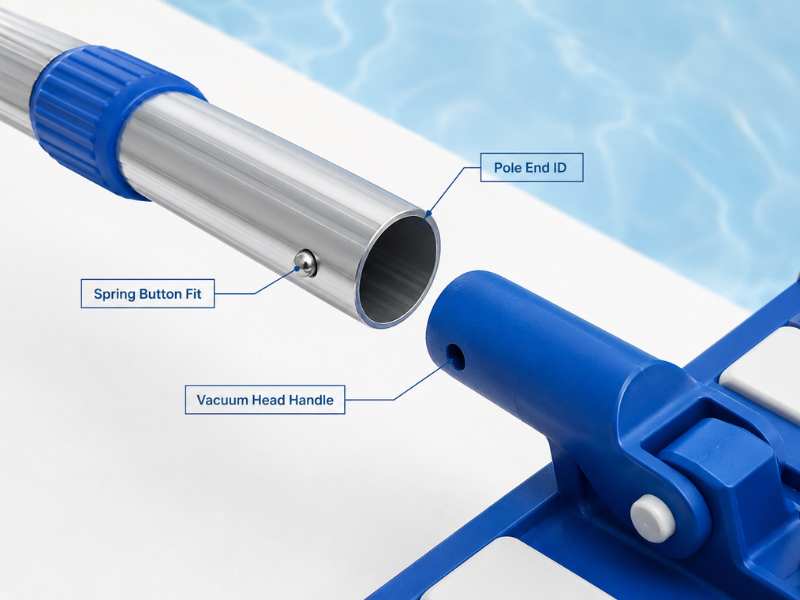
Most pool vacuum heads fit a standard telescopic aluminum pool pole with the correct inner diameter and spring-button connection. The safest method is to test the pole end and vacuum head handle together before bulk production.
Some vacuum heads list compatibility with industry-standard pool poles using a 1.16–1.25 inch inner diameter. Some also fit 1.25-inch and 1.5-inch vacuum hoses, as shown in this pool vacuum head specification.
For OEM orders, “standard fit” is not enough. A small change in tube ID, spring-button hole position, or button engagement depth can create a loose connection.
Loose fit is often not caused by the vacuum head. It is caused by poor control of tube end ID, hole position, burr removal, and spring-button engagement.
Pool Vacuum Head Compatibility Checklist
| Compatibility Item | What Buyers Should Check | Poor Supplier Risk | Better Specification |
|---|---|---|---|
| Pole inner diameter | Match the vacuum head handle | Loose fit or failed assembly | Confirm ID with real sample |
| Spring-button hole | Hole diameter and distance from tube end | Rattling or poor button engagement | Control hole tolerance and deburring |
| Button engagement depth | How deeply the button locks into the hole | Accidental release during use | Test with repeated push-pull movement |
| Vacuum head handle | Spring clip, swivel, or fixed handle | Wrong compatibility claim | Test with actual vacuum head |
| Swivel handle clearance | Movement range after assembly | Hard steering underwater | Check turning angle before approval |
| Tube end strength | Wall thickness near drilled holes | Cracking or deformation | Reinforce tube end if needed |
| Plastic adapter | Need for adapter or sleeve | Loose fit across head models | Add custom adapter option |
| Surface around holes | Smooth edge and corrosion control | Burrs and hand complaints | Deburr before final assembly |
Ein zuverlässiger pool pole for vacuum head should pass a real fit test. Drawings are useful, but a vacuum head sample tells me more than a long email.
Why a Pool Vacuum Pole Bends or Slips During Vacuuming
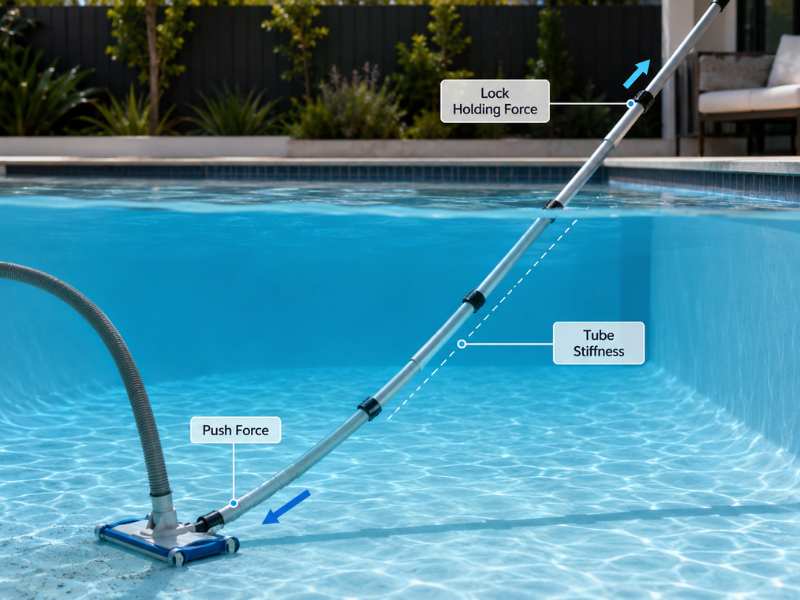
A pool vacuum pole bends or slips because vacuuming creates higher force than surface skimming. The pole must push a head through water, debris, floor slope, and pool corners.
A skimmer net catches leaves on the surface. A brush creates friction on walls. A vacuum head creates drag across the floor and transfers force through the full pole length.
During vacuuming, the pole receives:
- Forward pushing force
- Pull-back force
- Downward pressure
- Turning force
- Bending load at full extension
- Locking load between tube sections
- Connection stress at the vacuum head handle
A pole may look strong when closed. It may also look good in a store display. But at 12 ft or 16 ft, weak tube design becomes obvious.
The Real Test Is Force Transfer
A good telescopic pool vacuum pole must transfer force without too much bending, shaking, or shortening. Reach alone does not prove quality.
When force transfer is poor, users feel these problems:
- The vacuum head does not follow direction
- The pole bends during pushing
- The lock slips under pressure
- The tube sections rattle
- The pole feels weak at full length
- The head connection feels loose
In our factory, I do not call a long thin-wall pole “heavy duty” just because the product label says so. A heavy-duty pole must hold its shape under vacuuming force.
For buyers, this matters because bending and slipping become customer complaints. Those complaints later become returns, replacements, and weaker reorder confidence.
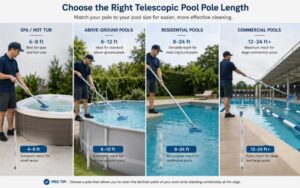
Best Pool Pole Length for Vacuum Head by Pool Type
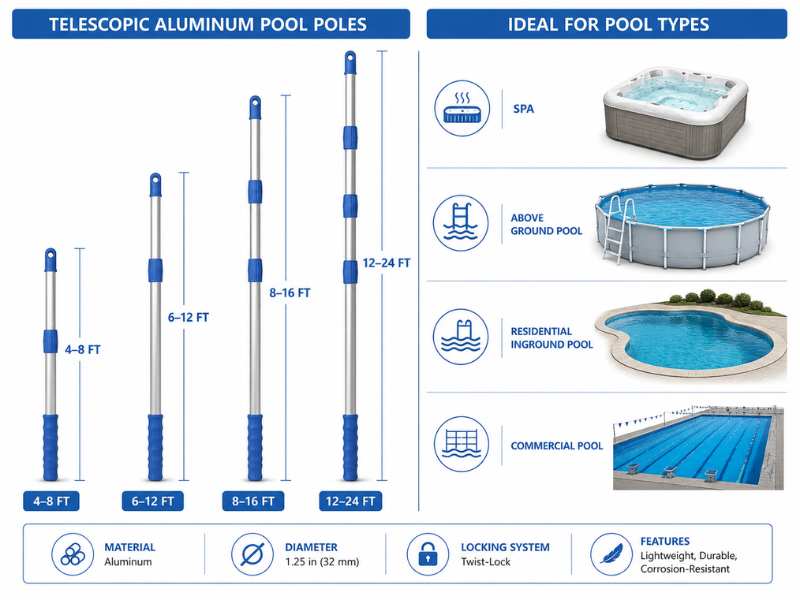
The best pool pole length for vacuum head is the shortest length that reaches the cleaning area with stable control. Longer is not always better if the tube and lock are weak.
For retail and wholesale buyers, length also affects carton size, ocean freight cost, warehouse handling, shelf position, and SKU planning.
| Pool Type | Empfohlene Stangenlänge | Optimale Nutzung | B2B Buyer Note |
|---|---|---|---|
| Spa or small pool | 4–8 ft | Spot cleaning and shallow pools | Easy carton size and lower freight cost |
| Above ground pool | 6–12 ft | Regular vacuuming | Strong entry-level SKU |
| Residential inground pool | 8–16 Fuß | Mainstream pool floor cleaning | Best retail balance for many stores |
| Large residential pool | 12–18 ft | Deep floor and far corners | Needs stronger tube overlap |
| Commercial pool | 12–24 Fuß | Long reach vacuuming | Requires heavier tube and stronger lock |
A 16 ft pole with poor rigidity can feel worse than a well-built 12 ft pole. Length must work with tube diameter, wall thickness, overlap, and lock force.
For deeper length selection, read our guide on best pool pole length for vacuuming.
Aluminum Pool Vacuum Pole vs Fiberglass and Plastic
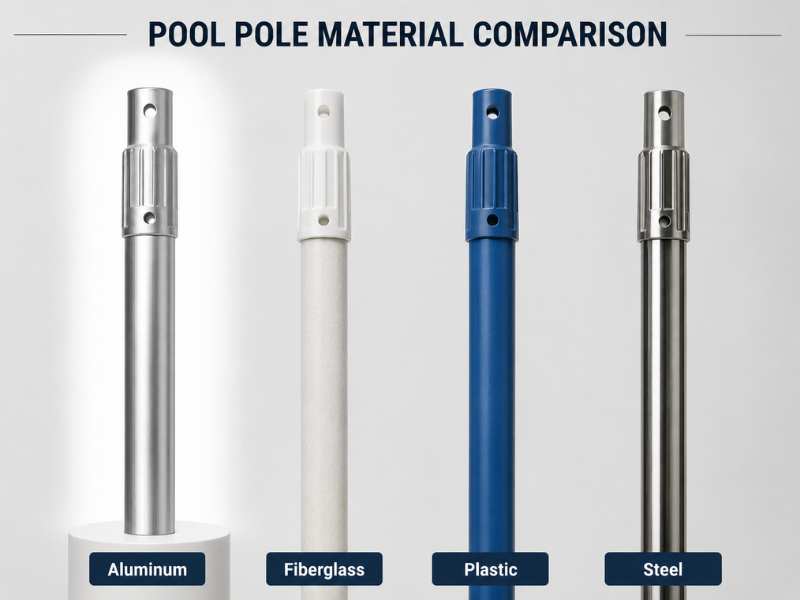
Ein aluminum pool vacuum pole gives most OEM buyers the best balance of strength, weight, surface finish, and production cost. It also supports extrusion, machining, anodizing, plastic part assembly, and custom packaging.
The Aluminum Extruders Council explains that aluminum extrusion uses a selected alloy, extrusion die, heated billet, and tooling to form an aluminum profile. You can review the basic Aluminium-Extrusionsverfahren.
| Material | Main Advantage | Main Risk | Best B2B Use |
|---|---|---|---|
| Aluminium | Good strength-to-weight ratio and clean anodized finish | Poor tolerance control can cause wobble | OEM and wholesale pool vacuum poles |
| Fiberglas | Stiff and non-conductive | Higher cost and different damage pattern | Premium or special safety-focused poles |
| Plastic | Low cost and light weight | Weak for long vacuuming reach | Short, low-duty pool tools |
| Stahl | High strength | Heavy and corrosion risk | Rare for pool vacuum pole retail lines |
For most pool accessory distributors, aluminum is the practical choice. It can be made in multiple lengths, colors, locking systems, and packaging styles.
Why OEM Buyers Often Choose Aluminum Pool Vacuum Poles
OEM buyers often choose aluminum because it allows controlled tube size, surface finish, and scalable production. It also gives a better retail look than low-cost plastic poles.
A complete custom aluminum pool vacuum pole may include:
- Aluminum telescopic tubes
- Plastic twist locks or flip locks
- Spring buttons
- Inner plugs
- Outer caps
- Rubber grips
- Vacuum head connection ends
- Labels, sleeves, or retail cartons
This matters because a pool pole is not only an aluminum tube. It is a full assembled product.
At Xingyong, we can match aluminum tubes, plastic components, rubber parts, locking structures, surface treatment, and final packaging. This reduces the risk of buyers coordinating several separate suppliers.
Pool Vacuum Pole Wall Thickness: Why Tube Strength Matters
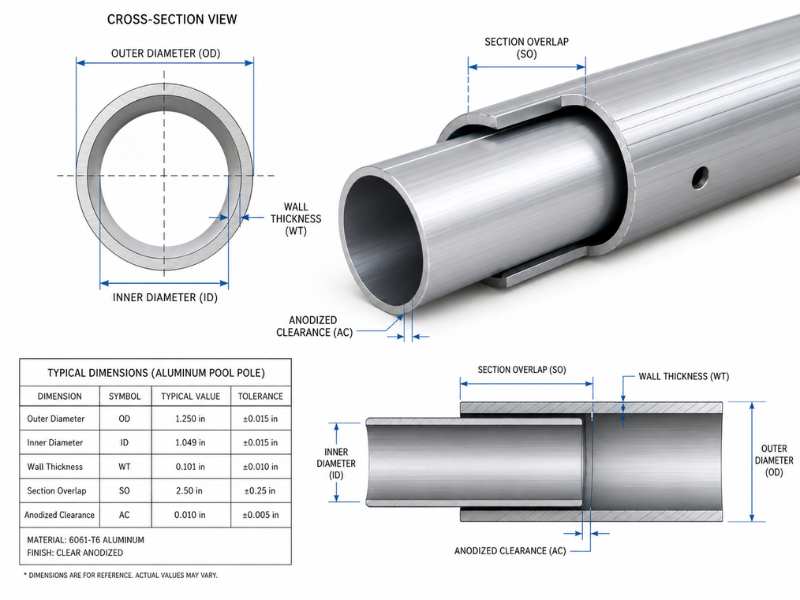
Pool vacuum pole wall thickness controls bending resistance, end strength, and user confidence. Thin tubes can reduce price, but they often increase hidden cost.
Important tube factors include:
- Outer diameter
- Inner diameter
- Wandstärke
- Roundness
- Geradheit
- Tube section overlap
- Tolerance stability
- Surface thickness after anodizing
For telescopic poles, tolerance is not a factory detail only. It decides whether each tube section slides smoothly without obvious wobble.
The Aluminum Association provides resources on aluminum extrusion tolerances, including how extruded profiles are measured against industry standards.
If the clearance is too wide, the pole shakes. If it is too tight, the pole may become hard to extend after anodizing.
If the pole feels loose before anodizing, finishing will not magically fix it. Surface treatment can improve appearance, but it cannot correct weak tube design.
Tube Design Factors for a Heavy Duty Pool Pole for Vacuum Head
| Tube Design Factor | What It Affects | Buyer Risk if Ignored |
|---|---|---|
| Outer diameter | Overall stiffness and hand feel | Pole feels weak at full extension |
| Inner diameter | Vacuum head fit and tube nesting | Loose connection or poor telescopic fit |
| Wandstärke | Bending resistance and end strength | Tube bends or deforms near holes |
| Section overlap | Stability between telescopic tubes | Shaking and poor force transfer |
| Roundness | Smooth extension and rotation control | Hard movement or uneven sliding |
| Geradheit | Full-length handling | Poor steering during vacuuming |
| Hole quality | Spring-button engagement | Rattling, burrs, or accidental release |
| Anodized clearance | Movement after surface treatment | Pole becomes tight or noisy |
This is where Xingyong’s extrusion and inspection capability matters. We focus on precision aluminium tube manufacturing and tolerance control for telescopic pole systems, not only tube supply.
Why Thin Pool Poles Create Returns
Thin pool poles create returns because they bend, dent, deform, or feel unstable under real vacuuming force. This problem gets worse as length increases.
Common thin-wall risks include:
- Bending at full extension
- Deformation around spring-button holes
- Dents during shipping
- Weak connection near the vacuum head
- Poor confidence when users push the pole
- More after-sale complaints
I have seen buyers lose more money from replacement claims than they saved from a thinner tube. The first quotation looked better. The total season cost did not.
For pool-season products, a late quality problem is more expensive than a slightly higher factory price.
Best Locking Mechanism for a Pool Pole for Vacuum Head
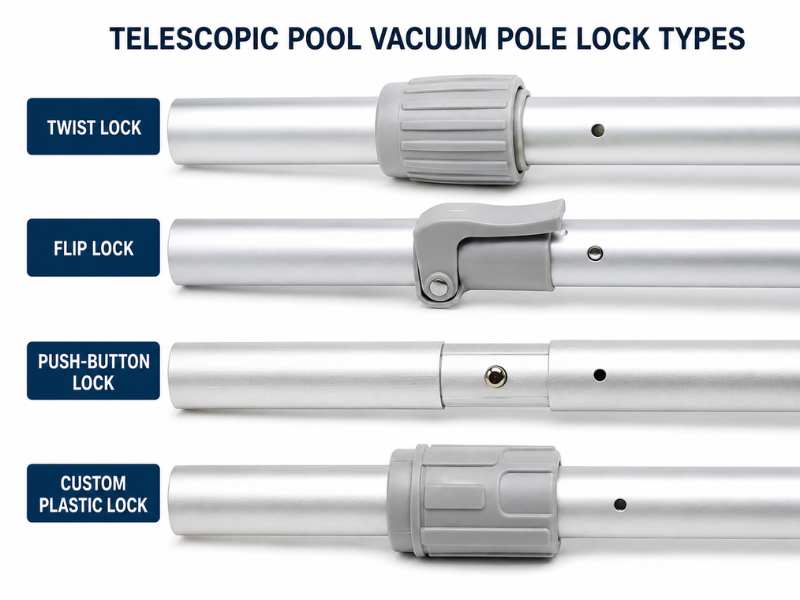
The best locking mechanism for a pool pole for vacuum head must hold axial force when the user pushes the vacuum head. A lock that works for a skimmer may not work for vacuuming.
Common pool pole locks include:
- Drehverschluss
- Klappverschluss
- Cam lock
- Push-button lock
- Custom plastic lock
- Combined lock structure
A weak lock creates one clear complaint: the pole collapses during vacuuming.
This usually happens when the lock cannot hold the tube sections under wet, loaded, repeated use. A dry hand test in the factory is not enough.
For a deeper comparison, read our guide to telescoping pole locking mechanisms.
What I Check Before Approving a Pool Vacuum Pole Lock
I check a vacuum pole lock under movement, not only by hand feel. Vacuuming creates push force, twist force, and water resistance.
Before approval, I check:
- Does the pole shorten under pushing force?
- Does the lock hold at full extension?
- Can wet hands tighten or release it?
- Does sand affect the lock?
- Does pool water reduce grip?
- Does the lock scratch the anodized tube?
- Does the lock make noise during use?
- Can the plastic part survive repeated operation?
A good lock should feel simple to the end user. But the plastic geometry, tube tolerance, and friction design must be correct behind that simple feeling.
This is why we do not treat locks as low-value accessories. The lock decides whether the pole feels reliable during real vacuuming.
Anodized Aluminum Pool Vacuum Pole: Why Surface Finish Affects Durability
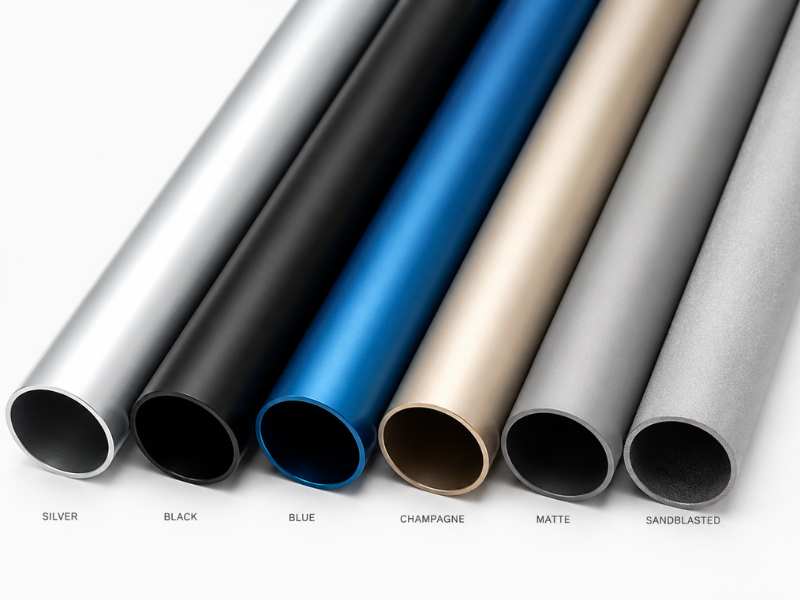
Anodized aluminum improves the appearance, corrosion resistance, and sliding feel of a Pool-Staubsaugerstange. Pool products face water, chlorine, UV exposure, hand contact, and abrasion.
A research article on anodized 6061 aluminum reports that anodizing and sealing can improve corrosion resistance. You can review this study on anodized aluminum corrosion resistance.
For pool vacuum poles, common finish options include:
- Silver anodized aluminum
- Black anodized aluminum
- Blue anodized aluminum
- Champagne anodized aluminum
- Matte anodized finish
- Sandblasted anodized finish
- Brushed aluminum finish
Surface finish affects more than color. It affects user touch, section sliding, scratch visibility, and retail shelf value.
Surface Defects That Damage Retail Sales
Surface defects damage buyer trust before the product is used. A customer sees the pole before they test its strength.
Common defects include:
- Color mismatch between tube sections
- Visible scratches
- Burrs around drilled holes
- Rough tube ends
- Uneven sandblasting
- Dirty marks inside packaging
- Poor sliding after anodizing
At Xingyong, I always connect surface control with dimensional control. Anodizing changes the tube surface. If tube clearance is not planned, the pole may lose smooth movement after finishing.
Deshalb anodizing, surface consistency, and dimensional control for smooth telescopic movement must be managed together.
OEM Pool Vacuum Pole Buying Decision Table
A good OEM buyer should compare more than price. The right pool pole for vacuum head must meet fit, strength, lock, finish, packaging, and mass production requirements.
| Buyer Concern | What to Check | Poor Supplier Risk | Better Buying Decision |
|---|---|---|---|
| Vacuum head fit | Pole ID and button hole position | Loose connection and complaints | Test with real vacuum head sample |
| Long reach | Tube diameter, wall thickness, overlap | Bending at full extension | Match tube structure to length |
| Lock stability | Wet push-pull test | Pole collapses during vacuuming | Use stronger lock design |
| Surface durability | Anodizing quality and scratch control | Poor shelf appearance | Inspect finish and color consistency |
| Tube movement | Roundness and tolerance | Shaking or hard extension | Control extrusion and post-treatment fit |
| Versand | Carton length and strength | Bent poles or damaged packaging | Design export carton by SKU length |
| Retail clarity | Label, length, and compatibility claim | Wrong buyer expectation | Print clear fit and use information |
| Margin protection | Return rate and replacement cost | Hidden after-sale loss | Buy by total seasonal cost |
This table is often where serious buyers change their thinking. A pool pole is not cheap if it creates high return pressure.
How to Choose a Pool Vacuum Pole Supplier
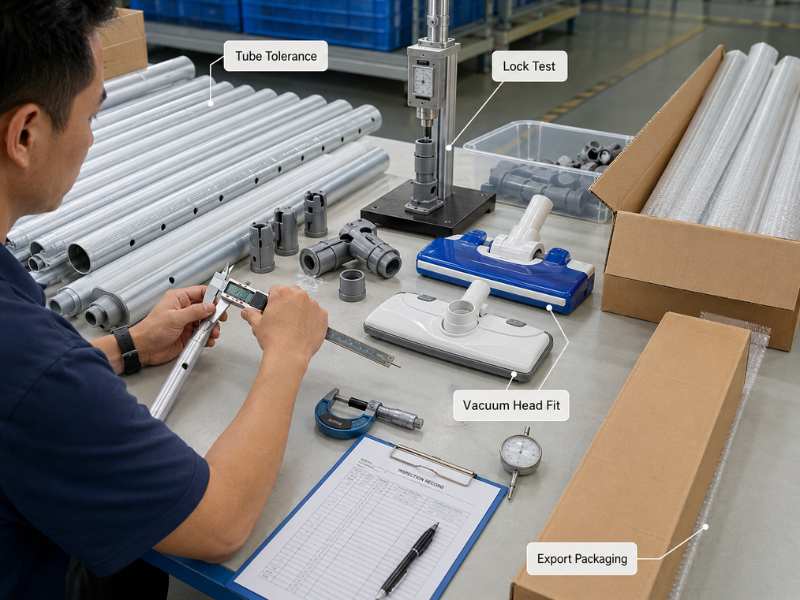
A good pool vacuum pole supplier should understand aluminum tubes, plastic locks, vacuum head fit, surface finish, final assembly, packaging, and mass production risk. A low price alone does not prove supplier strength.
| Supplier Capability | What to Ask | Warum das wichtig ist |
|---|---|---|
| Aluminum tube production | Can you control OD, ID, wall thickness, and straightness? | Prevents bending, shaking, and poor fit |
| Telescopic tolerance control | How do you control tube clearance after anodizing? | Keeps extension smooth and stable |
| Plastic lock support | Can you match or develop locks and connectors? | Reduces multi-supplier risk |
| Vacuum head fit testing | Can you test with our real vacuum head sample? | Prevents loose connection claims |
| Oberflächenbehandlung | Can you control anodizing color and scratch level? | Improves retail shelf appearance |
| Post-processing | Can you drill, punch, slot, tap, swage, and deburr? | Supports custom connection design |
| Final assembly | Can you assemble complete telescopic poles? | Reduces buyer coordination work |
| Pilot run support | Can you support small-batch validation before mass production? | Lowers bulk order risk |
| Exportverpackung | Can you design cartons for long poles? | Reduces shipping and warehouse damage |
| Quality records | Can you keep batch checks and inspection control? | Helps stable repeat orders |
This checklist helps buyers avoid a common mistake: choosing a tube supplier when they actually need a complete pole assembly supplier.
Xingyong is better suited for projects with structural, appearance, and functional requirements. We are not only selling aluminum tubes. We help buyers turn custom telescopic pole ideas into manufacturable products.
Distributor Profit Logic: Cheap Pool Poles Can Be Expensive
A cheap pool pole for vacuum head can reduce first order cost, but it can damage distributor profit after sale. Pool products are seasonal, so timing makes the risk worse.
When the pool season starts, distributors need stable supply, low complaint rates, and fast reorder confidence. A failed pool pole SKU creates problems at the worst time.
Hidden costs include:
- Customer returns
- Replacement shipments
- Store complaints
- Bad online reviews
- Damaged cartons
- Warehouse handling cost
- Lost seasonal sales
- Retailer delisting risk
- Lower reorder confidence
- Pressure from chain-store buyers
For private label orders, poor quality also damages brand trust. A weak pole may carry the buyer’s logo, but the complaint goes to the buyer, not the factory.
What Buyers Should Compare Beyond Unit Price
A better buyer asks, “What will this pole cost after 10,000 units are sold?”
Compare these factors:
- Return rate risk
- Vacuum head compatibility
- Lock slipping rate
- Carton damage rate
- Replacement cost
- Review score risk
- Retail buyer confidence
- Chargenkonsistenz
- Ocean freight damage risk
- Seasonal replenishment risk
This is where an experienced pool vacuum pole manufacturer can protect the buyer. The supplier must understand not only production cost, but also retail failure points.
How Xingyong Manufactures Pool Poles for Vacuum Head Projects
Xingyong manufactures aluminum telescopic pole systems for buyers who need structural, appearance, and functional control. We are not only a standard pole seller, and we are not only an aluminum tube supplier.
Our factory was founded in 2002. We support aluminum extrusion, anodizing, sandblasting, machining, plastic and rubber part matching, lock assembly, final inspection, and packaging.
Our production capacity includes:
- 14 aluminum extrusion machines from 350T to 2000T
- 2 large automatic anodizing production lines
- Long and short material sandblasting machines
- CNC machines, saws, punches, milling machines, lathes, polishing machines, shrinking and expanding equipment
- Inspection equipment including Oxford spectrometer, profile imaging equipment, microscopes, tensile testing machines, hardness testers, and coating thickness testers
- Monthly output around 3000 tons
- Certifications including ISO 9001:2015, ISO 14001:2015, ISO 45001:2018, ISO 50001:2018, IATF 16949:2016, BSCI, and social audits
For a custom pool vacuum pole manufacturer project, we can work from a sample, CAD file, STEP file, PDF drawing, retail product, or product concept.
When I review an RFQ, I first look for the vacuum head sample and target length. These two details tell me most of the structural risk.
Some buyer designs look fine in a drawing. But the lock, tube clearance, spring-button position, or plastic part may not suit mass production.
The Problem-Capability-Result Logic
| Buyer Problem | Xingyong Capability | Practical Result |
|---|---|---|
| Pole bends during vacuuming | Aluminum extrusion and wall thickness control | Better rigidity at working length |
| Tube sections shake | OD, ID, roundness, and straightness control | Smoother telescopic movement |
| Lock slips under force | Plastic lock matching and assembly testing | More stable vacuuming operation |
| Vacuum head connection is loose | Drilling, punching, deburring, and sample fit testing | Better spring-button engagement |
| Surface scratches hurt retail sales | Sandblasting, anodizing, and finish inspection | Cleaner shelf appearance |
| Buyer needs custom design | CAD, STEP, PDF, sample review, and DFM support | Easier move from idea to production |
| Supplier coordination is hard | Aluminum tubes, plastic parts, rubber parts, and assembly | Fewer handoff risks |
| Shipping damage occurs | Packaging review for long pole SKUs | Lower carton damage risk |
This is the real reason factory capability matters. Equipment is useful only when it solves buyer risk.
From Aluminum Tube to Complete Pool Vacuum Pole Assembly
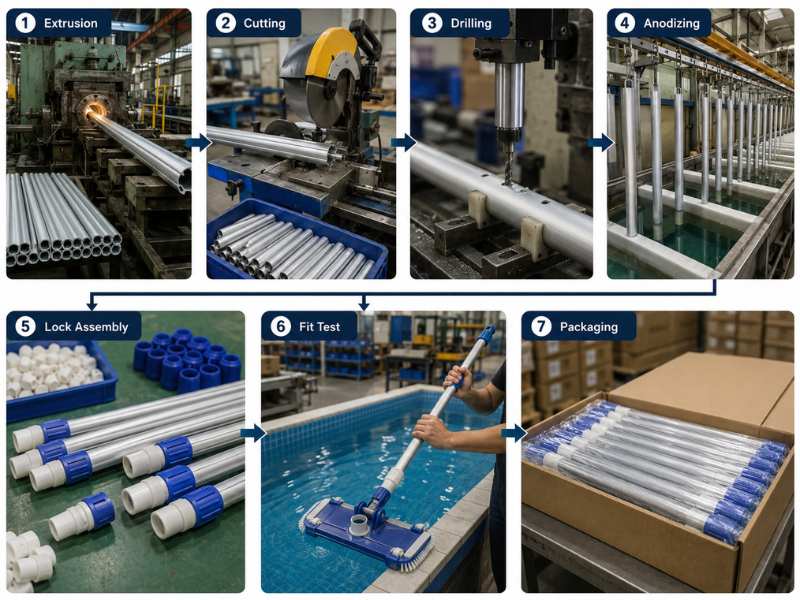
A complete OEM pool vacuum pole project may include:
- Application and target market review
- Aluminum alloy and tube structure selection
- Extrusion die and tube production
- Zuschneiden auf Länge
- Drilling, punching, slotting, tapping, grooving, reducing, or flaring
- Sandblasting, brushing, or polishing
- Anodizing and color control
- Plastic lock and connector assembly
- Vacuum head connection test
- Extension, sliding, and lock test
- Retail or bulk packaging
This is why we focus on complete telescopic pole assembly, not only aluminium tubes.
For product background, you can also review our guide on how pool vacuum poles are made and our Aluminium-Poolverlängerungsstange page.
Pool Pole for Vacuum Head RFQ Checklist
A clear RFQ helps the factory quote faster and make better samples. It also helps buyers control MOQ, lead time, packaging, and final landed cost.
| RFQ Item | What to Send | Why It Helps |
|---|---|---|
| Target product | Pool pole for vacuum head | Confirms force and application |
| Length range | 4–8 ft, 6–12 ft, 8–16 ft, or custom | Controls tube structure and carton size |
| Tube size | OD, ID, and section count | Confirms fit and strength |
| Wandstärke | Required value or target range | Controls bending resistance |
| Staubsaugerkopf | Sample, handle drawing, or photo with size | Confirms connection |
| Lock type | Twist, flip, push button, or custom | Controls user experience |
| Oberflächenbeschaffenheit | Silver, black, blue, matte, sandblasted | Controls appearance and corrosion resistance |
| Verpackung | Bulk carton, label, sleeve, or color box | Controls retail and shipping cost |
| Target market | Pool store, supermarket, OEM kit, online retail | Controls SKU design |
| Order plan | Trial order and annual volume | Helps plan MOQ and lead time |
| Compliance needs | Audit, certification, or retailer requirement | Supports large-channel purchasing |
For export orders, buyers should also confirm carton size, shipping marks, labeling, pallet loading plan, and customs document support.
If you already have a vacuum head, send us the sample or handle drawing. We can review the pole end fit, recommend tube structure, and check the assembly risk before sampling.
Common Mistakes When Buying Wholesale Pool Poles for Vacuum Heads
The biggest mistake is buying the pool pole by maximum length only. A long pole is not useful if it bends, slips, or fits poorly.
Common buying mistakes include:
- Choosing the longest pole without checking wall thickness
- Ignoring vacuum head handle fit
- Assuming all “standard” poles fit the same
- Using weak locks on long poles
- Testing dry operation only
- Ignoring wet-hand use
- Forgetting burr control around holes
- Choosing surface finish only by color
- Using weak export cartons
- Skipping real vacuum head assembly tests
- Buying from a tube supplier when full assembly is needed
For wholesale buyers, these mistakes scale quickly. A small design issue can become a batch problem.
Häufig gestellte Fragen
What pole fits a pool vacuum head?
Most pool vacuum heads fit a standard telescopic aluminum pool pole with a compatible spring-button connection. For bulk orders, buyers should test the vacuum head sample against the pole end before approving production.
What size pool pole do I need for a vacuum head?
Most residential buyers use a 6–12 ft or 8–16 ft pool pole for vacuuming. Larger inground or commercial pools may need 12–18 ft or 12–24 ft poles with stronger tubes.
Do all vacuum heads fit standard pool poles?
No, not all vacuum heads fit every standard pool pole perfectly. Inner diameter, spring-button hole position, button engagement depth, and handle shape can still create loose fit.
Why does my pool pole collapse when vacuuming?
A pool pole collapses when the lock cannot hold pushing force during vacuuming. Weak plastic locks, worn friction parts, and thin tube sections often cause this problem.
What causes high return rates for pool vacuum poles?
High return rates often come from bending, lock slipping, loose vacuum head fit, scratches, and weak packaging. These issues usually start from poor tube design and weak supplier control.
How do I choose a pool vacuum pole supplier?
Choose a pool vacuum pole supplier that can control aluminum tube tolerance, locks, finishing, assembly, packaging, and sample testing. A simple aluminum tube factory may not handle full pole risks.
What should private label buyers check before ordering pool vacuum poles?
Private label buyers should check pole strength, lock feel, vacuum head compatibility, finish consistency, carton quality, and batch stability. These points protect brand reviews and repeat retail orders.
Can Xingyong make custom pool vacuum poles for OEM projects?
Yes, Xingyong can manufacture custom aluminum pool vacuum poles with matching plastic and rubber parts. We support extrusion, machining, anodizing, lock assembly, inspection, and packaging.
What should I include in a pool vacuum pole RFQ?
You should include length, tube size, wall thickness, lock type, vacuum head sample, finish, packaging, and order volume. This helps the factory quote accurately and reduce sample revisions.
Build a Pool Vacuum Pole SKU That Survives the Season
A strong pool pole for vacuum head starts with fit, but it does not end with fit. Buyers also need the right tube structure, wall thickness, lock design, anodized finish, packaging, and real vacuum head testing.
In my experience, the safest B2B buying decision is not the lowest factory price. It is the pole that keeps its shape, holds its lock, fits the vacuum head, and creates fewer problems after sale.
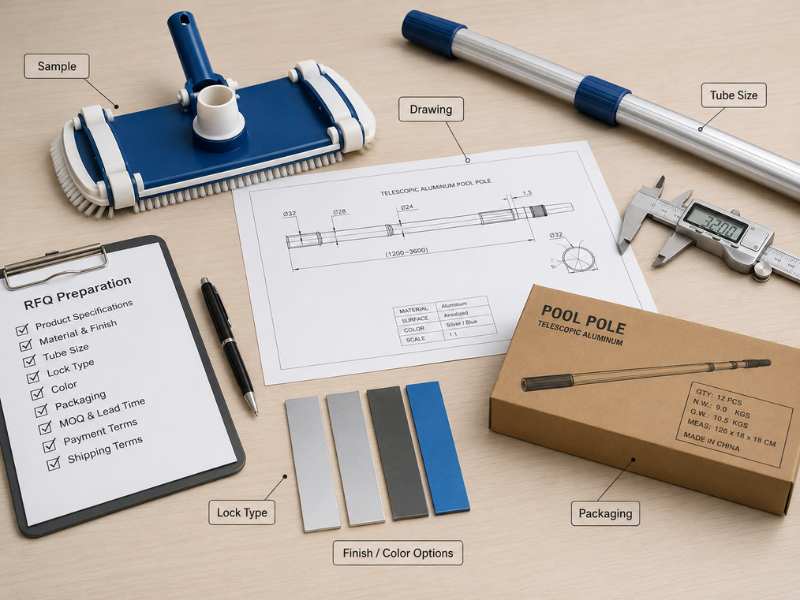
Send Us Your Vacuum Head and Pole Specification
Send Xingyong these details for your custom pool pole for vacuum head project:
- Vacuum head sample or handle drawing
- Target pole length range
- Tube OD, ID, and wall thickness if available
- Preferred lock type
- Oberflächenbeschaffenheit und Farbe
- Packaging style
- Target retail market
- Trial order quantity
- Erwartetes Jahresvolumen
- Compliance or audit requirements
We will review the tube structure, connection fit, lock choice, anodized finish, carton design, and mass production feasibility before sampling.