
Ten feet — that is the number, and everything else hangs off it.
Backyard sets get planted at whatever height the box allowed, then the game plays wrong: the ball drags for kids or sails over adults, and nobody knows why. Tetherball has real dimensions, and they are simple.
Here are the regulation numbers, the court layout, install depth, and how to scale the setup for younger players.
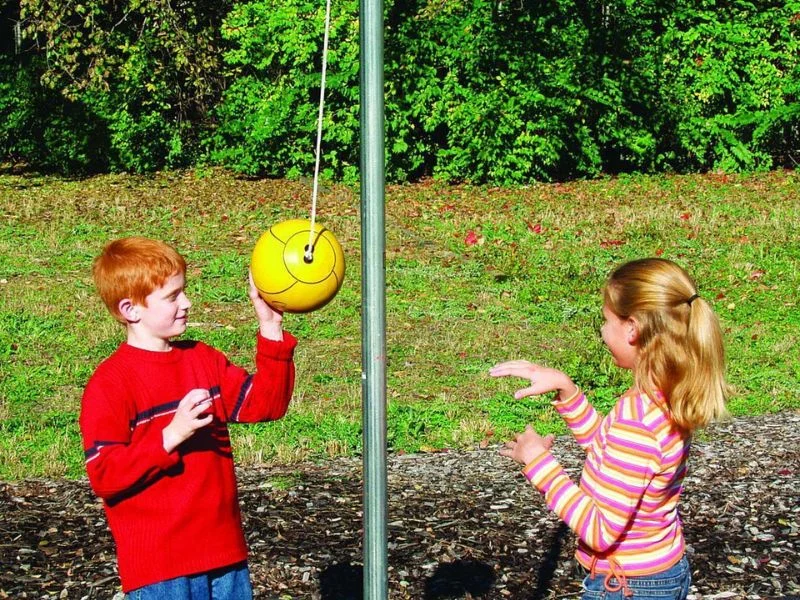
Regulation Tetherball Pole Height
A tetherball pole stands 10 ft above the ground. With a ground sleeve or buried base that means a pole roughly 12 ft overall, since about 2 ft goes below grade for stability.
The rope hangs from a top eye and typically runs about 7–8 ft, leaving the ball to rest around 2 ft off the ground — high enough to circle freely, low enough for players to strike.
Court and Rope Dimensions
The play area is a 20 ft diameter circle centered on the pole, split into two halves; players may not cross the center line.
| Elemento | Regulation | Note |
|---|---|---|
| Pole height above ground | 10 pés | ~12 ft pole with 2 ft buried |
| Rope length | 7–8 ft | Ball rests ~2 ft off ground |
| Court circle | 20 ft diameter | Two halves, center line |
| Neutral zones | Optional 3 ft wedges | School variants |
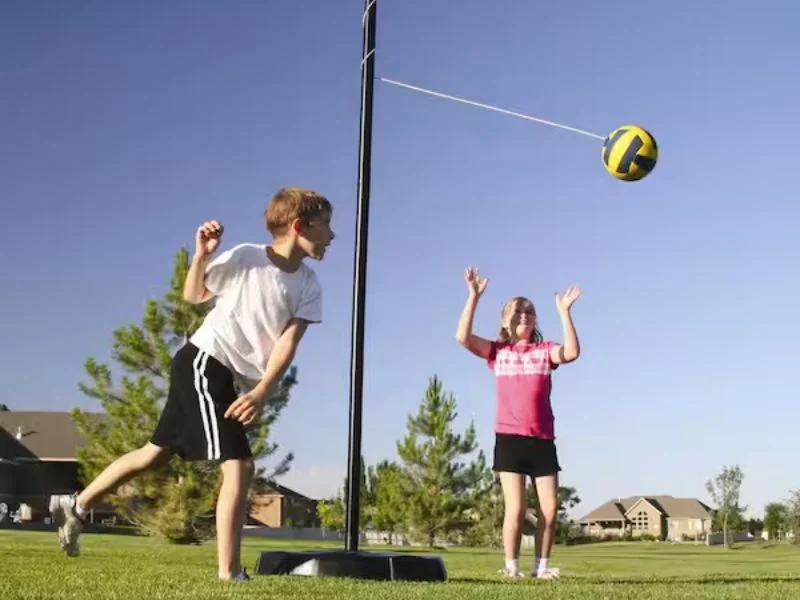
Install Depth and Anchoring
Sink a ground sleeve about 24 in deep in concrete for a permanent set; portable bases trade some stability for a dig-free driveway setup.
The sleeve approach keeps the pole removable for mowing and winter. Rope-wrap impact loads the pole sideways all game long, which is why wall thickness matters more here than on a static pole — a detail our aluminum tetherball poles are walled for specifically, at a fraction of steel’s carton weight.
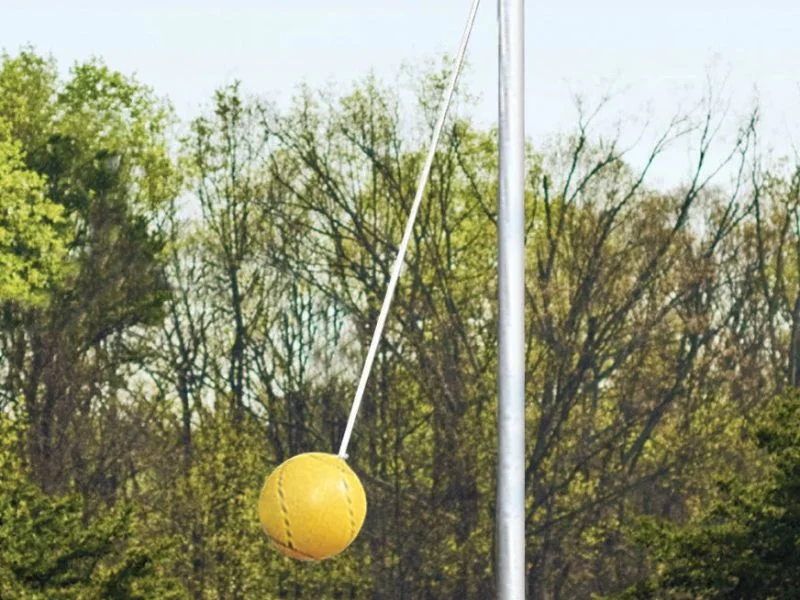
Height Adjustments for Younger Players
Drop the effective height to about 7–8 ft for elementary players by choosing an adjustable pole or a shorter sleeve set — the game teaches better when kids can actually reach the ball’s arc.
Organized play references from bodies like USA Volleyball follow the same principle across net sports: scale the equipment, keep the rules. Sectional aluminum poles make this a one-section change rather than a new purchase.
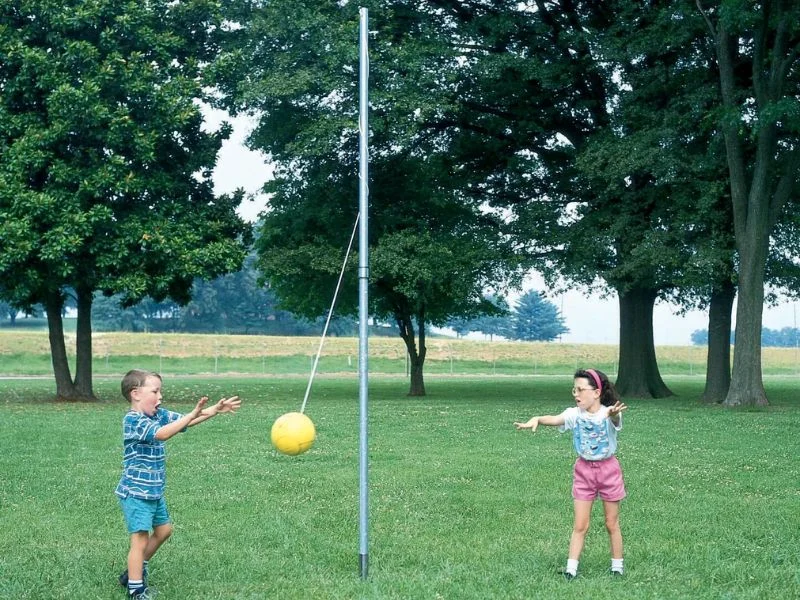
Setup Checklist
Plumb the pole, set the sleeve in cured concrete, clip the rope to the top eye, and mark the 20 ft circle and center line. A level pole is the difference between a fair game and a permanent home-court advantage toward the lean.
Marking the Court, Step by Step
Center the pole, tie a string to it at 10 ft, walk the circle, and mark the 20 ft diameter boundary plus a straight center line splitting it in two — a complete court takes fifteen minutes with paint or ground chalk.
The string trick keeps the circle honest: any wobble in a hand-drawn boundary becomes an argument by game three. On grass, inverted marking paint survives mowing for weeks; on a driveway, sidewalk chalk does the job per weekend. Schools painting permanent courts add the optional 3 ft neutral wedges on either side of the center line — worth copying at home if the players take their rules seriously.
Leave runoff room beyond the circle. Players chase the ball at full tilt facing upward; a court with a fence, planter or grill inside arm’s reach of the boundary is a scraped elbow on a schedule.
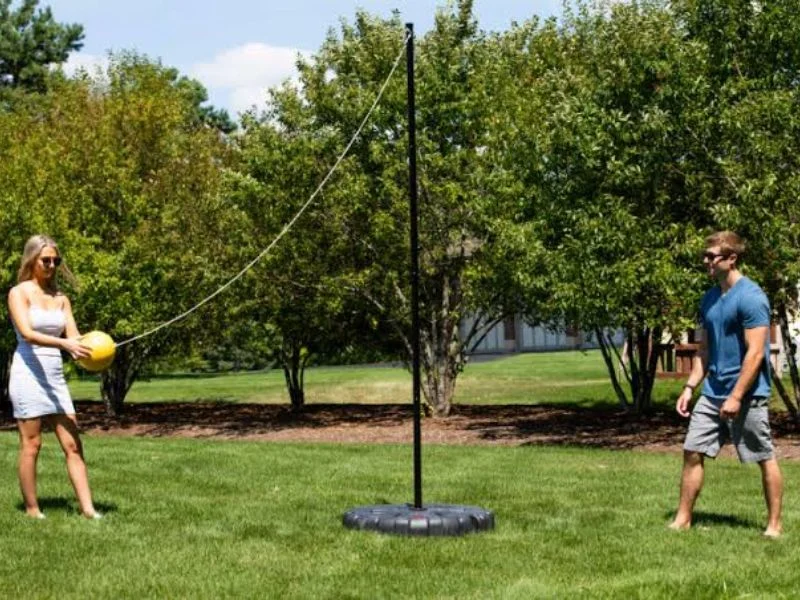
In-Ground Sleeve vs Portable Base: The Real Trade
A concrete-set ground sleeve gives tournament-grade rigidity and an empty lawn in the off-season; a portable base trades a little stiffness for a court that can move — pick by who plays and where.
The sleeve is the committed answer: dig roughly 24 in, set the sleeve plumb in concrete, let it cure, and the pole drops in and lifts out for the mower forever after. Frost-country installs slope the concrete collar so water sheds instead of freezing in the sleeve. The portable route — a weighted or fillable base — suits renters, driveways and families who are not sure the game will stick; its honest cost is sway at the pole top, which slightly changes ball behavior in hard play.
What neither option forgives is a lean. A tilted pole gives one side a permanently shorter swing arc — check plumb with a level on two faces at install, and again each spring after the ground has done its winter moving.
Assembly and First-Game Checklist
Seat every section fully, orient the top eye away from the sun-side serve, clip the rope, hang the ball at about 2 ft off the ground, and play the first point gently — the first game is the final quality check.
Sectional poles reward a wipe-down before assembly: a grain of grit in a joint becomes a click you will hear all summer. Check that the swivel spins free under load — a lazy swivel winds the rope short and turns legal serves into tangles. If the set includes a portable base, top up its ballast after the first week; settling is normal and quiet.
For sporting-goods buyers reading with a spreadsheet open: everything in this checklist is decided at the factory — section fit, eye machining, swivel quality, carton completeness. A set that assembles cleanly reviews well, and reviews are the category’s real marketing budget.
Storage, Winter and the Second Season
Lift the pole out of its sleeve at season’s end, cap the sleeve, coil the rope off the ball, and store sections dry — aluminum asks nothing else, and the set opens next June exactly as it closed.
The rope is the real consumable: sun and wrap-impact age it faster than any other part, so inspect it each spring and keep a spare in the carton. Sectional storage is where the packable design pays twice — the same carton that shipped the set stores it, standing in a garage corner instead of lying across the rafters like a one-piece steel pole.
Backyard Set or Playground Build: Two Duty Classes
A family backyard set and a school playground pole are the same game at two duty classes: the backyard build optimizes carton weight and easy install, the playground build optimizes abuse tolerance and permanence.
The difference lives in three specs. Wall thickness first — a schoolyard pole absorbs recess-grade wrap hits from dawn to dusk, so it carries more metal per foot. Anchoring second — playground installs are always sleeved or footed in concrete, never portable, because a base that can move is a base that will be moved. Finish third — powder-coat in school colors handles gang-tackle contact better on institutional builds, while anodized keeps backyard sets looking retail-fresh with zero upkeep.
Buyers assembling a range should carry both and say so plainly on the box: families upsell themselves to the sturdier build for driveways with teenagers, and schools never buy the light one twice. Two duty classes, one platform — that is the whole category strategy in a sentence.
Rules Refresher: Settling Arguments Before They Start
Serve alternates by game, players may not touch the pole or the rope, and the winner is the side that winds the rope fully in their direction above the marker — write these three on the box and half the backyard disputes disappear.
The common house-rule variations are worth naming so sets can support them: some families play carries and double-hits as legal for younger kids, and school variants add the neutral wedges where neither player may stand. None of it changes the hardware — but a rules card in the carton is the cheapest customer-satisfaction feature a set brand can print, and it costs less than one support email.
Why Height Gets Measured Wrong
The classic install error is measuring 10 ft of pole instead of 10 ft above the ground — a sleeved pole loses its buried length, and the game plays a foot short all summer.
Read the set spec carefully before digging: a pole sold as 12 ft overall with a 2 ft sleeve depth delivers the regulation 10 ft; a pole sold as 10 ft overall delivers 8, and nobody notices until an adult reaches the ball flat-footed. Sectional builds sidestep the confusion when the maker prints assembled play height on the carton — the number families actually need — instead of raw pole length. It is a labeling detail that separates sets designed by players from sets designed by spreadsheets.
Perguntas frequentes
How high is a tetherball pole?
10 ft above the ground — typically a 12 ft pole with about 2 ft set below grade in a sleeve or base.
How long is a tetherball rope?
About 7–8 ft, hung from the top eye so the ball rests roughly 2 ft off the ground.
How big is a tetherball court?
A 20 ft diameter circle centered on the pole, divided into two halves with a center line players cannot cross.
How deep should a tetherball pole be buried?
About 24 in, ideally as a concrete-set ground sleeve so the pole lifts out for mowing and off-season storage.
Can the pole be lowered for kids?
Yes — sectional or adjustable poles drop the effective height to 7–8 ft for elementary players without changing the rules of the game.

 English
  Español
  Français
  Deutsch
  Português