
A pure water window cleaning system is three machines pretending to be one.
Kit brands often spec the pole carefully and treat the rest as accessories — then field complaints trace back to water quality or flow, not the pole at all. Knowing what each stage does keeps the blame, and the engineering budget, in the right place.
This guide breaks down the three stages, what spot-free really depends on, and which decisions belong to the pole platform.
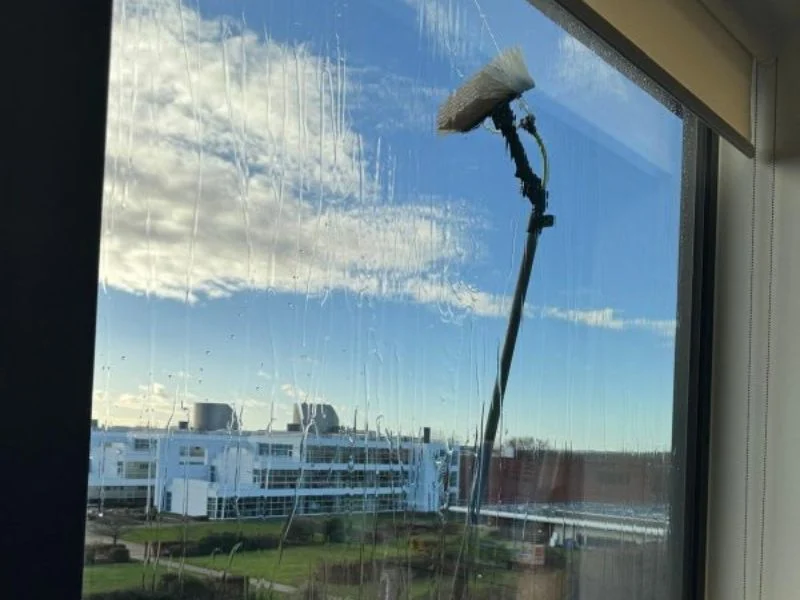
What a Pure Water Window Cleaning System Includes
A pure water window cleaning system combines a purification stage (RO and/or DI), a delivery stage (tank, pump and hose), and a working stage — the water fed pole and brush. Glass comes out spot-free because the water carries almost no dissolved minerals, so nothing is left behind as it dries.
| Estágio | What it does | Typical hardware |
|---|---|---|
| Purification | Strips dissolved solids from tap water | RO membrane, DI resin vessel, TDS meter |
| Delivery | Moves water to the work face | Tank, 12 V pump or mains pressure, hose reel |
| Fim de trabalho | Agitates and rinses the glass | Water fed pole, brush head, jets |
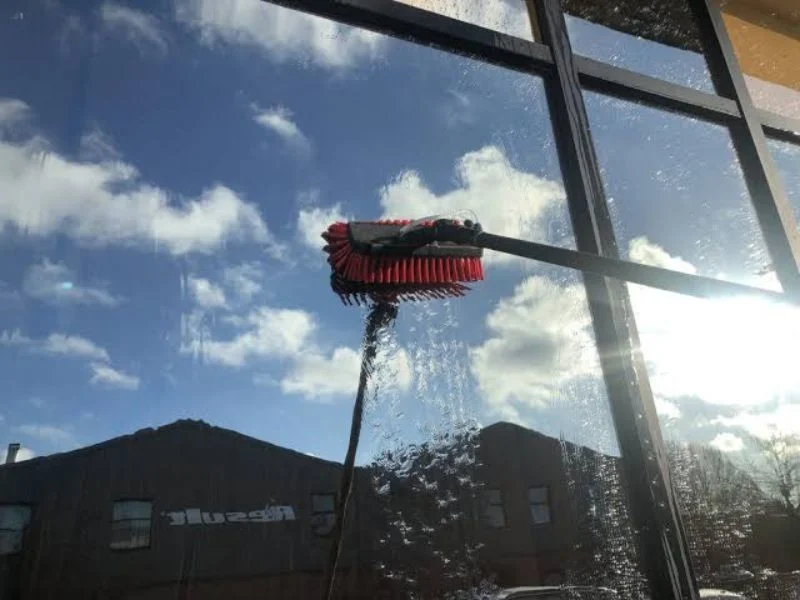
RO, DI and What the TDS Number Means
RO membranes remove the bulk of dissolved solids; DI resin polishes the remainder toward zero. Operators check the result with a TDS meter — the closer to zero, the surer the spot-free dry-down. Water treatment references from the Water Quality Association cover the underlying chemistry; for window work the practical takeaway is simple: measure, don’t guess.
Which combination a kit needs depends on local tap water: soft-water regions may run DI-only carts, while hard-water regions pair RO ahead of DI to keep resin costs sane.
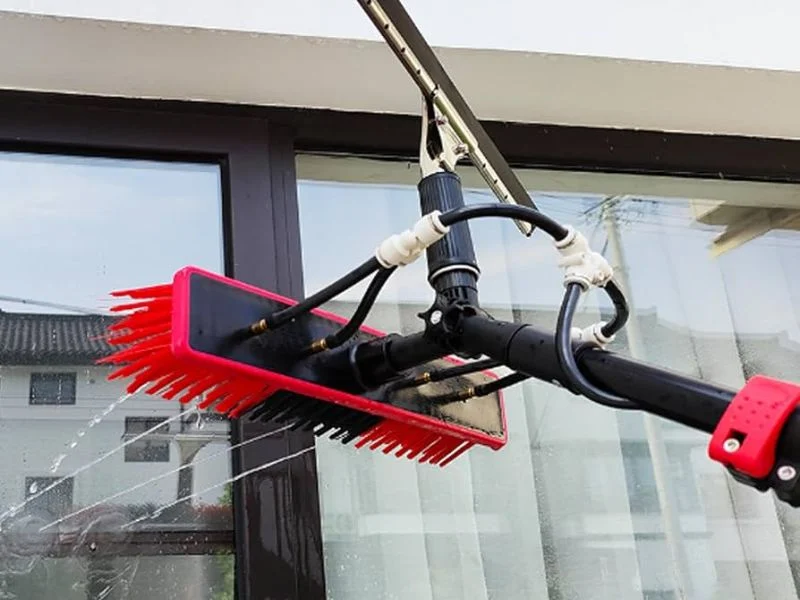
What the Pole Platform Decides
The pole decides reach, brush control and how the hose gets to the brush — and it is the part of the system a brand can own outright. Filtration hardware is largely commodity; the aluminum water fed pole is where a kit differentiates on feel, weight and fit, and where OEM engineering pays back.
Hose routing, section balance and the brush interface all get locked at the pole spec stage — decisions covered in detail on our platform page.
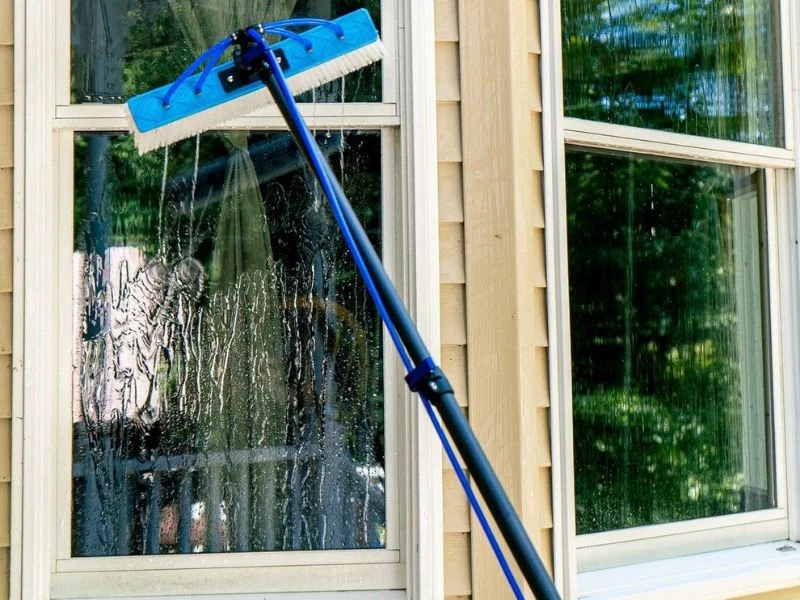
Maintenance and Running Cost
Running cost lives almost entirely in the purification stage: membranes and resin are consumables, poles and brushes are not. That is why route operators track TDS creep weekly — resin swapped on time is cheap, glass re-cleaned under warranty is not.
For the pole, upkeep is minimal: rinse the sections, check the seals, store dry on the van rack.
Matching RO and DI to the Water You Actually Have
Test the tap first: soft-water regions often run DI-only carts economically, hard-water regions put RO ahead of DI so the resin survives — the TDS pen decides, not the catalog.
The economics are simple once you see resin as the consumable it is. DI resin polishes water to zero but exhausts in proportion to what it swallows; feeding it hard tap water burns money by the cartridge. An RO membrane strips the bulk load first at far lower running cost, leaving DI a light finishing job. Below roughly 100 ppm feed water, many operators skip RO entirely; well past that, RO-then-DI is the configuration that keeps monthly costs sane.
Kit brands should write this into the box logic rather than the fine print: a cart sold configurable — DI-only or RO/DI — covers both markets with one platform, and the dealer conversation starts with a TDS reading instead of a guess.
Sizing the Delivery Stage: Tank, Pump, Hose
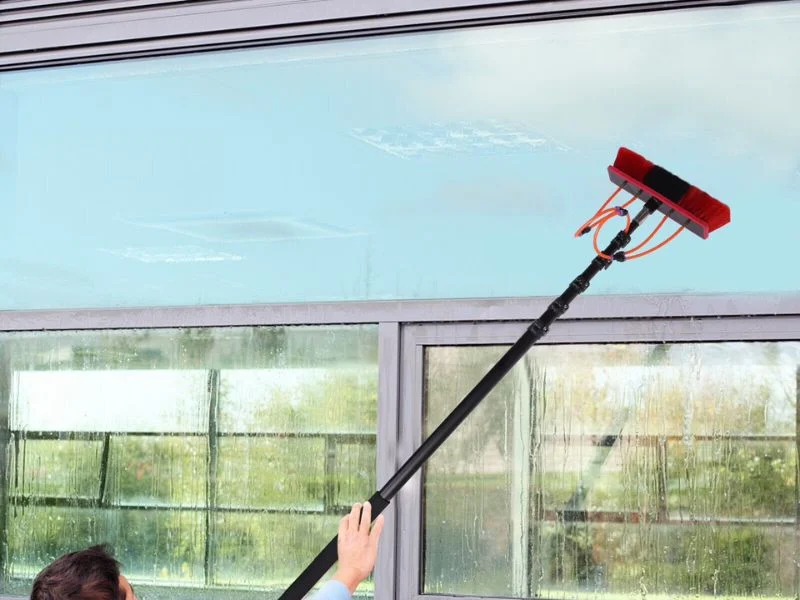
Size delivery around the day, not the job: enough tank for the route between refills, a 12 V pump that holds steady flow at your tallest work, and hose that reaches without coiling drama.
Tank size is a route decision — vans running commercial rounds carry water for a full day, while residential setups refill between houses. The pump spec that matters is sustained flow at height: gravity fights every foot of pole, and a pump that sprays confidently at ground level can dribble at the top of a 20 ft class reach. Controllers that vary pump speed pay for themselves in water saved and in brush behavior — flow you can trim is streaks you do not chase.
Hose is the stage everyone undersizes. Kink-resistant lines on a reel turn setup into a thirty-second job; a cheap coil in a crate costs five minutes a stop and one van door slammed on it per month. Match connectors across the whole stage at spec time — the field-assembled adapter chain is where flow quietly dies.
The Kit Brand Spec Checklist
A complete pure-water kit spec answers seven lines: feed-water assumption, purification stages, tank size, pump and controller, hose and reel, pole reach class, and brush-and-jet selection — anything unwritten becomes a support ticket.
Work the list in water-flow order and the dependencies stay visible: the feed assumption drives the RO/DI decision, route height drives pump and pole class together, and the brush choice closes the loop back at flow rate. The pole line deserves its own scrutiny because it is the one component customers touch all day — section behavior, hose routing and head interface are specified there, which is why the platform page exists for that half of the decision.
Write the assembly level into the spec too: kits shipped as boxed systems with pre-fitted fittings review better than parts collections, and the difference is decided at the factory bench, not in the customer’s driveway.
First-System Mistakes That Cost a Season
The four classics: trusting the tap without testing, buying pole reach the pump cannot feed, skipping the TDS pen to save a few dollars, and swapping resin late because the glass ‘still looked fine.’
Each one traces back to treating the system as separate purchases instead of one water path. The operator who tests feed water sizes purification right the first time; the one who buys pump and pole together never discovers the dribble at full reach; the one who logs TDS weekly swaps resin on schedule and never re-cleans a street of spotted glass under warranty.
The fix is boring and effective: one supplier conversation covering the whole path, a TDS pen in every kit, and a laminated card of the numbers that matter. Water does not improvise; systems specified as systems do not either.
Reading the TDS Log Like an Operator
Log two numbers weekly — feed TDS and output TDS — and the system tells you everything: rising output means resin is finishing, rising feed means the municipality changed something, and a steady pair means keep working.
The log turns maintenance from guesswork into a calendar. Resin exhaustion is not a cliff but a slope; an operator who watches output creep from zero toward double digits swaps the cartridge on a quiet Friday instead of discovering spots on a Monday route. Seasonal feed swings are real too — snowmelt, reservoir changes and summer demand all move municipal TDS, and the log catches the shift before the glass does.
For kit brands, this is a packaging decision: a printed log card and a pen loop in the case cost cents and change how professional the whole system feels. The customers who log are the customers who reorder resin from you instead of blaming the pole.
Winterizing and the Off-Season
Drain everything that holds water — tank, pump head, hose and pole line — before the first hard frost; ice is the only failure mode that takes out every stage of the system in one night.
The routine takes twenty minutes: run the pump dry, open the low points, blow the pole’s water path clear and store hose uncoiled of tension. RO membranes dislike both freezing and drying — regions with real winters either bring the purification cart indoors or store membranes wet in preservative per the maker’s sheet. Resin vessels just need to stay sealed.
Spring restart is the mirror image plus one habit: flush the first tank of the season through the system before it touches customer glass, and log a fresh TDS baseline. Systems treated this way run for years; systems left wet in a cold van get replaced in April, one cracked fitting at a time.
Perguntas frequentes
What is a pure water window cleaning system?
A three-stage setup: RO/DI purification, a tank-pump-hose delivery line, and a water fed pole with brush. Purified water scrubs and rinses glass that dries spot-free without squeegeeing.
Why does pure water dry without spots?
Because dissolved minerals are what leave spots; purified water carries next to none, so it evaporates clean off the glass.
Do I need RO and DI, or just DI?
Depends on tap water hardness: soft-water regions often run DI-only, hard-water regions put RO first so DI resin lasts. A TDS meter settles it.
Does the system need a pump?
Mains pressure can feed low work, but most route setups run a 12 V pump for consistent flow at height and van-tank independence.
Which parts should a kit brand OEM?
The pole, brush interface and fittings — that is where feel and fit differentiate a kit. Filtration hardware is commodity and usually bought in.


 English
  Español
  Français
  Deutsch
  Português