You can find hundreds of mastro telescópico suppliers in China within minutes. The real problem starts after you place the order.
Locks begin to loosen. Tubes start to wobble. Anodized finishes vary from batch to batch. What looked like a good deal turns into returns, complaints, and margin loss.
If you are sourcing aluminum telescopic poles for OEM, retail, or distribution, the difference between success and failure is not the supplier list—it is how you evaluate engineering capability, production control, and long-term consistency.
This guide shows you exactly how to do that.
How do you source telescopic poles from China?
To source telescopic poles from China successfully:
Step 1: Define exact specifications (material, structure, tolerance)
Step 2: Shortlist real manufacturers (not traders)
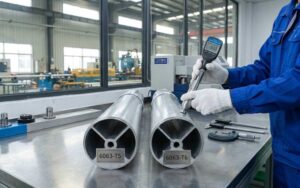
Step 3: Verify production capability (process + equipment)
Step 4: Test samples under real conditions
Step 5: Lock pricing, MOQ, and specifications
Step 6: Implement quality control inspections
Step 7: Control shipping, duties, and total landed cost
If you cannot control production, you cannot control your product.
Start with Engineering: What Actually Defines a Good Telescopic Pole
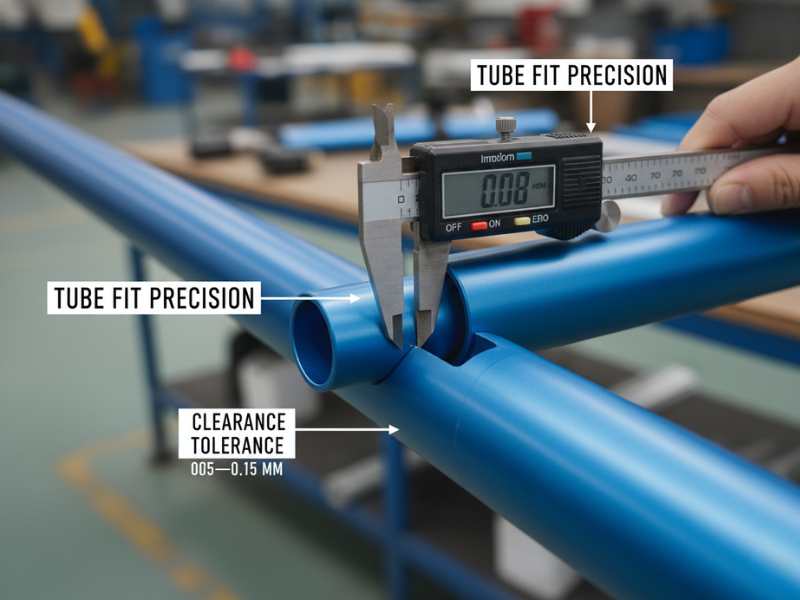
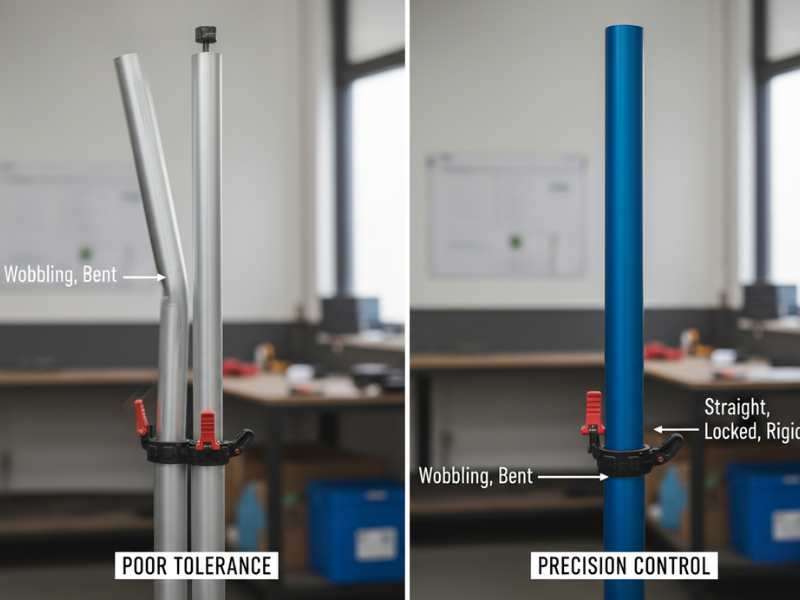
Tube tolerance determines stability
Most buyers overlook this.
Telescopic poles rely on sliding tube sections. The gap between inner and outer tubes must be controlled precisely.
- Too tight → difficult extension
- Too loose → wobble and instability
Typical control range:
- Clearance tolerance: 0.05–0.15 mm
- Straightness deviation must be minimal
Poor tolerance is the main cause of “shaking poles.”
Aluminum alloy: 6063 vs 6061 (real difference)
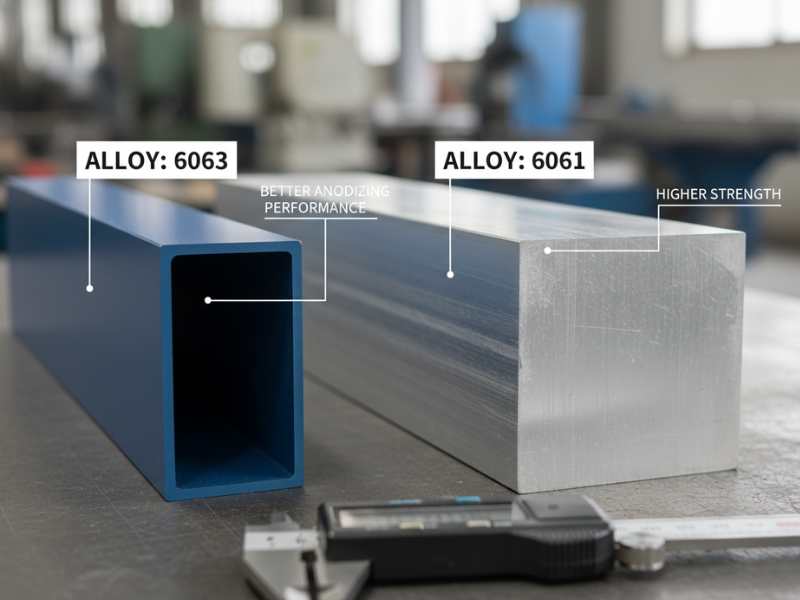
| Liga | Força | Surface Quality | Melhor uso |
|---|---|---|---|
| 6063 | Médio | Excellent anodizing | Postes telescópicos |
| 6061 | Alto | Moderado | Peças estruturais |
Why 6063 is preferred:
- Better extrusion consistency
- Smoother surface → better sliding
- More uniform anodizing
👉 Reference: aluminum material data (MatWeb)
Anodizing thickness affects lifespan
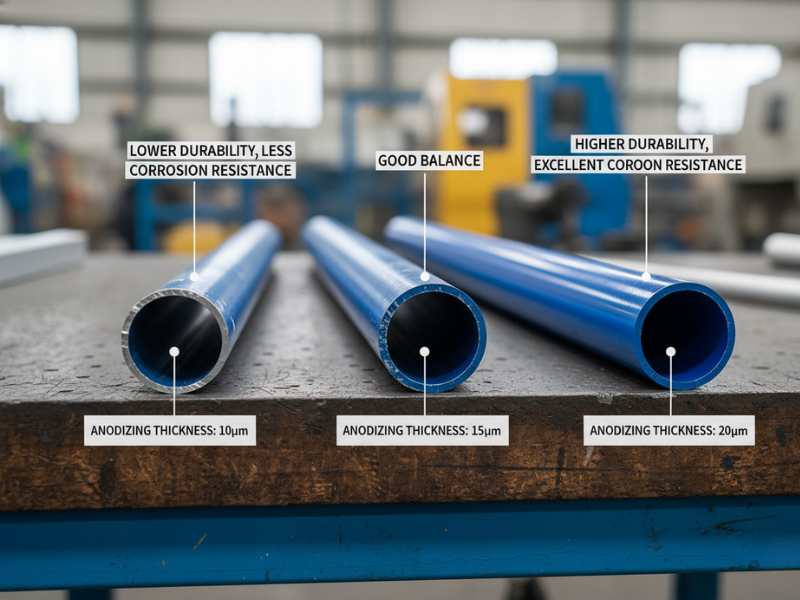
| Grossura | Performance |
|---|---|
| 10 μm | Basic protection |
| 15 μm | Standard industrial |
| 20 μm+ | Alta resistência à corrosão |
Impact:
- Thin coating → scratches, oxidation
- Thick coating → longer life, better appearance
Most low-cost suppliers reduce anodização thickness to cut cost.
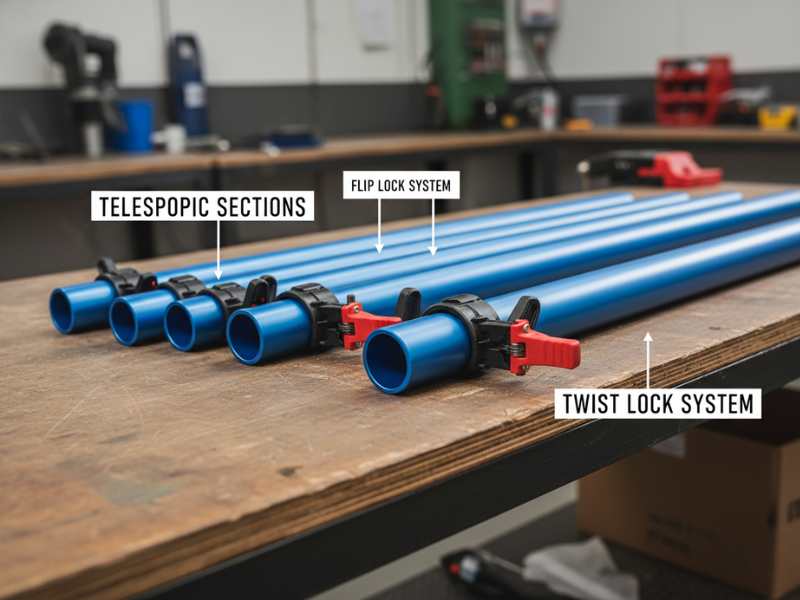
Lock system is the failure point
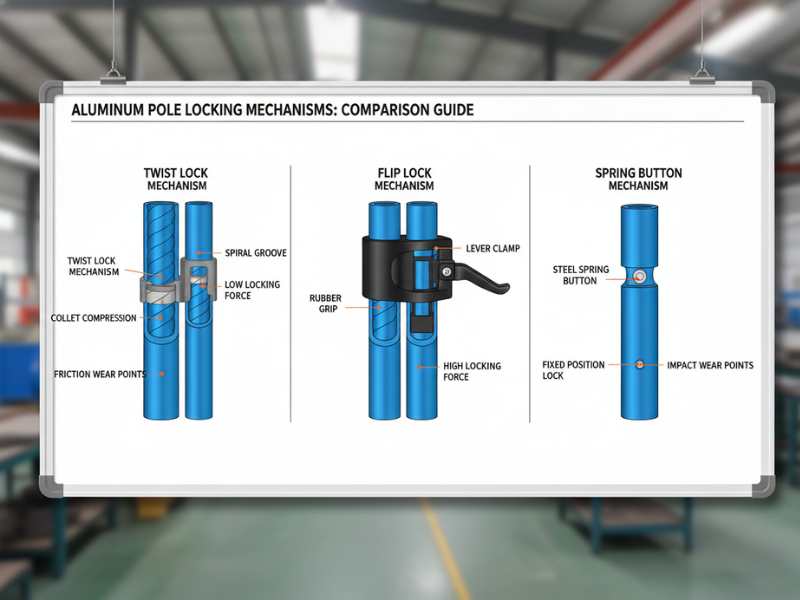
| Tipo de fechadura | Failure Risk | Durabilidade |
|---|---|---|
| Trava giratória | Médio | Moderado |
| Trava de alavanca | Baixo | Alto |
| Spring Button | Baixo | Muito alto |
Common failure causes:
- Plastic fatigue
- Thread wear
- Weak clamp design
Over 70% of product complaints come from lock failure.
Manufacturer vs trading company vs integrated factory
| Criteria | Trading | Factory | Integrated Manufacturer |
|---|---|---|---|
| Production control | Nenhum | Partial | Completo |
| Quality stability | Baixo | Médio | Alto |
| Personalização | Limitado | Moderado | Forte |
| Risk level | Alto | Médio | Baixo |
Why integrated manufacturers perform better
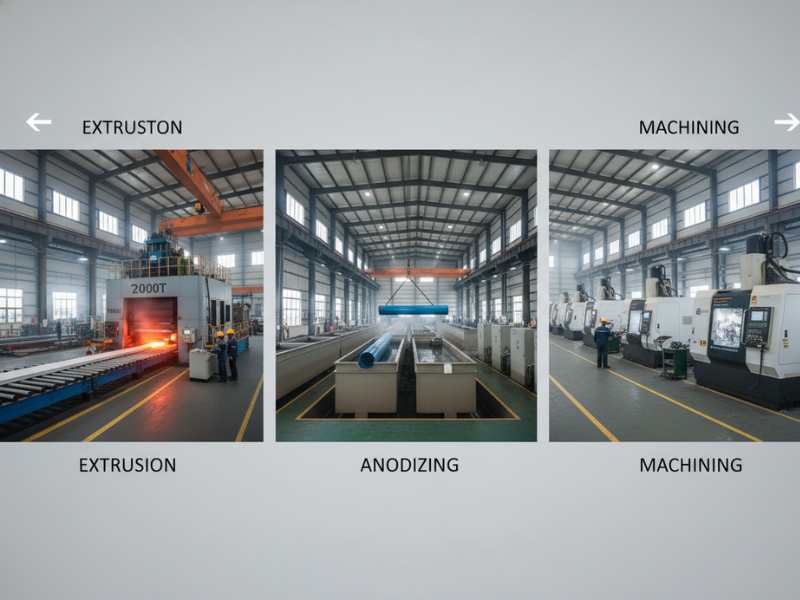
Telescopic poles require:
- Extrusão de alumínio
- Anodização
- usinagem CNC
- Conjunto
Factories that control all steps deliver consistent quality.
Manufacturers with full in-house production—including extrusion, anodizing, machining, and inspection systems—can maintain stable quality even at large production volumes.
How to Verify a Supplier Like a Professional Buyer
Ask process-based questions
- Do you produce aluminum tubes in-house?
- Is anodizing outsourced?
- What is your tolerance control standard?
- What testing equipment do you use?
Weak suppliers avoid technical answers.
Verify production reality
- Request factory videos
- Check machines and workflow
- Confirm monthly capacity
Inspection system is mandatory
| Estágio | Purpose |
|---|---|
| Pre-production | Validate materials |
| During production | Control variation |
| Pre-shipment | Final inspection |
How to Evaluate Samples Properly
Do not trust visual quality
A good-looking sample does not guarantee production consistency.
Test under real conditions
- Extend fully
- Apply working load
- Repeat cycles
- Test wet environment
Convert sample into specification
Everything must be documented:
- Dimensões
- Tolerances
- Materials
- Terminar
If it’s not documented, it will not be consistent.
China Telescopic Pole Suppliers: Which One Should You Choose?
Supplier comparison
| Tipo | Força | Weakness |
|---|---|---|
| Trading | Easy communication | No production control |
| Factory | Better pricing | Partial control |
| Integrated | Full control | Slightly higher cost |
The real decision logic
Do not ask:
❌ Who is cheapest
Ask:
✅ Who can deliver the same quality repeatedly
Telescopic Pole Quality Checklist
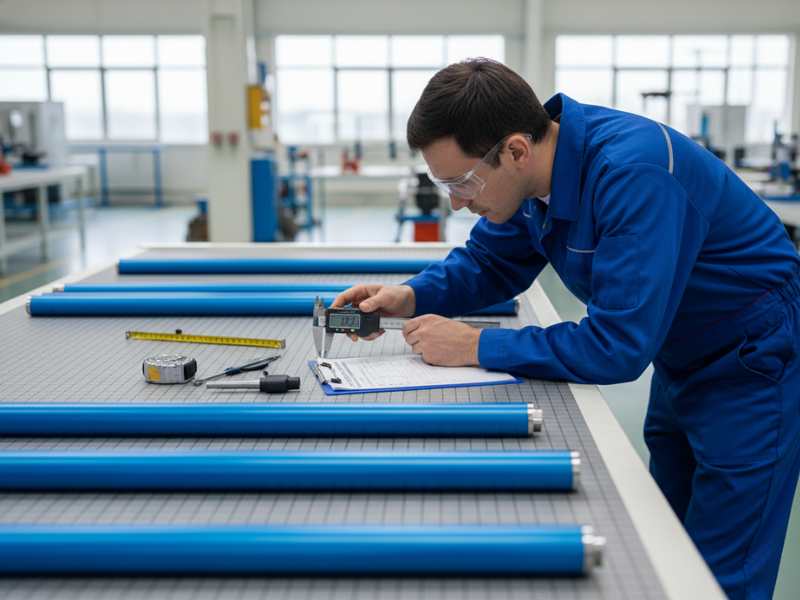
| Categoria | Checkpoint | Exigência |
|---|---|---|
| Tube | Grossura | Consistent |
| Superfície | Anodização | Uniform |
| Lock | Força | No slipping |
| Conjunto | Fit | Suave |
Real Cost Breakdown (What Buyers Miss)
| Custo | Impact |
|---|---|
| Produto | Alto |
| Freight | Alto |
| Duties | Alto |
| Defects | Muito alto |
Hidden cost: defect rate
Exemplo:
- Supplier A: cheaper, 8% defect
- Supplier B: higher price, <1% defect
Result:
👉 Supplier B is more profitable
MOQ Strategy for Telescopic Poles
| MOQ Level | Vantagem | Risco |
|---|---|---|
| Baixo | Low risk | Alto custo |
| Médio | Balanced | Moderado |
| Alto | Lowest price | Inventory risk |
Shipping and Landed Cost
Choose shipping method
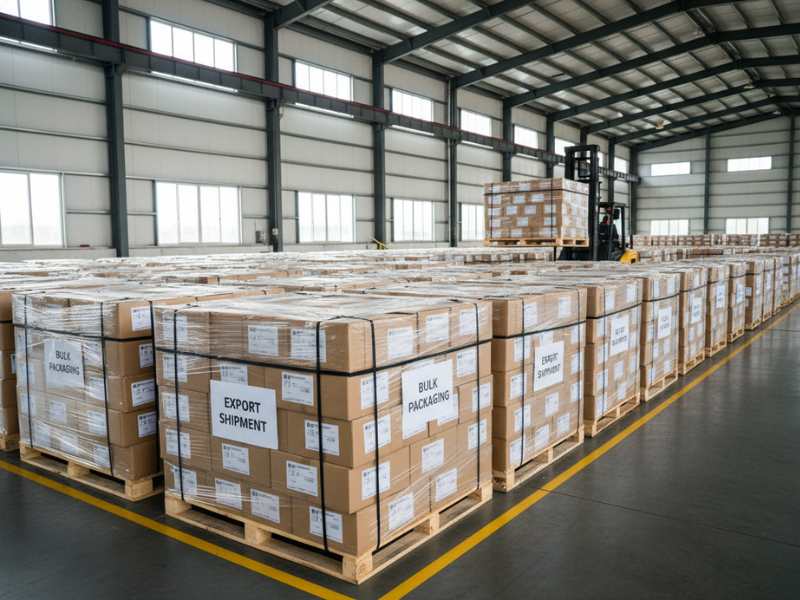
- Sea: bulk orders
- Air: urgent
Include all costs
- Produto
- Inspeção
- Freight
- Duties
👉 Tariff reference: https://www.whitehouse.gov/
Supplier Red Flags Checklist
Avoid suppliers who:
- Cannot explain production process
- Offer prices far below market
- Avoid QC discussions
- Cannot show real factory
Real Case: Why Buyers Change Suppliers
A distributor sourced low-cost poles:
- First order OK
- Second order inconsistent
Problems:
- Lock failure
- Color variation
Cause:
- Outsourced production
Solution:
- Switched to integrated manufacturer
Result:
- Stable quality
- Lower returns
Internal Resources for Better Sourcing Decisions
- Aluminum alloy guide → /aluminum-alloy-series-guide
- Lock comparison → /twist-lock-vs-flip-lock
- Extension pole selection → /extension-pole-length-guide
Why Control Is the Real Advantage
In telescopic pole sourcing:
- Price wins orders
- Quality keeps customers
- Consistency builds brands
Work With a Manufacturer That Can Scale With You
A strong supplier should:
- Support OEM development
- Maintain consistency
- Scale production
What a Scalable Telescopic Pole Manufacturer Actually Looks Like
By now, the selection criteria should be clear.
A supplier that can support long-term growth is not defined by price or catalog size, but by process control, engineering depth, and production stability.
Here is what that looks like in practice.
1. Real Aluminum Processing Capability (Not Assembly-Only)
A scalable manufacturer should control:
- Aluminum extrusion for consistent tube dimensions
- Surface treatment (anodizing / sandblasting)
- Precision machining for tube fit and lock performance
When extrusion is outsourced, tube tolerance varies.
When anodizing is outsourced, color consistency becomes unstable.
Control over raw aluminum processing is the foundation of product consistency.
2. Stable Surface Treatment System
For telescopic poles, anodizing is not cosmetic—it affects durability.
A reliable supplier should have:
- Linhas de anodização automatizadas
- Controlled coating thickness
- Consistent color matching across batches
This is critical for:
- Retail product appearance
- Resistência à corrosão
- Brand consistency
3. Machining and Assembly Precision
Telescopic pole performance depends on:
- Tube clearance control
- Lock installation accuracy
- Alignment during assembly
Factories equipped with CNC machining, forming, and assembly systems can maintain:
- Extensão suave
- Reduced wobble
- Longer product lifespan
4. Inspection and Testing Infrastructure
A qualified manufacturer does not rely on visual checks alone.
They should have:
- Espectrômetro para verificação de ligas
- Hardness testing equipment
- Coating thickness measurement tools
- Mechanical testing for load and durability
This ensures every batch meets the same standard.
5. Production Capacity That Matches Growth
Many suppliers can produce samples.
Fewer can maintain quality at scale.
A scalable partner should have:
- Multiple extrusion lines (covering different tonnage ranges)
- Dedicated anodizing workshops
- Full machining and assembly capacity
- Stable monthly output
Xingyong Aluminum established with 14 extrusion lines (350T–2000T), automated anodizing systems, and full machining workshops, can support consistent production at 3,000 tons per month capacity. :contentReference[oaicite:0]{index=0}
This level of capacity is not about volume—it is about stability under pressure.
Why This Matters for Your Business
When your supplier controls the full production chain:
- Product consistency improves
- Defect rates decrease
- Lead times become predictable
- Scaling becomes easier
This directly impacts:
- Customer satisfaction
- Brand reputation
- Profit margin
A Practical Way to Evaluate Your Current Supplier
Before placing your next order, ask:
- Can they control extrusion, or do they outsource it?
- Is anodizing done in-house with stable thickness control?
- Do they have real testing equipment or only basic inspection?
- Can they guarantee consistency across multiple batches?
If the answer is unclear, your risk is high.
Choosing a Supplier Is Choosing Your Product Stability
In telescopic pole sourcing:
- The first order proves capability
- The next orders prove reliability
The suppliers that win long-term are not the cheapest.
They are the ones that can repeat the same quality every time.
Work With a Manufacturer That Understands Aluminum From the Source
If your product depends on aluminum performance, surface finish, and structural precision, you need a supplier that understands aluminum—not just assembly.
Manufacturers with deep experience in aluminum extrusion, anodizing, machining, and inspection can support:
- OEM product development
- Stable long-term supply
- Consistent product performance across markets
This is what separates a supplier from a manufacturing partner.
Start with a Technical Evaluation, Not Just a Quote
Before your next RFQ:
- Review your current pole structure
- Identify weak points (lock, tolerance, finish)
- Compare supplier capabilities at process level
The right partner will not only quote your product—
they will help you improve it.
Start with a Technical Review Before Ordering
Before your next order:
- Review your product design
- Identify weak points
- Optimize structure
A capable manufacturer will help you improve—not just quote.
A Practical Example of an Integrated Aluminum Telescopic Pole Manufacturer
To make the evaluation criteria more concrete, it helps to look at what a fully integrated manufacturer actually looks like in practice.
A typical example is a manufacturer like Xingyong, established in 2002, focusing on aluminum extrusion and telescopic pole production.
What This Level of Manufacturing Looks Like
Instead of relying on external suppliers, this type of factory operates:
- 14 linhas de extrusão de alumínio (350T–2000T) for different profile requirements
- Automated anodizing production lines for stable surface finishing
- Complete machining workshop including CNC, forming, and assembly
- Full inspection system with spectrometer, hardness testing, and coating measurement
This allows control over:
- Tube tolerance and straightness
- Anodizing thickness and color consistency
- Lock fitting precision
- Batch-to-batch stability
Monthly production can reach 3.000 toneladas, which ensures both capacity and consistency under large-volume orders. :contentReference[oaicite:0]{index=0}
Perguntas frequentes
Best aluminum alloy?
6063 for most telescopic applications.
How to avoid defects?
Define specs and inspect production.
Lead time?
At Xingyong, we promise 20–45 days.