Buying custom aluminum extension poles in bulk often feels like a gamble between inventory risk and seasonal deadlines. If you order too much to meet a factory’s high Minimum Order Quantity (MOQ), you tie up vital capital in warehouse dust; if your lead time is off by even two weeks, you miss the peak pool cleaning or DIY renovation season, losing shelf space at major retailers. At Xingyong, we have spent over two decades balancing the scales between manufacturing efficiency and the agile supply chain needs of global distributors and big-box retailers.
What is the typical MOQ and lead time for custom aluminum extension poles?
For most professional-grade aluminum extension poles, the standard MOQ is 500 to 1,000 units, or a total material weight of approximately 500kg per profile. The average lead time ranges from 30 to 45 days, depending on whether new tooling is required. At our facility, we leverage 14 extrusion lines to compress the schedule, but high-precision items involving Usinage CNC or specialized anodisation may extend this window to ensure structural integrity and finish consistency.
2026 Production & MOQ Benchmark Table
| Product Category | MOQ (Units) | Est. Lead Time | Key Production Constraint |
|---|---|---|---|
| Standard Pool Poles | 1,000 | 25–30 Days | High-speed extrusion & automatic anodizing |
| Professional DIY Poles | 500 | 35–40 Days | Multi-stage CNC drilling & assembly |
| Heavy-Duty Industrial | 300 | 30–35 Days | Wall thickness cooling requirements |
| OEM/Patent Designs | Negotiable | 45–60 Days | Tooling design, T1-T3 sample testing |
The “Melt and Run” Logic: Why MOQs Aren’t Arbitrary
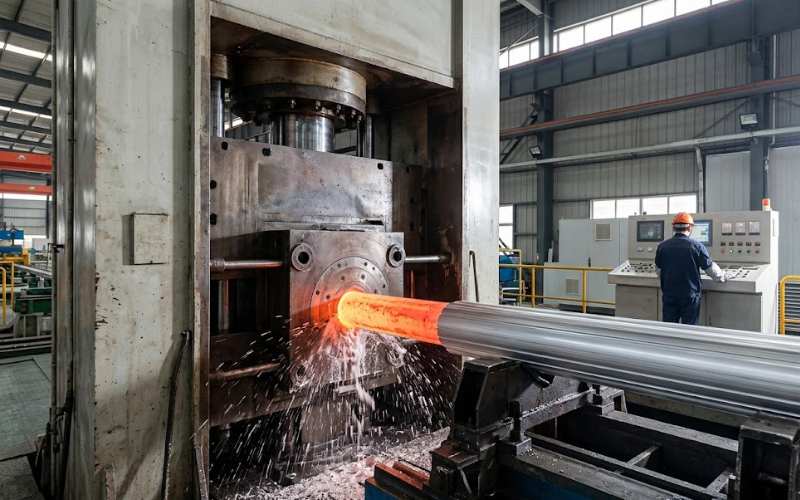
In my 20 years on the factory floor, I’ve seen many procurement managers frustrated by MOQs. It isn’t an arbitrary number designed to force more sales. It is dictated by the physics of aluminum extrusion. Every time we change a die on one of our 2000T presses, there is a “setup scrap” period. We must run a certain amount of aluminum through the die to stabilize the pressure and temperature to meet ISO 9001:2015 normes.
If we run only 50 poles, the waste ratio makes the unit cost astronomical. By hitting the 500kg threshold, we spread the machine setup costs and energy consumption of our aging furnaces across enough units to keep your landed cost competitive. For distributors, hitting this MOQ is the difference between a 15% margin and a 40% margin when competing in spaces like Walmart or Home Depot.
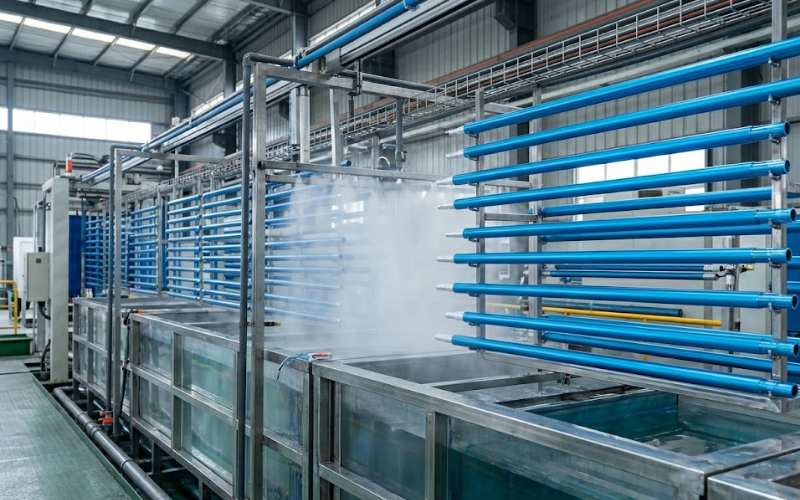
Deconstructing the 45-Day Lead Time: An Insider’s Timeline
Where does the time actually go? Transparency is rare in international trade, but as a manufacturer, I believe you should know exactly what happens to your capital during those six weeks.
- Tooling & Die Fabrication (Days 1–12): If your design is custom, we must cut a new H13 steel die. This involves heat treatment and precision wire cutting.
- Extrusion & Solution Heat Treatment (Days 13–18): We transform raw billets into your specific pole profile. We then “age” the aluminum in ovens to reach the required Webster Hardness.
- Surface Treatment (Days 19–28): Whether it’s a blue anodized finish for a perche de piscine télescopique or a powder-coated DIY handle, the chemical baths take time. We run two automatic lines to prevent bottlenecks.
- Secondary Processing & CNC (Days 29–38): This is where the “pole” becomes a “product.” CNC drilling for locking holes, laser marking your brand, and installing internal cam locks.
- Packaging & Logistics (Days 39–45): Crucial Note: Custom retail color boxes for Home Depot compliance often take 12 days to print. We overlap this with production to ensure zero downtime.
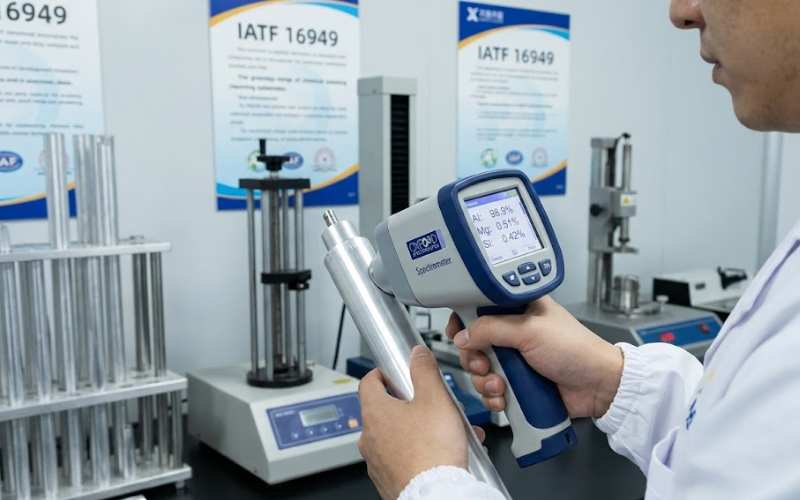
Point de vue d'un ingénieur : Many “trading companies” promise 20-day lead times. They achieve this by skipping the aging process or using secondary aluminum scrap. At Xingyong, we use Spectromètres d'Oxford to verify 6063-T5 purity. If the alloy isn’t right, we don’t ship. A “fast” pole that bends under 5kg of pressure is a liability, not an asset.
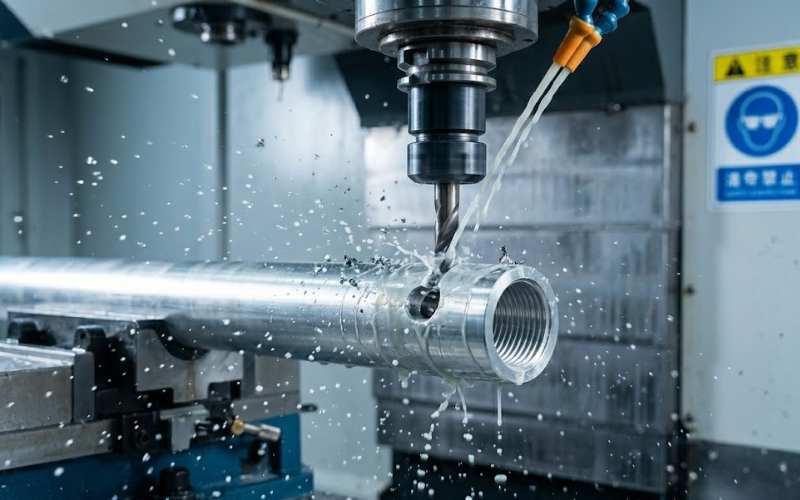
Technical Factors That “Stretch” Your Timeline
Not all poles are created equal. If your procurement strategy involves high-performance gear, watch out for these variables:
- Wall Thickness Variations: Thinner walls (under 0.8mm) are harder to extrude at speed without warping, requiring slower press speeds and more frequent manual straightening.
- Salt Spray Requirements: For pool cover reels used in coastal areas, we ensure the anodizing layer exceeds 15 microns. This extra time in the oxidation tank is non-negotiable for long-term durability.
- The “Tolerance” Trap: We utilize Israeli Lemite cross-section scanners to ensure concentricity. If your pole has an inner/outer tube fit of ±0.05mm, the assembly speed is naturally slower than “loose” hardware store versions.
The Distributor’s Profitability Logic: Beyond Unit Price
I often tell our partners: “Don’t buy for today; buy for the transit time.” In the current 2026 shipping climate, lead time is only half the battle. When you factor in the 25-35 day ocean freight, you are looking at a 75-80 day total cycle.
The “Blanket Order” Strategy: To combat high MOQs, our most successful partners use “Blanket Orders.” We extrude 5,000 units of the raw aluminum profile (locking in the LME aluminum price) and keep them as semi-finished stock in our warehouse. We then process, assemble, and ship 1,000 units per month. This gives you the pricing of a 5,000-unit run with the inventory flexibility of a 1,000-unit run.

Why IATF 16949 Standards Protect Your Q1 Sales
Even if you aren’t in the automotive sector, our IATF 16949:2016 certification is your best protection against lead time delays. This standard forces us to have “contingency plans.” If an extrusion press goes down, our redundant 14-line setup ensures your order simply moves to the next available machine.
Managing your supply chain isn’t just about finding the lowest price—it’s about finding the manufacturer who understands the cost of a “lost day.” With 3,000 tons of monthly output and a legacy since 2002, we provide the stability your brand needs to scale.
Secure Your Production Window
Don’t let seasonal demand catch you with empty shelves. If you are a procurement manager for a major retailer or a brand owner looking to transition from a trading company to a direct factory relationship, let’s talk about your 2026-2027 requirements. Contactez notre équipe d'ingénieurs dès aujourd'hui for a DFM (Design for Manufacturing) review of your aluminum extrusion process and secure your Q1 production slot.